
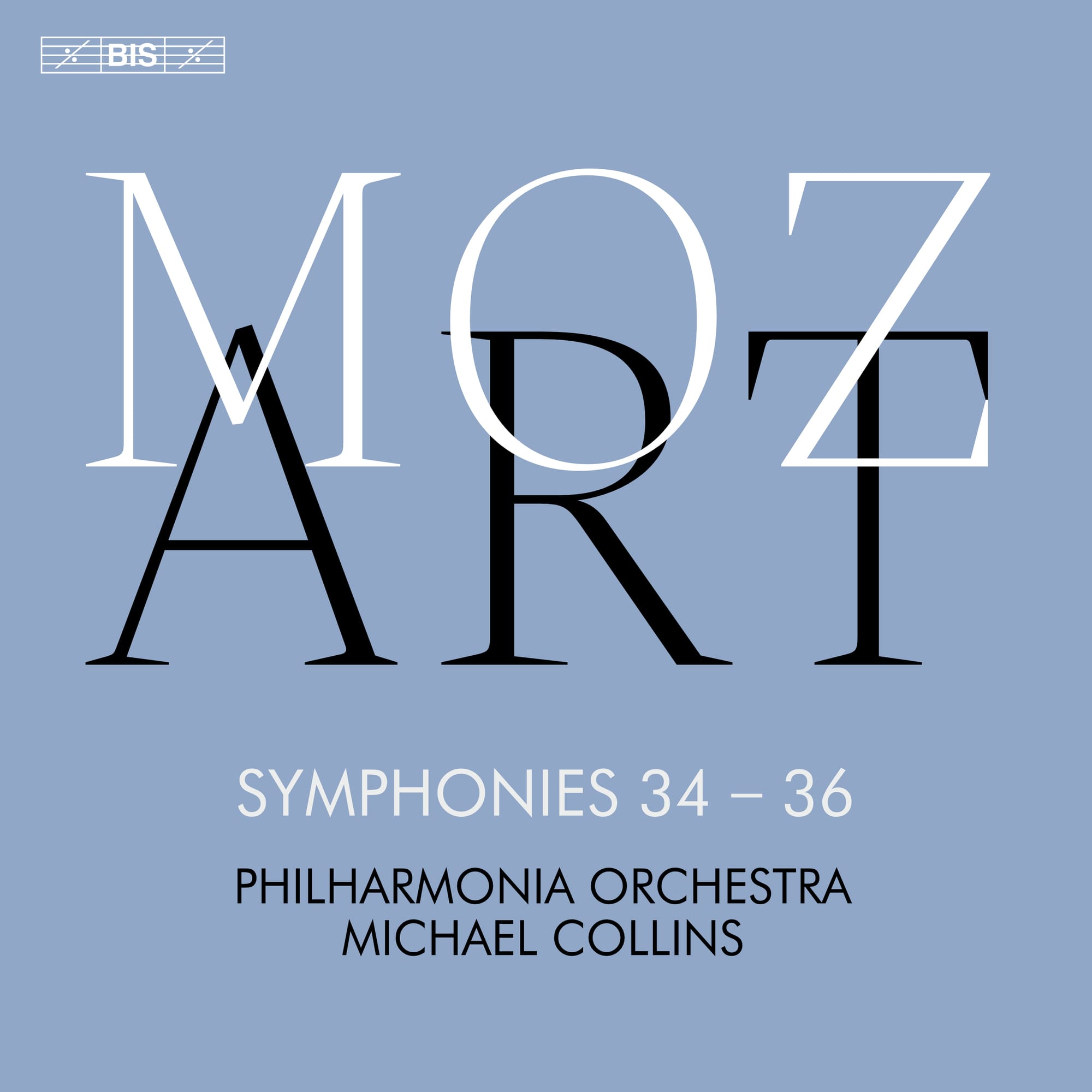
There consecutive symphonies here, two nicknames, one Minuet. It’s a recipe for much delight, as Michael Collins leads the Philrmonia in performances of strength and lyricism, performance material based on the Neue Mozart Ausgabe (New Mozart Edition) scores ftom Bärrenreiter.
Symphony No. 34 is problematical in the sense it originally contained a Menuet, but that was abandoned by Mozart. There is a tradition of insertion, as Polling did in his Manchester concert with the ECO on February 8, 1981 (my first experience of tha Maestro live – the Festival Hall concert a few days later was broadcast by BBC Radio 3); he sounded it by two Piano Concertos, which he directed from the keyboard (Nos. 14 and 17). Here, Collins offers the Minuet in C, K 409 as an “afteought”, tracked after the finale. The insertion was suggested by Alfred (not Albert!) Einstein, who suggested the minuet was composed in 1782 specifically for K 338; but there is no overt proof of this (and also he scorings don’t match0>
The first movement of No. 34 is a blaze of C-Major light, though. This is a 2022 recoding from Fairfield Halls, Croydon, and the BIS engineers captire it well, with just the high amount of body to the soul. eh Philharmonia is in fine fettle:
You do have to “programme” the Meneut in if you want it as part of the symphony experience, though, A graceful Andante di moto più tasto Allegretto follows, and Collins’ tempo honours that direction perfectly. These are no run-of-the-mill performances: Collins’ ex-orchestra plays beautifully for him:
Teh finale extras boisterously, with unexpected vim. It sounds for all teh world like an opera ovate, fizzing away with is woodwind solos, so beautifully taken here:
The Minuer in C, K 409 dates fom 1782, two years after the 34th Symphony, perfectly congruent in its brightness It works well against the equivalent power of the opening of the “Haffner” Symphony. Note, as Ian Page reminded us recently, there is also a symphony from the Haffner Serenade;.this is the better known, and Collins absolutely goes for the “con spirito” part of the first movement indication. Interesting how Collins emphasises some clarinet doulibngs of strings (inevitably, one might argue!); but it does add a distinctive tinta:
The Andante is.dream, and yet Collins does not let the music drag for a second; and the Trio of the Meuuet is lovely. The finale takes us to opera buffa, and the smell of geese paint again, as it should:
Finally. the “Linz” Symphony, K 425 of the next year, 1783. Colllins shapes the slow introduction superbly, and the Allegro spirito that follows is perfectly judged, another celebrational movement hat also contains much grace, plus a fascinating approach to the moment of capitulation:
Th Andtane opens fo all he world like an aria from a Mozart opera. It moves, but horns are almost noo existent in the slow arpeggio. Collins does enjoy the shift: though, when the “voice” would enter, Mozart just moves to different territory. It is a simply magnificent performance, complimented by a footlight Menuetto (but on full of contrasts) and an oboe-dominated Trio, beautifully performed (as is the bassoon response, which instrument then joins the oboe in dialogue).
The finale blazes away, but it is in the moments of darkness when Collins’ perfomance really comes alive. And what bassoon and oboe staccato. it’s Presto, but not Prestssimo: every note can speak:
Collins and the Philharmonia stylishly capture all the freshness of Mozart;s symphonies while perfuming on modern instruments. An ideal compromise, beautifully delivered.
The disc is available a Amazon here. Streaming below, except iDagio here..


%20Graham%20Boulton.jpeg?w=160&resize=160,160&ssl=1 "Celebrating John Joubert at Royal Birmingham Conservatoire in advance of his 2027 centenary")