


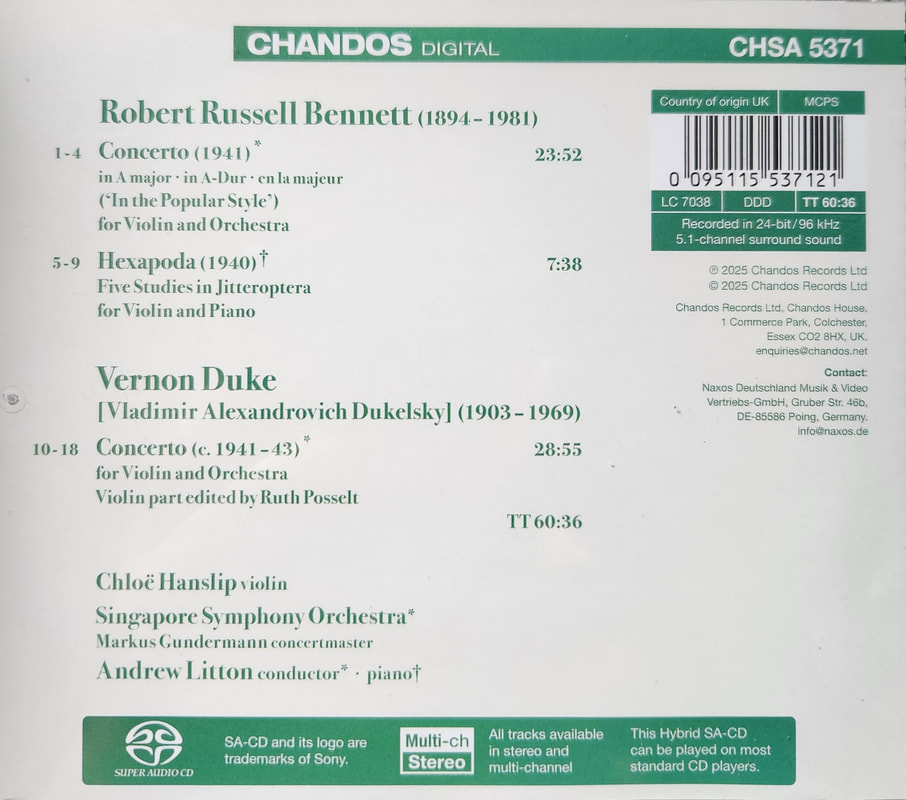
And I’m so glad to finally have it! Mainly because I adore Robert Russell Bennett (the American composer – not to be confused with British composer Richard Rodney Bennett). Robert Russell Bennett (RRB) is, of course, the guy who orchestrated all those fabulous symphonic suites of Broadway musicals. His Porgy and Bess, A Symphonic Picture is a symphonic masterpiece in its own right, as are his orchestrations of Richard Rodgers’ music for the “Victory at Sea” series.2 He also wrote one of my very favorite original compositions for band: Suite of Old American Dances – fantastic music, brilliantly scored specifically for wind ensemble (though it’s quite difficult to play).3 Band music doesn’t get better than this.
So I was eager to hear his original Violin Concerto. Astonishingly, this is the first recording of it since its previous only recording (mono) in 1956 with Bernard Herrmann conducting. And it is so fabulous, one wonders why it hasn’t been rediscovered before now.
Not sure what to expect from the opening Allegro moderato, it is instantly appealing – sprightly, energetic, melodic, rhythmically syncopated and infectiously propulsive. Not at all what I would expect from a moderato! And I immediately notice the fantastic recorded sound too – full, spacious, boldly colorful and enormously dynamic. I wasn’t familiar with violinist Chloe Hanslip before, but I instantly recognize Andrew Litton on the podium, as I’m once again reminded what a great conductor he is. He isn’t just an accompanist – ever. He interjects himself into the musicmaking with commanding authority. And there is no denying the orchestral contribution is significant here. For instance, just listen to the very dynamic passage leading up to the 1st movement cadenza. Wow!
Not that they overshadow this violinist. Definitely not. She is a prominent force and literally owns this piece. She possesses a full, rich tone, and the recording engineer balances her perfectly with the orchestra – with just enough presence to project her sound out into the hall without spotlighting the violin in the slightest. Once again, when Chandos gets it right, they are unbeatable in this regard.4 The orchestra is assertive yet never overpowering. And it’s awesome to hear.
I was actually surprised when the 2nd movement began playing. That first movement is well over 11 minutes long, but I was so engaged in the music, it was over before I knew it. It never felt long, and not for an instant did my interest trail off. An Andante moderato follows it, and it too does not seem in the slightest moderato. Not that it’s particularly fast; it’s just not “moderate”. In fact, it’s actually a bit jazzy, with more than a hint of Ragtime that RRB was so fond of in his youth. And it swings so nicely here! It’s so tastefully done, understated in its delivery, it’s almost comical – and oh so much fun. Litton is just marvelous here, getting this orchestra to play it so naturally and idiomatically that it never sounds contrived or mannered. (Actually one wonders – why, of all the orchestras in the world, was this recording made with the Singapore Symphony?)
There is a very short Vivace (barely a minute-and-a-half), leading very abruptly, almost like there was a big cut, to the final Allegro vivo, which is a tour de force – bustling with energy, driving the music to an exuberant close. I can imagine an audience jumping to its feet with enthusiasm at its conclusion.
At just 24 minutes in total, this was immensely enjoyable from beginning to end. And I didn’t want it to end. Fortunately, Hanslip and Litton have an encore for us next, in the form of RRB’s delightful Hexapoda for violin and piano, where Litton reminds us he’s also an excellent pianist as well. It’s an amusing little party piece, written at the request of violinist Louis Kaufman (who premiered the Concerto), asking the composer for “something that would clothe American dance-hall material in the respectable garments of educated music”. And that’s exactly what it is! It’s even got amusing movement titles: Gut-Bucket Gus, Jane Shakes Her Hair, Betty and Harold Close their Eyes, Jim Jives and Till Dawn Sunday. All great fun and played with supreme professionalism. And that’s what makes it work. It’s fun – but serious fun.
Wishing there were more from Robert Russell Bennett, instead we have another rarity – the Violin Concerto by Vernon Duke, written in 1940 for none other than Jascha Heifetz. Duke was born Vladimir Alexandrovich Dukelsky in Ukraine, but later changed his name at the suggestion of his friend George Gershwin (who was also of Russian/Ukrainian descent.5) Duke studied at the Kyiv Conservatory and was friends with Prokofiev. He moved to America in 1929, where this concerto was composed some 10 years later. It’s not in the slightest “Amercian”- sounding like Bennett’s is. In fact, the presence of Prokofiev permeates all this music.
Interestingly, where Bennett’s opening Allegro is marked moderato but doesn’t sound like it, Duke’s is marked Allegro molto but sounds moderato! I’m not sure if it’s the tempo itself or the overall feel of it, but it doesn’t sound at all fast. Nor is it at all fun like Bennett’s. And it certainly has none of Bennett’s quirky rhythmic syncopation. It is instead much more determined, and determined to sound like a “serious” work. In short, it is distinctly unAmerican and not as carefree with its harmonic, rhythmic or melodic creativity. Rhythms are sturdy, steady and firmly “on the beat”, revealing his Ukrainian roots along with the influence of his friend Prokofiev. This first movement contains a very long cadenza too, which, surprisingly, isn’t all that interesting. It sounds to be largely based on little more than arpeggios and broken chords rocking along. And it just goes on for a while, not really related to anything around it, before the orchestra finally rejoins the proceedings.
The 2nd movement Valse is not very waltz-like, at least not at first, with a curious pizzicato solo violin leading the way. But soon, the orchestral strings take over with a glorious sweeping tune, and Litton ensures everyone is waltzing the night away. This little movement, just under 5 minutes, is quite charming in its way. The 3rd and final movement is a Theme and Variations. And at last, the theme itself suddenly takes on a distinctly American flavor for the first time in the piece. It is followed by another cadenza of sorts from the soloist in the 1st Variation, which rather loses sight of the main theme. Along the way, we hear violin noodling which could easily become scratchy in less capable hands, but never does with the exceptionally fine playing of Chloe Hanslip – who really does a wonderful job making the most of this music.
And so it goes, with some really nice lyricism in Var 2’s lamentoso, alternating with unmistakable references to Prokofiev, with spiky rhythms and abrupt phrase/harmonic resolutions suddenly falling back to the tonic. I even detected hints of his other friend, George Gershwin, in the 3rd Var, while continually tinged with Prokofiev. What an interesting combination this is! There is a beautiful, lyrical 5th Var, where the violinist responds to various woodwind solos in the orchestra (clarinet, English Horn, flute), while the final 6th Var is more rhythmic, containing another cadenza before coming to a rather unassuming close.
Each variation is short, 1-2 minutes apiece, with terrific variety which holds one’s interest throughout. I enjoyed this 12-minute set of variations a lot. And I actually ended up liking the Valse quite a bit too. But it must be admitted, it is the playing of this wonderful violinist, and the invigorating orchestral contribution from Litton which draw one in and make the piece perhaps better than it might otherwise be. It is a great performance of music which is not quite as instantly gratifying as Bennett’s is. Where Bennett’s concerto is an instant crowd-pleaser, Duke’s takes a little more time to get to know. (Not to say that it is an acquired taste; nothing like that.) But in the end, it really is quite enjoyable, especially a second time through, just in a decidedly different way than the companion on this program.
Both of these composers are seriously underrepresented on disc (other than arrangements and studio scores, etc.) and their concert music deserves to be better known. With this release, we are indebted to Hanslip’s commitment to bringing these concertos to new life, and I sincerely hope Chandos will be inspired to explore more of their music – especially that of Robert Russell Bennett. Wikipedia attributes to him a piano concerto, a couple of symphonies, lots of band music and substantial amounts of chamber music (sonatas, trios and quartets for various instruments). I think he deserves an entire series dedicated to his music, and it’s a pity Naxos abandoned a great opportunity to do so after just one marvelous recording back in 1999 of his symphonic music (the Lincoln Symphony and Sights and Sounds), with the Moscow Symphony led by renowned film score conductor, William T. Stromberg.
This SACD is an absolute must now that you can find it (though, exasperatingly, it remains very expensive) – for the music, for the playing, and most definitely for the recorded sound. Chandos has done it again.
1 I buy all my own CDs; I rarely receive “promo” or “review” copies. And one day, just by chance, Amazon randomly had this one available recently, at a price that wasn’t ridiculous (which is extremely rare), so I snapped it up before it disappeared again – or they raised the price again, which is exactly what they did almost immediately.
2 We sure could use a new, modern recording of this music.
3 There is a superb recording of it on Chandos (2016), played by the Royal Northern College of Music Wind Orchestra, along with more of his original band music. A fantastic collection.
4 I am reminded of their recent recording of Walton’s Violin Concerto with the Sinfonia of London, which is another state-of-the-art concerto recording.
5 I didn’t know this before reading it here in the booklet. Even though Gershwin was born in Brooklyn, his original name was Jacob Gershovitz before he changed it. Hmmm…learn something new every day.