


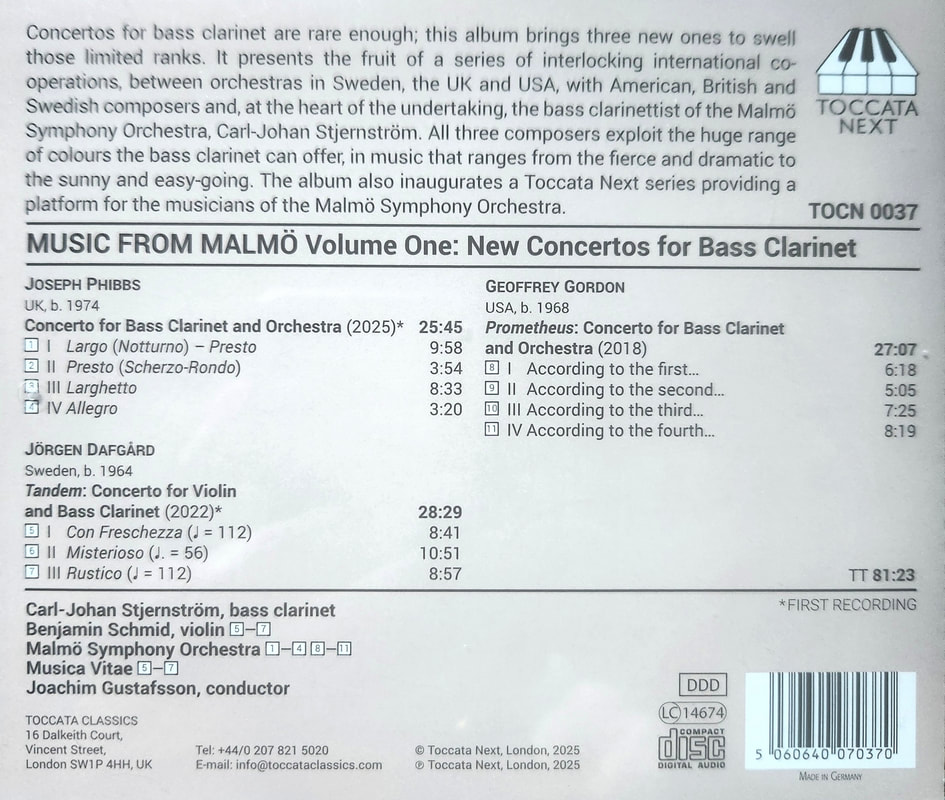
The front cover initially aroused curiosity. It lists the composers (presumably) in alphabetical order, rather than in the order their music is played on the program. And I wondered about the album’s “Music from Malmo” theme, as I noticed one of the concertos is played by Musica Vitae, which is based in Vaxjo, not Malmo. But reading in the (excellent) booklet that all 3 works were recorded in Malmo Live Concert Hall (road trip for Musica Vitae!), and the soloist is a member of the Malmo Symphony, it all begins to make more sense.
As to the music, the three composers represented here come from differing backgrounds – Phibbs, London; Dafgard, Sweden; and Gordon, USA/UK. So it’s no wonder their music sounds so uniquely individual.
Joseph Phibbs has been a favorite of mine ever since I heard his Clarinet Concerto on a 2019 Signum Classics recording of it. Then his 4 String Quartets made an even stronger impression – the 1st from 2014, the next 3 just last year, all recorded by the wonderful Piatti Quartet. I admit I was a little disappointed that he returned to the clarinet for this latest work (albeit the bass this time) rather than something completely different. (Oh how I’d love to hear a violin or piano concerto from him.) But never mind; anything from this wonderful composer is cause for celebration. And I was glad his concerto comes first on the program.
The opening movement starts with a lyrical Notturno marked largo, but appealingly kept moving along more like a Moderato. It is a bit pensive, even melancholy, before the main allegro takes flight. It is marked presto but doesn’t really sound all that fast. (Maybe it’s because of the sheer weight of the bass clarinet.) It is propelled by invigorating rhythmic patterns, with the orchestra the driving force. There are even occasional hints of jazz in some of the more energetic orchestral exclamations which had me smiling right away. In fact, the orchestra is such a dominating factor, I often forgot about the bass clarinet altogether! The colorful orchestration and rhythmic vitality continually captivate one’s interest – so much so, I actually wished this was a purely orchestral work, rather than a concerto, as the unique and wonderful sound of Joseph Phibbs is brilliantly on display.
The Scherzo is another presto, and this time sounds more like one. This instantly reminds me of a space/science-fiction film score – and that’s certainly a compliment coming from me! The bass clarinet is more importantly incorporated into the musical fabric here, with interesting interplay between soloist and various sections of the orchestra. It’s all very rhythmic, with lots of punctuated interjections from the orchestra, interspersed with a couple of brief, reflective interludes before it takes off again. Excellent!
And then the rather lengthy Larghetto, pensive and full of longing, provides the soloist the opportunity to display an impressive, sustained legato. But it was here I began to crave a different sonority after a while. The bass clarinet is simply not capable of producing the myriad variety of color and texture that, say, a cello inherently can with variations in bowing and vibrato – not to mention double/triple stops, pizzicato, etc. The bass clarinet is just what it is and not much more. So it falls to the orchestration to provide the variety of color needed to keep the listener fully engaged. And Phibbs excels at this. There’s even a dramatic climatic passage from the orchestra in the middle of this movement further demonstrating this.
The final Allegro is fleet and vibrant, and the bass clarinet tries its best to be nimble enough to keep up. (I almost wished it were an octave higher on a standard clarinet). But the music sweeps one along until, about a minute in, everything comes to an abrupt halt and a lengthy cadenza ensues, which is surprisingly slow and brooding – nothing like the Allegro on either side of it. And soon thereafter, the piece just…ends. Again very abruptly, leaving me wanting more. (This movement lasts just over 3 minutes.)
As a concerto for a somewhat challenging instrument, Phibbs succeeds completely – not unlike similar works by American composer, Kenneth Fuchs, whose concertos for electric guitar (ahem) and bass trombone are memorable almost entirely for the orchestral contribution rather than the soloistic writing. But I realize this commission was for a bass clarinet concerto, and that is what Mr. Phibbs has expertly provided, with all the creative ingenuity he possesses. I would imagine bass clarinet players everywhere will find this piece a gift from the gods; and probably a lot of clarinetists will be dusting off their basses to play it as well!
Let me interject here that the recorded sound is superb, as is the orchestral contribution from the Malmo Symphony Orchestra conducted by Joachim Gustafsson. These attributes contribute significantly to the success of this piece. (I will expound more on this at the end.)
Up next, Jorgen Dafgard adds a solo violin to his bass clarinet, but reduces the orchestra to just strings. So it has a distinctly different sound. The opening Freschezza is rhapsodic, rather than dramatic, with glamorous orchestration. (One can hardly believe this is just a string orchestra.) The violin certainly adds much needed variety of tone and color (not to mention, range), and immediately assumes a prominent role. Curiously, the bass clarinet just kind of broods along rather indistinctly underneath, almost as an afterthought – particularly in the (much too long) misterioso second movement. However, there is some very attractive and interesting interplay between the two soloists in the final Rustico, which is definitely the highlight of the piece. It is jovial and a little quirky, befitting the instrumentation. (Pairing a violin and bass clarinet is, in itself, a little quirky.) The Vitae chamber group is enormously characterful and pleasantly energetic from beginning to end. Their contribution makes a significant and lasting impression in this.
Now the final concerto by Geoffrey Gordon. Though he was born in the USA, he focuses his time and creative energy in the UK (for unspecified reasons). Interestingly, this concerto was a joint commission by the Philharmonia and Minnesota Orchestras, along with the Malmo Symphony and their bass clarinetist, Carl-Johan Stjernstrom, our soloist here. (One wonders how all that managed to come about.) After the variety of sound in Dafgard’s double concerto, we immediately return to the somewhat gloomy primary voice of the bass clarinet as we begin Part I. But it doesn’t last long. Soon, the orchestra claims dominance over the proceedings with some very dramatic punctuations interrupting the soloist’s melodic line, developing into something not unlike a suspense/thriller movie soundtrack. (And again, this is a compliment coming from me.) This composer skillfully incorporates the bass clarinet into his dark and very dynamic score, which predominantly features a massive orchestra in a massive way – replete with an absolutely awesome bass drum, cushioned on humongous pillows of air, captured with genuine (and mighty) weight, size and amplitude by the engineer. What a delectable sonic treat that is! (And surprisingly rare to hear with such stunning realism on a recording.)
Part II is much the same, a bit more dissonant and overtly brassy than before, but just as dark and dramatic. The bass clarinet assumes a more prominent role musically, becoming an authoritative and more interesting soloist. Some eerie string glissandi and rhythmic chugging create a marvelous atmosphere which adds to the suspense and intrigue, occasionally reminding me of Bartok’s Miraculous Mandarin. Part III is more intriguing still, and even more suspenseful, with lots of dark color from the orchestra and extremely wide range from the soloist (way up high for that instrument) – superbly played here.
By the time we get to IV, I admit I was longing for some variety of mood and temperament (not to mention tempo) after 20 minutes of this already. But it doesn’t come. Gordon continues with the brooding, suspenseful mood of the piece, though some interesting percussion parts sprinkled about add some tantalizing sonic touches. (I wish there was more of this.) And there are some imposing purely orchestral interludes as well. Again, this sounds much like movie music, making me wonder if Gordon has scored any films. He’d be excellent at it.
While I wouldn’t have expected to enjoy an entire album of music featuring the bass clarinet, I must say this is a complete success – for several reasons. First and foremost is the mastery of the composers. Never did any of this music sound contrived; nor did any of it sound like just another “on-demand” commission. This music comes from truly accomplished composers – creative, innovative and inspired. Best of all, each of the three works sounds distinctly different from one another, providing enough variety in the program to hold one’s interest throughout. That 3 bass clarinet concertos can sound absolutely nothing alike is quite amazing, actually.
Second, the playing of Carl-Johan Stjernstrom is exceptional. Most impressive is the consistency of his sound from top to bottom – never strained (or screechy) up high and never honking down low. He truly is a world-class bass clarinet player. And the orchestral support he receives from conductor Joachim Gustafsson is simply superb. What an absolute pleasure (and real rarity) to hear an orchestra playing something completely out of their comfort zone, with a freshness well above the normal routine, encountering something so new (and so accomplished) that it inspires them to play with real commitment and engaging involvement. Their contribution alone makes this album worth hearing, immersing the listener into the music in ways we rarely experience – especially in unusual concertos like these, especially on a recording.
And finally, the recorded sound is absolutely stupendous. Chandos has more than met its match with this CD from Toccata Classics. In some ways, this is more natural and realistic than the typical bold, upfront Chandos house sound. In fact, for sheer accomplishment of recorded orchestral sound, this is one of the most impressive orchestral recordings I’ve heard in a long time. The orchestra (particularly the full Malmo Symphony) expands effortlessly into the acoustic with stunning amplitude and breathtaking dynamic power. All the while, the hall envelopes them in spaciousness – adorned in rich color and beauty of sound – utterly natural in its portrayal of a magnificent symphony orchestra in all its glory.* And to the engineer, Daniel Davidsen’s inestimable credit, the soloist is never overwhelmed by it all – which is no mean feat, given its entire range is right there in the thick of the orchestra’s midrange.
As you might have guessed from the title of this review, I was afraid this was going to be too much of the same thing for an entire CD – over 81 minutes playing time! But that was not the case. There is so much variety in the music itself, the program is rewarding musically. and is certainly a knockout sonically. This CD motivates me to explore more titles from Toccata Classics (and the Malmo Symphony – what a concert hall!). This is, quite simply, a fantastic recording.
*And it’s not even SACD! This is good old-fashioned CD – proving once again, when done right, the CD can still be a state-of-the-art recording format/playback medium – even more so today than ever before. I would proclaim this recording the equal of just about any SACD I’ve heard.


%20Graham%20Boulton.jpeg?w=160&resize=160,160&ssl=1 "Celebrating John Joubert at Royal Birmingham Conservatoire in advance of his 2027 centenary")