
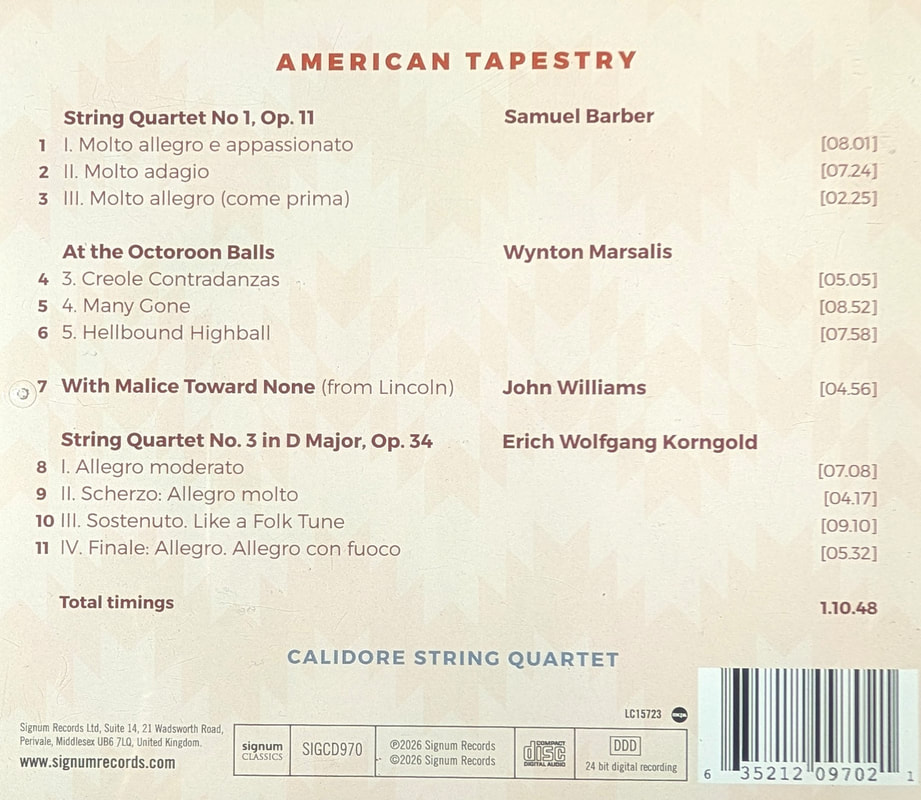
After this group’s Beethoven set impressed me as being somewhat lacking in personality, I was curious to hear them do something different. So a collection of American quartets seemed to be just the ticket. But why did it have to be Barber? Oh it’s just fine; much like their Beethoven. But did we really need yet another recording of it? To their credit, it is certainly more distinguished and stylistically appropriate than the stagnant one from the Miro Quartet on Pentatone a couple years ago. The opening appassionato may lack a little drama, but it is played with fervor where the Miros were curiously detached. And while the Adagio is traditionally paced, they get through it more than 2 minutes quicker than the Miros do. (Good god, what an excruciatingly dreary, lethargic, absolutely funereal rendering that was on Pentatone.) So the Calidore are definitely in a higher category – but it’s still the Barber Quartet. Wasn’t there any other American string quartet they could have chosen instead? (I can think of half a dozen right off the top of my head which would have been infinitely more rewarding and valuable.) Fortunately, the remainder of the program is much more imaginative and interesting.
Next we have some excerpts from Wynton Marsalis’ At the Octoroon Balls (aka his 1st String Quartet), which is refreshingly different. Jazzy and bluesy, almost improvisational at times, in the opening “Creole Contradanzas”, then switching gears in “Many Gone” – an expressive, emotional interlude evoking the lament of African American spirituals, featuring the cello prominently in extended solo passages, wondrously played here by cellist Estelle Choi. Then hold on for “Hellbound Highball”, which serves as a makeshift finale. It is an enormously fun, energetic escapade depicting an unstoppable locomotive charging ahead at full steam – though Marsalis ingeniously tries to stop it (musically) a few times along the way. The Calidore are fabulous in this music, with enough flair and rhythmic freedom to be entirely convincing (and thoroughly entertaining) without going overboard with it. Unfortunately, they play just 3 of the 7 movements from the full work – although that seems to be just about the right amount of this kind of thing, as each is quite lengthy, totaling over 22 minutes in all. Nonetheless, I am intrigued enough to want to hear the other 4 sections at some point (though I don’t find any current recordings of the complete work.)* All 3 selections are very entertaining and played with enthusiasm. If only they had included more of this and skipped the Barber…
They follow it, ill-advisedly, with a solemn John Williams theme from the movie Lincoln (“With Malice Toward None”), arranged for string quartet by the composer himself. I found it amusing reading the group’s recounting of meeting Mr. Williams and requesting a new work from him, and he came up with this. I have a feeling string quartets are not really his thing and opted for this little arrangement instead. Unfortunately, it sounds nothing like the familiar trumpet solo of the same name, and is actually just a reworking of an arrangement Williams had previously made several years prior, for the album “A Gathering of Friends” (with Yo-Yo Ma soloist). I didn’t like it then; I don’t like it now. Musically, it is somber and more than a little out of context away from the movie – and sounds even more out of place here coming immediately after Marsalis’ rollercoaster train ride. That was bad programming for sure; it didn’t stand a chance.
Korngold’s 3rd Quartet was a splendid choice to close the concert. It is well played, with lyricism and vitality, though it sounds just a touch careful compared to the irrepressible Pacifica Quartet on their recent recording of it. (In all fairness, the Pacifica are so characterful and spontaneously carefree in Korngold, it would be well nigh impossible to match them). And the final movement, with its insistent, jagged rhythms, doesn’t quite nag as it should; I would have welcomed a bit more quirkiness to it. (Same with the Scherzo, actually.) The up-close, matter-of-fact recording does them no favors, which tends to lack something in atmosphere and spaciousness. Curiously, I made similar observations of their Beethoven cycle – which, not surprisingly, employed the same engineer.
Taken as a whole, this is an enjoyable concert, expertly played by a very accomplished string quartet and reasonably well recorded. It has enough variety to hold one’s interest, but it is undeniably the jazzy Marsalis piece which is the main attraction here, and shows the Calidore String Quartet at their finest. How I wish they had been more innovative with some of the other selections.
*There is a 2024 YouTube video of the Jupiter String Quartet playing these same 3 sections (with even more charisma), which leads me to believe the complete work is not often performed – likely due to its unnecessary, extreme length which seems to be common for this composer dabbling in the Classical genre. Why is that? Why does it take him so long to convey his musical ideas?


%20&%20Samantha%20Price%20(Dido)%20-%20credit%20Richard%20Hubert%20Smith.jpg?w=160&resize=160,160&ssl=1 "Less is more: Elena Langer's Ariadne & Purcell's Dido hit home in finely abstract productions, a real ensemble achievement from English Touring Opera")