

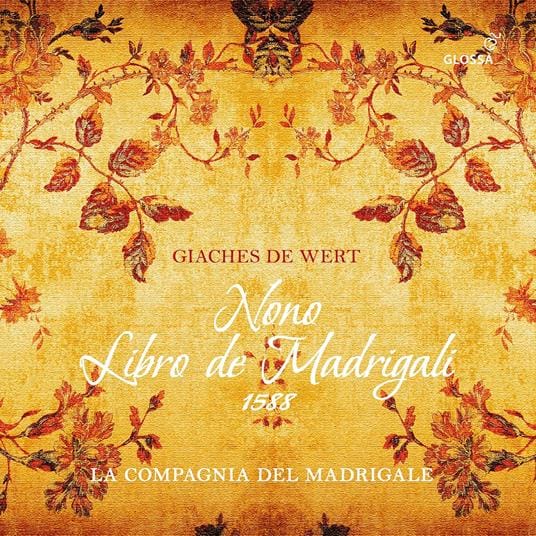
Netherlandish madrigalist Giaches de Wert (1535-96) spent much of his life in Italy, initially as choirboy to the Marchesa of Padulla (Salerno);he and was later court musician to counts of Nobellara, and the maestro di cappella at the court church of Santa Barbara at Mantua. It was here in this last that Duke Guglielmo Gonzaga made him maestro of the private chapel in recognition of de Wert’s ten-failing health.
de Wert had a difficult life. He married a respected lady at Novellara who, at Mantua, had an affair which lessened de Wert’s stature. She also became embroiled in conspiracy and was sentenced to life in prison (in which, she died). When de Wert later had an affair with the performer and composer Tarquinia Molza, it ruined her career due to familial dissent: she was banished to Modena (frankly, there are worse places to be banished!) while Wert returned to Mantua.
de Wert wrote eleven books of madrigals a 5 (No. 9 is a 5 and a 6) and one a 4. He was admired by Palestrina, who called him (in writing), “virtuoso così raro”.de Wert’s Ninth Book of Madrigals was published in 1588; two sopranos, two altos, two tenors and one bass comprise La Compagnia die Madrigale
The present disc by La Campagnia del Madrigale begins with a madrigal dedicated to the accession of the new Duke of Mantua, Vincenzo Gonzaga, “Now let Heaven Rejoice” (Or si rallegri il Cielo), its exuberant descending lines immediately putting me in mind of “O primavera” from Monteverdi’s Third Book of Madrigals (the quoted performance below is by La Venexiana, who we previously met in Gesualdo’s Fourth Book of Madrigals). De Wert’s madrigal celebrates Mantua’s glory, and is decidedly festive:
Gustave Reese, in Music in the Renaissance, likens process in this canzone to Sweelinck’s clearly defined tonality. Is it in G-Minor? A more complex explanation (which results in the same scale!) is that it is in a transposed Hypodorian mode, but with a sharpened F
In total contrast comes a madrigal entitled “My wounded soul” (L’anima mia ferita). A “river of sorrow” pours from the eyes, the weeping “the blood of the soul” (the text is by Ferrando Gonzaga). Listen to the upper-voice dissonances, unsupported by deep bass, as an expression of this space of vulnerable pain:
A song of encroaching Winter and grief, Vago angelietto che cantando (Pretty little bird, as you go singing) moves through a whole range of states. It serves as an entry point to “lament and melancholy” as the booklet notes put it, heard in full form in Valle, che de’ lamenti miei se piana (River, swelled higher by my tears), its opening incredibly expressive. The descending lines fall slowly, as if in slow motion, and the performance holds its nerve beautifully:
There has to be a nightingale somewhere, and here it is: Quel rosignol, che si soave piagne (That nightingale, who weeps so sweetly). Epitomising the Renaissance idea of “sweet sorrow,” the rare six-voice texture includes nightingale “trills” for the upper parts:
There is a certain purity to de Wert’s setting of Ecco che un’altra volta, o piagge apriche (Once again, sunlit slopes) that is tinged by careful chromaticisms; against this is an almost spoken way with chords:
A setting of Petrarch, Mia benigna fortuna (My kindly fortune) moves from a depiction of tranquility to a longing for death, from light to dark, in the most poignant of ways. As the booklet notes state, this is not so far from the astonishing works of Carlo Gesualdo. The shift at “Crudel, acerba, inexorabil Morte” (Cruel, bitter, pitiless Death) is real:
de Wert’s setting of Sovra un bel cristallino e puro rive (Beside a clear and soarkling strem) manages to retain the sense of light and movement while simultaneously creating a light texture. Interestingly, the notes suggest thisis very different from what Luca Maernzio would have done; further exploration between the two is probably best via the article Marenzio and Wert read Tasso: A Study in Contrasting Aesthetics by Jessie Ann Owens (Early Music, Volume 48/4, which was entirely dedicated to Marenzio).
Again in six voices, Un bacio solo (A single kiss) seems to teem with the excitement of the title’s activity (kissing ain’t what it sued to be back then!). This is the only setting of Battista Guarini, a favoured poet of both Marenzio and Monteverdi. The performance captures the atmosphere perfectly:
I do like the way this release leaves substantial time between madrigals, allowing for a listener “reset”; and one is definitely needed for Di morte già sentia (I already felt Death’s cruel, final dart), dark, sorrowful:
Mesola, il Po si lato (Mesola, the Po river on either side) is a glorious unfolding of counterpoint and carefully-calibrated changing textures; to a text by Tasso; O come vannegate, Donna (O how mistaken are you, my Lady) sets Guarini with the most remarkable sense of poignancy, playing registers against each other with trie mastery:
While Ha ninfe adorno e belle (Chaste Margherita has adorned the lovely nymphs; Tasso) is bright as a button, the book (and disc) ends with a prayer: Padre del ciel, dopo i perduti giorni (Father of Heaven, after lost days), a piece of supplication (Have mercy on mu unworthy suffering). The counterpoint sits in a liminal space between the madrigalist secular and the sacred, interestingly, and one hears this particularly at the end of a straight play through of the disc:
Throughout, La Compagnia di Madrigale is impeccable in both accuracy and style, supported by a fine recording (Confraternio del Santi Rocco e Sebastiani, Cumiana, Italy). But most of all, Giaches de Wert’s madrigals are such a rewarding discovery.
This wonderful disc is available at Amazon here.