


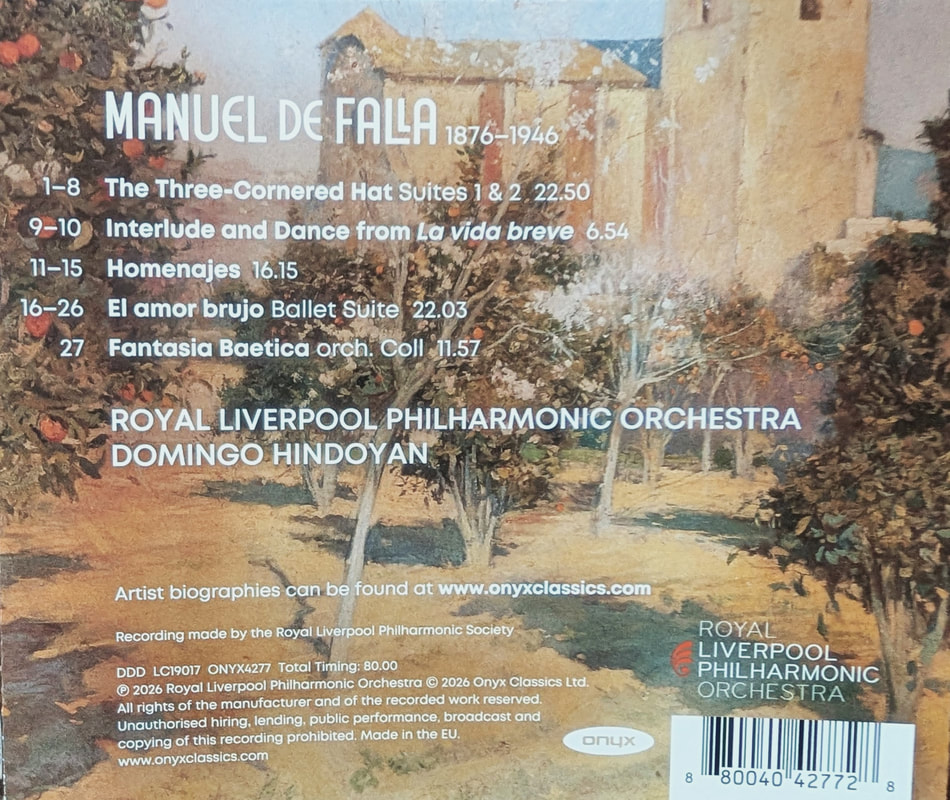
In my review of this team’s previous album, Iberia, I mused, Is Hindoyan losing his spark already? And I get the same feeling with this latest album. If there is any repertoire that I would expect him to be sensational in, it would be the music of de Falla. But sadly this is pretty ho-hum, at least in the ballets – though matters improve in the less familiar music, recorded at different sessions.
But before I get there, it’s important to note the main offerings here are suites, not the complete ballets, which is certainly not made clear looking at the front cover. And in such familiar excerpts like these, a conductor has to spring them to life to differentiate himself in a very crowded field. But Hindoyan struggles to do that, especially in the 2nd Suite from The 3-Cornered Hat, which lacks character and sparkle, or a convincing sense of spontaneity. The music refuses to take flight in dance as ballet music absolutely must, remaining steadfastly earthbound and leaden. And the lackluster recording doesn’t help. The acoustic is a bit dry and lacks spaciousness and dynamic impact. (There’s not even a decent bass drum wallop there in the opening section of the Final Dance.) Worse, the Spanish flavor and rhythmic vitality so essential in this music are curiously curtailed. Though the 1st Suite was a bit more engaging, as the 2nd Suite dragged on with somewhat sluggish tempos and a distinct lack of energy, I got bored and was ready to move on to something (hopefully) more interesting.
The Interlude from La vida breve suddenly gains passion and drama, taking on an appropriately operatic quality. I’m instantly reminded how good Hindoyan was in his earlier Verismo album. And the recording has more dynamic impact here as well. The booklet tells us this was recorded at different sessions, 9 months later; and that may explain it. I’m hearing an emotional involvement now that was curiously missing in the ballet, and this continues into the short Dance which follows.
“Tributes” is also enjoyable, but for a different reason – it simply isn’t often played. I’m not sure I’ve ever heard the entire piece before. (Some parts are performed separately.) The booklet reveals this too was recorded at different sessions, this time a year-and-a-half later. This is Falla’s last orchestral work in which he pays tribute to 2 of his most revered composers, Debussy and Dukas, and his teacher, Felip Pedrell. Strangely, there are 2 short fanfares thrown into the mix which don’t have anything to do with anything, making this a rather odd piece. But the musicmaking here continues to be an improvement. Hindoyan does a good job bringing out the French elements in the Debussy and Dukas sections, while never losing sight that this is de Falla. He finds more atmosphere and color here than in the ballet music, and this occasionally reminds me of Nights of the Gardens of Spain without the piano – especially in the last section, “Pedrelliana”, which is the most substantive and substantial at 7-1/2 minutes. None of this is terribly demanding or dynamic music, which seems to suit these musicians just fine.
The opening of El amor Brujo, which immediately follows it, should sound bracing, with bright and acerbic piccolos over muted trumpets biting through the texture. But it doesn’t here; it’s just as refined and mild-mannered, dynamically, as 3-Cornered Hat. Even the underlying orchestral punctuations sound oddly confined and a bit congested. I’m immediately reminded this was recorded at the earlier sessions along with Hat. This is somewhat better characterized though, at least initially. But as the Romance sets in, I begin to grow bored with it and jump ahead to the “Ritual Fire Dance”. Not that I’m necessarily in the mood to hear it (especially with Arthur Fiedler’s Boston Pops vividly etched in my memory), but I’m wondering if Hindoyan will ever exhibit some real energy and, well, fire – especially in this, of all places. But he doesn’t. In fact, he seems to go out of his way to make it even more civilized and unexciting than usual. There is no flair; no exuberance; no flavor. And dynamics continue to be constrained.* As it lingers on, I kept wishing there were more vivid characterization and enthusiasm to it. It seems Hindoyan is going for atmosphere above all else, and frankly, the lackluster recorded sound hampers his efforts.
Something entirely new comes at the conclusion of the program with an orchestration of the piano piece, Fantasia Baetica, made by contemporary Spanish composer/trombone player Francisco Coll. And I suspect it is the raison d’etre for this album. Hindoyan must have stumbled upon this new transcription and wanted to record it; thus the concept of an album was born, with the ballet suites deemed suitable fillers. And that’s pretty much how they sound. But the “new” work is interesting and engaging, and the orchestra sounds inspired by encountering something different. I’m not familiar with the original, but the orchestration seems to work well enough, reminding me often of Nights.
After listening to this CD another time or two to prepare for writing this review, I found myself thinking it’s really not bad. However, Hindoyan should excel in this music, and the fact that he’s “not bad”, as opposed to fresh and invigorating, or even distinctive, is what is so disappointing about it. And in the end I wonder why this is so lacking in vitality. Even the orchestra sounds like they’re merely playing on autopilot. I found his Iberia album to be very similar in this regard; both collections provide good, reliable readings which are surprisingly routine compared to the best.
While no one needs yet another recording of these ballet suites, particularly in run-of-the-mill readings such as these, it’s therefore up to the individual collector to determine if the remaining 30-minutes of the album makes it worthwhile. The CD plays for an astounding 80 minutes (!) and there are definitely some good things to be heard here. I admit I enjoyed enough of it to almost justify the asking price, but I’m still left unsatisfied.
*Could it be this was intended for a radio broadcast, hence the engineer is restricting the dynamic range?



.jpg?w=160&resize=160,160&ssl=1 "Only love can bear the burden of truth: Ben Parry & Garth Bardsley on their new opera that premieres at Snape this Saturday")