


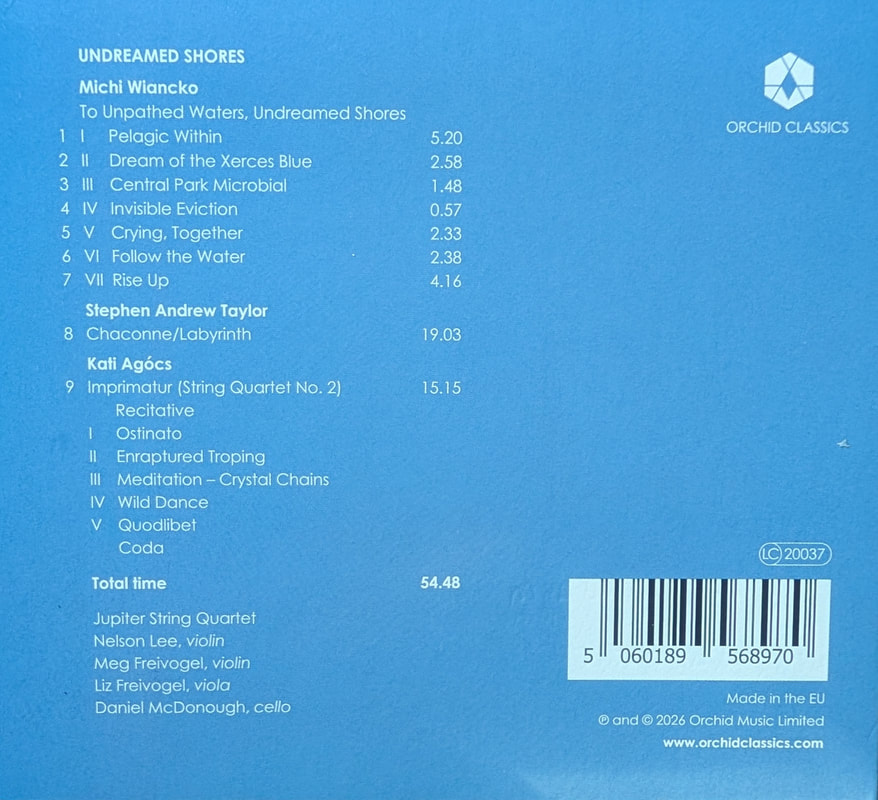
Here’s another album of new music with an “arty” title which is becoming so commonplace on Classical releases these days. This one is adorned with “Undreamed Shores” – and I wondered, what does that even mean? I was to discover it was actually part of the title of one of the works presented on this album. Okay fine.
The Jupiter String Quartet is an excellent quartet which I have encountered before, on 2 previous albums on the Marquis label. One was an unusual coupling from 2020 which pairs Beethoven’s Opus 131 with Ligeti’s 1st Quartet. The Beethoven is fine, nothing particularly distinctive or special, and their Ligeti is the much the same – well played certainly, but lacking a last bit of dynamic extremes and stunning astonishment which inform the very best performances. (I remember some sections exhibiting a coquettish quality not normally associated with Ligeti, which was memorable.) The other album, a year earlier, was even better, featuring all new music showcasing an American composer I really like, Pierre Jalbert (a new Piano Quintet and his earlier Piano Quartet), and less notable works from 2 other composers. The entire program was extremely well played and recorded.
This new album finds them switching from Marquis to Orchid, and it, too, features all new music, written especially for the Jupiter String Quartet. I had not heard of these 3 composers before and wasn’t real sure what to expect. Happily, this new music is not just the typical noise (er, I suppose I should say “sound”) which passes for a lot of new string quartet ”music”. For the most part, these pieces are harmonic, if not necessarily melodious; somewhat tonal, though at all times exploratory; and, simply put, real music, rather than just senseless sound effects.
But before going into more detail about the music, a quick word about the ensemble. I noticed on their website that the Jupiter Quartet has announced they have a new 1st violinist. They seem excited about it, but I admit being disappointed. The 1st violinist appearing on this current CD is Nelson Lee, an original founding member who had played with them for 24 years. Curious about the timing on this, I noticed this 2026 CD release was actually recorded in September 2024, just before Lee left the group. Lucky for us! His rich tone and sweetly singing lines are a pleasure to hear and his playing enhances everything on this album. As to the remaining members, it’s interesting to note that the 2nd violin and viola are sisters, one of which is married to the cellist. So it is definitely a family affair; but with a new 1st violin now.
As to the music, the Jupiter Quartet had the foresight to begin the program with an absolutely wonderful, and wonderfully original work by Michi Wiancko – “To Unpathed Waters, Undreamed Shores”. Ah…so that’s where the album title came from. The work is laid out in 7 rather short movements (roughly 1 to 5 minutes each), each given “artful” titles of their own. From the very first notes, I’m struck by the luscious acoustic captured so beautifully by the recording engineer, and the lushness of the sound of this wonderful quartet – individually and as a group. The opening (Pelagic [“the sea”] Within) is a determined thematic statement, followed by an intimacy which invites the listener to stay along to experience something wonderful. The music soon becomes delectably atmospheric, with soft, fleshy pizzicato and gentle tapping of the bows on wood, eventually developing into unmistakable elements of Minimalism, with recurring, insistent rhythmic pulses and snippets of melodic thematic material. I also hear some interesting string effects emerging from the musical fabric, adding color and fascination to the atmospheric tapestry.* It’s all very delicate and mesmerizing, and builds in intensity until stopped short by an abrupt pause just before the second movement begins. And I realize I’m hearing something special – not just the originality and imaginative creativity of the music, but great string quartet playing and a great recording. What a rare combination to behold. And it is simply glorious.
Part II (Dream of the Xerces Blue) has a restless rhythmic energy underlying more melodious invention, with both solo lines and duet combinations. It also introduces a few more interesting string effects, captivating the listener with atmospheric sounds – from bouncing bows to subtle sighs and bird-like whistles way up high on harmonics. Oh my goodness this is spellbinding – and the recording, amazingly, remains superbly “present” and perfectly focused even at ppp, allowing every detail to register, even at the softest whisper. While in III (Central Park Microbial), the effects are even more prominent, but now more wooden in sound (rather than stringy), with lots of col legno and gentle knocking of knuckles on the wooden bodies, over a rhythmic pizzicato cello, with even a bit of scratching creeping in (but not too much). There is a rather eerie, otherworldly tune of sorts from a delirious (or perhaps drunken) violin which simply fascinates the imagination. And with all its strangeness, there is an underlying, insistent, rhythmic pulse which propels it. Absolutely amazing writing and scoring.
IV is an unexpected, out-of-nowhere change to complete atonality and deliberate dissonance. It’s coarsely bowed and comparatively noisy for no apparent musical reason. Its title, “Invisible Eviction”, is no help in understanding it. I hoped this wouldn’t last long, and mercifully, it doesn’t – exactly 57 seconds actually. And with that out of the way, V (Crying, Together) is completely different and Wiancko returns to pleasantries. It is a freeform melodic outpouring played by the entire group in unison, in multiple octaves. It leads naturally into section VI (Follow the Water), which is even more lyrical and airy, with undulating viola filigree underlying the melodic expression – where at one point, the 1st violin is so enraptured with it, he takes the tune soaring heavenward into the highest register. Simply exquisite. There is a refreshing feel of the breezy, American outdoors to this as well. Ah…sheer loveliness. The finale (Rise Up) then returns to more minimalistic origins, with rhythmic elements underlying a tuneful solo line passed among the players. The tension builds until a pause gives way to an extended rhythmic pizzicato passage followed by rolling, articulated sul pont effects. And the piece just ends, very simply, with a plaintive viola (or perhaps cello) fading into a calming quietude. And I sit back in silence, and think, what a wonderful experience this was.
Sometimes a new piece of music speaks to me in such a way that I just can’t wait to write about it. And that’s exactly what happened after listening to this inspiring work by Michi Wiancko. Moreover, it receives the strongest possible advocacy from the fantastic Jupiter Quartet, complimented by superb recorded sound. The piece requires one’s undivided attention, as if listening attentively to a live concert, and in turn, rewards you with an extraordinary, enthralling experience. It is rare that I hear a new piece of music that I actually want to listen to again; this is definitely one of them.
But now – how can anything follow this? It’s like after watching a wonderful movie and then faced with a decision – do we just call it a night or actually try to find something worth watching on Netflix? Ha! Of course that’s an apples and oranges comparison to this, but there is a similar feeling that the remaining pieces on this program will inevitably struggle to measure up. So I decided to call it a day and come back later to listen to the rest – starting with Stephen Andrew Taylor’s Chaconne/Labyrinth.
I wasn’t really looking forward to listening to a new single-movement piece lasting nearly 20 minutes. And I was especially apprehensive after reading that this composer experiments with live electronics and improvisation. But fortunately, none of these hesitations proved founded. The piece opens somberly, gloriously melodious and rather traditionally harmonious, but creates a disquieting unease, before moving forward with a dramatic change of tempo and mood at the 3-minute mark. Skittish at first, it becomes more obviously “modern”, veering farther away from tonality as it progresses. The momentum calms, and another tune, this time on the viola, tugs on the heartstrings. Taylor eventually begins to introduce some unusual effects – some quarter-tone (“pitch-stretching”) at first, hinting at the electronic music he’s been involved with. There is a quite lovely, heartfelt melody on the 1st violin which grows emotional (and intentionally out of tune at one point), leading to a scurrying bustle which perks us up with an interesting variety of mood, including a very rhythmic burst of energy. It is interrupted by a deliberately out of tune melody, tossing around, back-and-forth, but gives way to a continuation of the rhythmic outburst at about the 10-minute mark, where Taylor gets very “modern” and experimental indeed – with lots of strange effects (exaggerated glissandos and the like), and music which is even more rhythmically propulsive and insistent.
There is an extended interlude, a somewhat desolate landscape, with more approximation of pitches stretching and upsetting an attempt at melody (much of which is a series of scales, ingeniously incorporated), before another scherzando takes off on a brief excursion. Taylor begins to build the tension until we crave relief from it, and a melancholy cello provides it just in time, with a plaintive little solo which is lovely indeed. And the piece draws to a close with a hesitant, and hesitating, harmonious chorale, recalling the apprehension and anticipation of the beginning, culminating in tremolos which finally resolve to a glorious A-Major chord crescendoing to the end. I again find myself sitting back, taking it all in, and thinking what another wonderful experience this was.
Fascinating; and fascinatingly different from the previous work. I enjoyed it very much – not least for its intriguing and somewhat unusual sound effects, which are musical intricacies and variances rather not often heard. Taylor’s use of what I call “pitch-stretching” (it’s not exactly quite as precise as quarter-tones, more like elongated/prolonged mini-portamentos) is really quite interesting and unique, and the Jupiter Quartet makes the most of it. In fact, it cannot emphasize enough how much the superb playing of the Jupiter Quartet, along with the superbly atmospheric recorded sound, contribute to making this piece what it is. So for something intriguingly different, yet not so unusual to be weird, this piece is inviting and captivating – even somehow vaguely familiar in its determined attempts at harmoniousness and tonality. It’s atonal without trying to be…if that makes sense.
So finally we come to String Quartet #2, “Imprimatur”, by Kati Agocs. I had to look up the word “imprimatur” (again wondering, what does that even mean?) and learned it has something to do with the Catholic church’s approval to print a text. Mmkay. The booklet tries to help, stating it can also mean a mark of distinction or an imprint. (That’s getting better.) While the composer, in her own program note, takes it to a seemingly unrelated meaning altogether, completely out of context: “a single idea imprints itself upon the memory through rapturous re-imagination”. Ok! The individual movements are given cryptic subtitles as well; but though they are listed in the booklet, the entire piece is inexplicably contained within just one track on the CD (lasting 15 minutes). Which is a real pity. I found it difficult to relate the movement titles to the correct passages of music, despite an occasional pause along the way. But I tried.
The piece starts with an inauspicious recitative – a stern proclamation of what might be a main theme, interrupted by passages determined to be dissonant for no discernable reason or musical purpose. Fortunately that’s over in about a minute and the Ostinato is instantly, mercifully, much more attractive. It is rhythmic and somewhat hesitant, followed by a lyrical passage (“Enraptured Troping” – don’t ask me) and then a meditation of sorts (“Crystal Chains”), which again tries to be deliberately atonal and I’m not sure why. It is at once pleasant then unnecessarily dissonant. Finally, around the 9-minute mark, a “Wild Dance” comes stomping in with an unhappy viola over agitated snap-pizzs in the cello. Now this is more like it! It features atonal chordal rhythms interspersed with some open fifths, giving it an uncultured, somewhat gypsy flavor. (Ravel’s Tzigane came to mind a time or two here.) The stomping comes to an abrupt stop for the “Quodlibet” (again…don’t ask me), where we have icy tremolos (sort of sul pont, but not quite) before a lovely duet in 2nd violin and viola sings over a restless arpeggiated cello. Interestingly, though the stomping has stopped, this continues to dance, more seductively now, replete with singing lines. This is rhapsodic and sensual and surely the highlight of the entire piece. The coda takes us to the end, rather pleasantly I might add, leaving me with a more satisfying impression of the piece than I had expected it would.
As a complete program, I enjoyed the 3 works from most to least in exactly the order in which they appear on this CD. Even though I thought this last one by Agocs was the weakest of the three, compositionally and creatively, it is nonetheless interesting and definitely worth hearing. The Jupiter Quartet must think the world of it, as they state in the booklet that they have returned to it over multiple seasons. (Perhaps I should return to it myself; it might make a stronger impression on me after another time through.) But it is without doubt the other two works on the program which are the most captivating, rewarding and musically enriching. And with such wonderful playing and recorded sound, this disc simply must be heard.
*Michi Wiancko is, herself, a violinist, so she knows exactly how to create these sounds and incorporate them into the musical fabric with maximum effectiveness.
The Jupiter String Quartet is an excellent quartet which I have encountered before, on 2 previous albums on the Marquis label. One was an unusual coupling from 2020 which pairs Beethoven’s Opus 131 with Ligeti’s 1st Quartet. The Beethoven is fine, nothing particularly distinctive or special, and their Ligeti is the much the same – well played certainly, but lacking a last bit of dynamic extremes and stunning astonishment which inform the very best performances. (I remember some sections exhibiting a coquettish quality not normally associated with Ligeti, which was memorable.) The other album, a year earlier, was even better, featuring all new music showcasing an American composer I really like, Pierre Jalbert (a new Piano Quintet and his earlier Piano Quartet), and less notable works from 2 other composers. The entire program was extremely well played and recorded.
This new album finds them switching from Marquis to Orchid, and it, too, features all new music, written especially for the Jupiter String Quartet. I had not heard of these 3 composers before and wasn’t real sure what to expect. Happily, this new music is not just the typical noise (er, I suppose I should say “sound”) which passes for a lot of new string quartet ”music”. For the most part, these pieces are harmonic, if not necessarily melodious; somewhat tonal, though at all times exploratory; and, simply put, real music, rather than just senseless sound effects.
But before going into more detail about the music, a quick word about the ensemble. I noticed on their website that the Jupiter Quartet has announced they have a new 1st violinist. They seem excited about it, but I admit being disappointed. The 1st violinist appearing on this current CD is Nelson Lee, an original founding member who had played with them for 24 years. Curious about the timing on this, I noticed this 2026 CD release was actually recorded in September 2024, just before Lee left the group. Lucky for us! His rich tone and sweetly singing lines are a pleasure to hear and his playing enhances everything on this album. As to the remaining members, it’s interesting to note that the 2nd violin and viola are sisters, one of which is married to the cellist. So it is definitely a family affair; but with a new 1st violin now.
As to the music, the Jupiter Quartet had the foresight to begin the program with an absolutely wonderful, and wonderfully original work by Michi Wiancko – “To Unpathed Waters, Undreamed Shores”. Ah…so that’s where the album title came from. The work is laid out in 7 rather short movements (roughly 1 to 5 minutes each), each given “artful” titles of their own. From the very first notes, I’m struck by the luscious acoustic captured so beautifully by the recording engineer, and the lushness of the sound of this wonderful quartet – individually and as a group. The opening (Pelagic [“the sea”] Within) is a determined thematic statement, followed by an intimacy which invites the listener to stay along to experience something wonderful. The music soon becomes delectably atmospheric, with soft, fleshy pizzicato and gentle tapping of the bows on wood, eventually developing into unmistakable elements of Minimalism, with recurring, insistent rhythmic pulses and snippets of melodic thematic material. I also hear some interesting string effects emerging from the musical fabric, adding color and fascination to the atmospheric tapestry.* It’s all very delicate and mesmerizing, and builds in intensity until stopped short by an abrupt pause just before the second movement begins. And I realize I’m hearing something special – not just the originality and imaginative creativity of the music, but great string quartet playing and a great recording. What a rare combination to behold. And it is simply glorious.
Part II (Dream of the Xerces Blue) has a restless rhythmic energy underlying more melodious invention, with both solo lines and duet combinations. It also introduces a few more interesting string effects, captivating the listener with atmospheric sounds – from bouncing bows to subtle sighs and bird-like whistles way up high on harmonics. Oh my goodness this is spellbinding – and the recording, amazingly, remains superbly “present” and perfectly focused even at ppp, allowing every detail to register, even at the softest whisper. While in III (Central Park Microbial), the effects are even more prominent, but now more wooden in sound (rather than stringy), with lots of col legno and gentle knocking of knuckles on the wooden bodies, over a rhythmic pizzicato cello, with even a bit of scratching creeping in (but not too much). There is a rather eerie, otherworldly tune of sorts from a delirious (or perhaps drunken) violin which simply fascinates the imagination. And with all its strangeness, there is an underlying, insistent, rhythmic pulse which propels it. Absolutely amazing writing and scoring.
IV is an unexpected, out-of-nowhere change to complete atonality and deliberate dissonance. It’s coarsely bowed and comparatively noisy for no apparent musical reason. Its title, “Invisible Eviction”, is no help in understanding it. I hoped this wouldn’t last long, and mercifully, it doesn’t – exactly 57 seconds actually. And with that out of the way, V (Crying, Together) is completely different and Wiancko returns to pleasantries. It is a freeform melodic outpouring played by the entire group in unison, in multiple octaves. It leads naturally into section VI (Follow the Water), which is even more lyrical and airy, with undulating viola filigree underlying the melodic expression – where at one point, the 1st violin is so enraptured with it, he takes the tune soaring heavenward into the highest register. Simply exquisite. There is a refreshing feel of the breezy, American outdoors to this as well. Ah…sheer loveliness. The finale (Rise Up) then returns to more minimalistic origins, with rhythmic elements underlying a tuneful solo line passed among the players. The tension builds until a pause gives way to an extended rhythmic pizzicato passage followed by rolling, articulated sul pont effects. And the piece just ends, very simply, with a plaintive viola (or perhaps cello) fading into a calming quietude. And I sit back in silence, and think, what a wonderful experience this was.
Sometimes a new piece of music speaks to me in such a way that I just can’t wait to write about it. And that’s exactly what happened after listening to this inspiring work by Michi Wiancko. Moreover, it receives the strongest possible advocacy from the fantastic Jupiter Quartet, complimented by superb recorded sound. The piece requires one’s undivided attention, as if listening attentively to a live concert, and in turn, rewards you with an extraordinary, enthralling experience. It is rare that I hear a new piece of music that I actually want to listen to again; this is definitely one of them.
But now – how can anything follow this? It’s like after watching a wonderful movie and then faced with a decision – do we just call it a night or actually try to find something worth watching on Netflix? Ha! Of course that’s an apples and oranges comparison to this, but there is a similar feeling that the remaining pieces on this program will inevitably struggle to measure up. So I decided to call it a day and come back later to listen to the rest – starting with Stephen Andrew Taylor’s Chaconne/Labyrinth.
I wasn’t really looking forward to listening to a new single-movement piece lasting nearly 20 minutes. And I was especially apprehensive after reading that this composer experiments with live electronics and improvisation. But fortunately, none of these hesitations proved founded. The piece opens somberly, gloriously melodious and rather traditionally harmonious, but creates a disquieting unease, before moving forward with a dramatic change of tempo and mood at the 3-minute mark. Skittish at first, it becomes more obviously “modern”, veering farther away from tonality as it progresses. The momentum calms, and another tune, this time on the viola, tugs on the heartstrings. Taylor eventually begins to introduce some unusual effects – some quarter-tone (“pitch-stretching”) at first, hinting at the electronic music he’s been involved with. There is a quite lovely, heartfelt melody on the 1st violin which grows emotional (and intentionally out of tune at one point), leading to a scurrying bustle which perks us up with an interesting variety of mood, including a very rhythmic burst of energy. It is interrupted by a deliberately out of tune melody, tossing around, back-and-forth, but gives way to a continuation of the rhythmic outburst at about the 10-minute mark, where Taylor gets very “modern” and experimental indeed – with lots of strange effects (exaggerated glissandos and the like), and music which is even more rhythmically propulsive and insistent.
There is an extended interlude, a somewhat desolate landscape, with more approximation of pitches stretching and upsetting an attempt at melody (much of which is a series of scales, ingeniously incorporated), before another scherzando takes off on a brief excursion. Taylor begins to build the tension until we crave relief from it, and a melancholy cello provides it just in time, with a plaintive little solo which is lovely indeed. And the piece draws to a close with a hesitant, and hesitating, harmonious chorale, recalling the apprehension and anticipation of the beginning, culminating in tremolos which finally resolve to a glorious A-Major chord crescendoing to the end. I again find myself sitting back, taking it all in, and thinking what another wonderful experience this was.
Fascinating; and fascinatingly different from the previous work. I enjoyed it very much – not least for its intriguing and somewhat unusual sound effects, which are musical intricacies and variances rather not often heard. Taylor’s use of what I call “pitch-stretching” (it’s not exactly quite as precise as quarter-tones, more like elongated/prolonged mini-portamentos) is really quite interesting and unique, and the Jupiter Quartet makes the most of it. In fact, it cannot emphasize enough how much the superb playing of the Jupiter Quartet, along with the superbly atmospheric recorded sound, contribute to making this piece what it is. So for something intriguingly different, yet not so unusual to be weird, this piece is inviting and captivating – even somehow vaguely familiar in its determined attempts at harmoniousness and tonality. It’s atonal without trying to be…if that makes sense.
So finally we come to String Quartet #2, “Imprimatur”, by Kati Agocs. I had to look up the word “imprimatur” (again wondering, what does that even mean?) and learned it has something to do with the Catholic church’s approval to print a text. Mmkay. The booklet tries to help, stating it can also mean a mark of distinction or an imprint. (That’s getting better.) While the composer, in her own program note, takes it to a seemingly unrelated meaning altogether, completely out of context: “a single idea imprints itself upon the memory through rapturous re-imagination”. Ok! The individual movements are given cryptic subtitles as well; but though they are listed in the booklet, the entire piece is inexplicably contained within just one track on the CD (lasting 15 minutes). Which is a real pity. I found it difficult to relate the movement titles to the correct passages of music, despite an occasional pause along the way. But I tried.
The piece starts with an inauspicious recitative – a stern proclamation of what might be a main theme, interrupted by passages determined to be dissonant for no discernable reason or musical purpose. Fortunately that’s over in about a minute and the Ostinato is instantly, mercifully, much more attractive. It is rhythmic and somewhat hesitant, followed by a lyrical passage (“Enraptured Troping” – don’t ask me) and then a meditation of sorts (“Crystal Chains”), which again tries to be deliberately atonal and I’m not sure why. It is at once pleasant then unnecessarily dissonant. Finally, around the 9-minute mark, a “Wild Dance” comes stomping in with an unhappy viola over agitated snap-pizzs in the cello. Now this is more like it! It features atonal chordal rhythms interspersed with some open fifths, giving it an uncultured, somewhat gypsy flavor. (Ravel’s Tzigane came to mind a time or two here.) The stomping comes to an abrupt stop for the “Quodlibet” (again…don’t ask me), where we have icy tremolos (sort of sul pont, but not quite) before a lovely duet in 2nd violin and viola sings over a restless arpeggiated cello. Interestingly, though the stomping has stopped, this continues to dance, more seductively now, replete with singing lines. This is rhapsodic and sensual and surely the highlight of the entire piece. The coda takes us to the end, rather pleasantly I might add, leaving me with a more satisfying impression of the piece than I had expected it would.
As a complete program, I enjoyed the 3 works from most to least in exactly the order in which they appear on this CD. Even though I thought this last one by Agocs was the weakest of the three, compositionally and creatively, it is nonetheless interesting and definitely worth hearing. The Jupiter Quartet must think the world of it, as they state in the booklet that they have returned to it over multiple seasons. (Perhaps I should return to it myself; it might make a stronger impression on me after another time through.) But it is without doubt the other two works on the program which are the most captivating, rewarding and musically enriching. And with such wonderful playing and recorded sound, this disc simply must be heard.
*Michi Wiancko is, herself, a violinist, so she knows exactly how to create these sounds and incorporate them into the musical fabric with maximum effectiveness.


%20Graham%20Boulton.jpeg?w=160&resize=160,160&ssl=1 "Celebrating John Joubert at Royal Birmingham Conservatoire in advance of his 2027 centenary")