
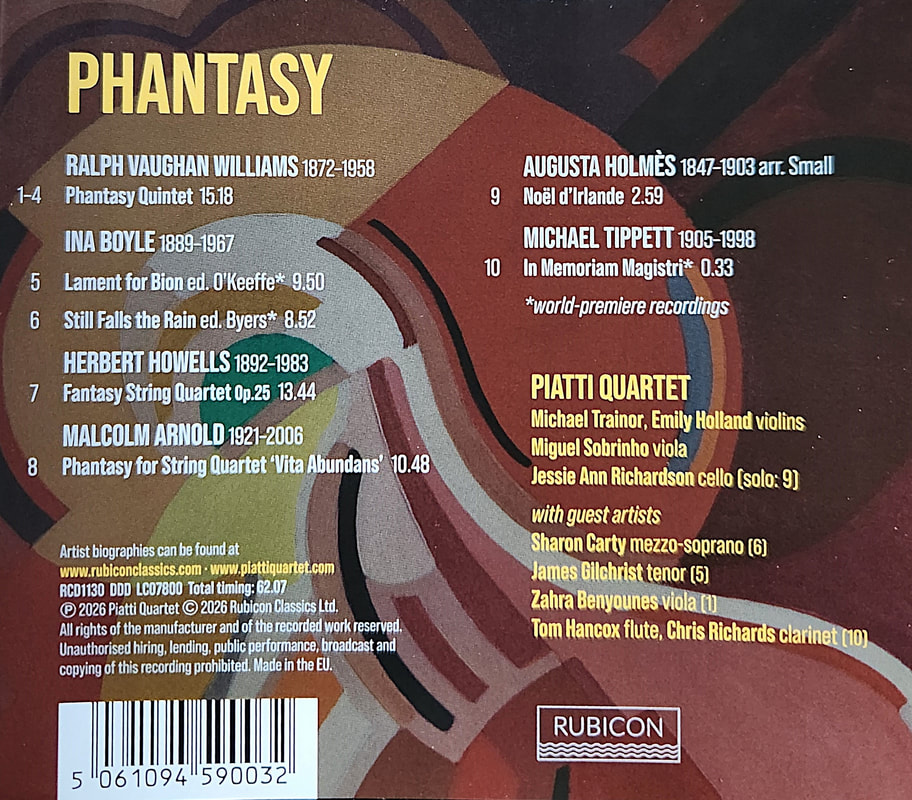
With this latest recording for Rubicon, 2 of their members are different from their previous recording for this label just two years ago (yup, the 2nd violin and viola). And even though the recording engineer and venue (St. Silas Church, London) are the same as before, the recorded sound is not quite as good – but just in the opening work, Vaughan Williams’ Phantasy for String Quintet, which begins the program. Though the a cappella viola solo at the beginning is gorgeous and richly textured, as the others join in and the volume and intensity of their playing increases, it becomes obvious there is something not quite right here. The acoustic sounds a bit tubby, with an empty-hall reverberation surrounding the musicians – most noticeable in the Scherzo and Burlesca, which sound a bit “busy”.
But it’s not serious. And once the ear adjusts, it’s easy to become immersed in the music. And one quickly realizes VW’s Phantasy is a wonderful piece of music. It has all the hallmarks of this composer, who so much of the time just can’t seem to get away from sounding like himself – specifically his own Thomas Tallis Variations and Lark Ascending. And such is the case here. You hear continual reminders of those works throughout the slow movements of this piece – especially as an additional viola enriches the traditional string quartet, making it even more like that wash of string sound in the Tallis variations. And that’s OK. It’s lovely music. And it’s lovingly played here. But there are contrasting sections too, including a vivacious scherzo in 7/8 time and a jaunty Burlesca at the end, providing splendid variety.
Next we have two dreary vocal works (which I never welcome on a string quartet program) by Ina Boyle, with whom the Piatti Quartet seems to have a special affinity. (They played her string quartet on the earlier album.) So I skipped over them without hesitation, and hoped the sound would improve in Herbert Howells’ Fantasy which comes next. And I’m so pleased to hear that it does! The group sounds to be ever so slightly closer to the microphones now, with just enough added presence and clarity to increase focus and realism, and more effectively control the acoustic. The piece begins in a gloomy mood though, and I feared the worst, as this extra closeness highlights a bit of coarseness to the texture of bow on string. But that is soon forgotten as one is drawn completely into the music. And what a gorgeous piece this is.
It’s an expansive work, with many differing sections, laid out in a single movement. And it, too, often sounds a lot like the Vaughan Williams of Tallis and Lark. Each instrument is featured in extended solo passages, sometimes con sordino, allowing each member of this wonderful string quartet to shine. And the extra touch of immediacy and illumination from the recording allows the group’s sound to expand effortlessly into the acoustic, with a vibrancy and emotional involvement which was slightly curtailed before. One is swept along as the music swells and picks up momentum, and Howells’ distinctive musical voice speaks out with ardor. This music sounds a bit like Vaughan Williams mingling with Delius, which is a very enjoyable combination indeed.
But it’s not done yet! Things really pick up about 8-1/2 minutes in, as an animated Allegretto breaks out, brimming with an irrepressible, melodic joyfulness. Then just as suddenly, it comes to an abrupt halt, and we’re back to VW again to close out the piece. And at the end, I once again marvel at the marvelous playing of the Piatti Quartet. And am so relieved the recording quality is so excellent, just as it was on their previous recording for Rubicon.
After this, it will be hard for Malcolm Arnold’s Phantasy to measure up. (And it doesn’t quite.) But it starts out promisingly and I have high hopes. It has more light and shade variety in mood, texture and, especially, in scoring. With pizzicato sprinkled throughout the group at the beginning, its distinct quirkiness is intriguing, sounding quite modern indeed! Agitated rhythms and incisive articulation abound, with a constant restlessness underlying it. And with the acoustic now better defined, the atmosphere created is most alluring, befitting the music perfectly. And the Piatti Quartet really dazzles us with it.
This music is definitely by a young composer, written some 25 years later than the VW and Howells, who is obviously exploring modernism. While much of the piece is tonal (more or less), Arnold is beginning to experiment with atonality, and even hinting at avant-garde effects yet to come. And he does get a little weird with it a few minutes in, where he almost lets the dissonance get the better of him. But once he’s got that out of his system, he drives the music with rhythmic propulsion and vigor, reminding me of Bartok at his most energetic. Then Arnold surprises us with a lovely, positively tender passage near the end (replete with the most sweetly singing violin), before finishing it off with a fleeting burst of youthful zest in a quick little zippy flourish in the closing measures. The Piatti Quartet excels at this kind of characterization, and they vividly project the variety of moods, sounds and temperament to great effect, and succeed in making the piece even better than it might otherwise be.
This would have made a splendid concert closer. But for no apparent, musical reason, the Piattis append at the end a couple of slow, somber mini-encores – which I’m not sure was at all necessary. First, there is a lovely but sad little song by Augusta Holmes, in an arrangement for solo cello and string quartet, which dampens the mood immediately. It is followed by an extremely unpleasant bit of noise – a “work” by Michael Tippett which lasts exactly 33 seconds (!) presented here in its “world premiere recording” (LOL). Oh and they even bring in a flutist and a clarinetist for this! All 33 seconds of it. Which, of course, is simply absurd.3 But there it is.
So while not all the music here is essential (ahem), the major string works are. And they are not that often recorded, making this disc even more enticing. (And I suppose some may even enjoy the vocal works, though I can’t imagine it, and it’s important to note, they take up nearly 20 minutes of the 60-minute total playing time.) Overall, the musicmaking here continues to inspire admiration for the Piatti Quartet – no matter what. And I can warmly recommend this album, especially to fans of the Piatti Quartet.
1 Though the roster is identical to the Nimbus Alliance recording of the Phibbs Quartets made just one year earlier (2024).
2 Notable for its wonderful performance of E.J. Moeran’s 2nd String Quartet and Vaughan Williams’ Household Music.
3 Could you imagine being the 2 woodwind players showing up for the recording session and having just one stave of music to play? At least it was easy to sightread and allowed for an early happy hour!