


That’s the question. Well…let me be more specific. Why can’t Chandos sound engineer, Ralph Couzens, achieve consistency with the recorded sound of the Sinfonia of London? Why is that so difficult? They record in the same venue (some big church) every time; so he surely has a mapping schematic for where he hangs his microphones. (Heck, the wires probably hang there permanently, so he doesn’t even have to move them.) So why is the sound so different from one recording to another? And more specifically, not just different, but good vs not so good.
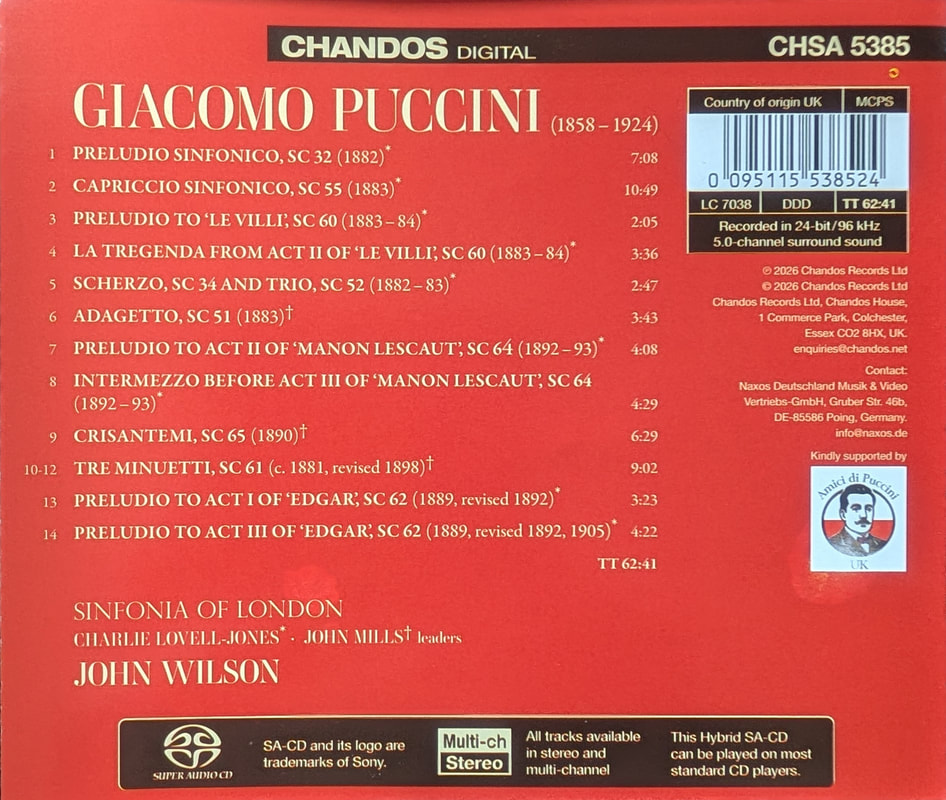
Let me back up. I was ready to be absolutely done with John Wilson after his lame Walton 1st last year. I have a feeling Chandos producer Brian Pidgeon may have had some reservations with it as well, because their final Walton installment (Symphony #2) is nowhere in sight.1 Instead, Chandos has shrewdly decided to release two guaranteed crowd-pleasers next. This one of relatively rare Puccini orchestral works just came out in March, and a collection of lollipops featuring The Sorcerer’s Apprentice comes out in May. I think Mr. Pidgeon knows what he’s doing most of the time, and is likely thinking these interim releases will bring the faithful Wilson fans back for sure, no matter how bad his Walton was. Then later, at some point, he’ll dump that final Walton installment on the market, hoping by then people will give him another chance on “serious” repertoire.
Fine. But getting back to my original subject, I ponder all this because the sound on this Puccini disc is absolutely sensational. It is very different from that heard in Walton’s First Symphony. The orchestra here is given enormous presence and impact – dynamic, energetic, powerful and full-bodied (but not too forward) – the exact attributes which were demonstrably lacking in their Walton. So why does Puccini merit this powerhouse dynamic range from an orchestra but not Walton’s First Symphony – a piece which absolutely requires it; indeed demands it? Good question with no apparent answer. I can’t begin to imagine what Mr. Couzens hears on his headphones when he’s monitoring and editing his recordings. Why did wimpy, anemic, woefully underpowered Walton sound good enough to him to go ahead and consider it a finished product? And then decide months later that Puccini – of all composers – deserved the knock-your-socks-off treatment from this same orchestra?
Not to belabor the point (but I will anyway), I have always asserted that the success of John Wilson has always been as much the Chandos recorded sound as any inherent ability he possesses as a conductor. I mean, let’s be honest, he’s really not that great a conductor. But more often than not, Chandos rescues him time and again with spectacular sound which almost (but not quite) convinces us he’s better than he is. This Puccini disc included. But they failed him (quite miserably) in Walton’s 1st; and in his Rachmaninoff 1st and Symphonic Dances. (Oh and let’s not forget his Daphnis and Chloe, arguably the worst of all.) And why is that? Why the disparity, recording to recording, from the same engineer working in the same hall with the same orchestra with the same conductor for the same record label. I just don’t get it.2
As to Wilson’s Puccini, I’m not going to get into great detail about it. It’s Puccini. And it’s a novel and appealing idea to gather all this uncommon miscellany together for one program. (The disc plays for 63 minutes.) So people will be drawn to it for that reason alone. And typical of John Wilson in this kind of stuff, he drives headlong through it for a majority of the program. And Couzens delivers sound with all the punch and pizzaz you could want. He even manages to capture the bass drum and timpani with realist presence and semblance of power – which were so completely MIA in Walton’s 1st, they might as well have been in another building down the block.
It’s reassuring to hear that this orchestra really can produce this kind of powerful involvement when they want to, and its brass and percussion really do have the chops when they feel up to it. But does it really befit Puccini? Wouldn’t this sound have been better suited for Walton than Puccini? Not that I’m necessarily complaining; it’s thrilling to hear Wilson’s orchestra come alive and produce something which demonstrates their professional roots. That being said, musically, I hear this Puccini as over-the-top and ruthlessly rushed most of the time. Wilson seems determined to drum up all the energy his Walton lacked, as if to say, “I’ll show them!” And he should; he absolutely needs to redeem himself. But in Puccini?
To be fair, there are some wonderful things here – moments of real passion, even some fleeting tenderness. And the strings are glorious – just as they used to be years ago. (They have strayed far away from gloriousness in recent recordings – leaner and thinner, with a fast, tight vibrato.) They are rich and full-bodied here, with a voluptuous vibrato appropriate for an opera composer. And they are well-behaved; that horrid, super-duper-fast, frantic, hysterical vibrato they were producing there for a while is gone. And as mentioned above, the brass have decided to join the proceedings and bring some dynamics with them. And Wilson lets them have at it in all the right places. And he relaxes beautifully when called for, even to the point of delightfulness in the Three Minuetti, arranged here for string orchestra, which turns out to be the most musically rewarding item on the entire program (at least to these ears). Elsewhere, though, there is a lot of gratuitous melodrama and histrionics, whipped into a frenzy for the sake of the microphones. And as such, it is undeniably very exciting – if that’s how you like your Puccini. Ultimately, if you want maximum drama and high voltage from Puccini, this collection will definitely fit the bill, especially with such great recorded sound.
I have to stop myself when I start to say, ‘This is what Wilson does best.’ No, this is what Ralph Couzens does best. And John Wilson is just along for the ride. And it will be interesting to hear their upcoming disc of lollipops. Will Wilson rush his way through it with lots of bravado and surface flash, or will he commit to making something more meaningful and produce a good record? (It’s hit and miss with John Wilson.) We can almost certainly be assured, though, that Couzens will deliver another sonic spectacular for it (after all, that’s what he does best), before unassumingly releasing his final Walton installment, kinda hoping no one will really notice.
We shall see.
Let me back up. I was ready to be absolutely done with John Wilson after his lame Walton 1st last year. I have a feeling Chandos producer Brian Pidgeon may have had some reservations with it as well, because their final Walton installment (Symphony #2) is nowhere in sight.1 Instead, Chandos has shrewdly decided to release two guaranteed crowd-pleasers next. This one of relatively rare Puccini orchestral works just came out in March, and a collection of lollipops featuring The Sorcerer’s Apprentice comes out in May. I think Mr. Pidgeon knows what he’s doing most of the time, and is likely thinking these interim releases will bring the faithful Wilson fans back for sure, no matter how bad his Walton was. Then later, at some point, he’ll dump that final Walton installment on the market, hoping by then people will give him another chance on “serious” repertoire.
Fine. But getting back to my original subject, I ponder all this because the sound on this Puccini disc is absolutely sensational. It is very different from that heard in Walton’s First Symphony. The orchestra here is given enormous presence and impact – dynamic, energetic, powerful and full-bodied (but not too forward) – the exact attributes which were demonstrably lacking in their Walton. So why does Puccini merit this powerhouse dynamic range from an orchestra but not Walton’s First Symphony – a piece which absolutely requires it; indeed demands it? Good question with no apparent answer. I can’t begin to imagine what Mr. Couzens hears on his headphones when he’s monitoring and editing his recordings. Why did wimpy, anemic, woefully underpowered Walton sound good enough to him to go ahead and consider it a finished product? And then decide months later that Puccini – of all composers – deserved the knock-your-socks-off treatment from this same orchestra?
Not to belabor the point (but I will anyway), I have always asserted that the success of John Wilson has always been as much the Chandos recorded sound as any inherent ability he possesses as a conductor. I mean, let’s be honest, he’s really not that great a conductor. But more often than not, Chandos rescues him time and again with spectacular sound which almost (but not quite) convinces us he’s better than he is. This Puccini disc included. But they failed him (quite miserably) in Walton’s 1st; and in his Rachmaninoff 1st and Symphonic Dances. (Oh and let’s not forget his Daphnis and Chloe, arguably the worst of all.) And why is that? Why the disparity, recording to recording, from the same engineer working in the same hall with the same orchestra with the same conductor for the same record label. I just don’t get it.2
As to Wilson’s Puccini, I’m not going to get into great detail about it. It’s Puccini. And it’s a novel and appealing idea to gather all this uncommon miscellany together for one program. (The disc plays for 63 minutes.) So people will be drawn to it for that reason alone. And typical of John Wilson in this kind of stuff, he drives headlong through it for a majority of the program. And Couzens delivers sound with all the punch and pizzaz you could want. He even manages to capture the bass drum and timpani with realist presence and semblance of power – which were so completely MIA in Walton’s 1st, they might as well have been in another building down the block.
It’s reassuring to hear that this orchestra really can produce this kind of powerful involvement when they want to, and its brass and percussion really do have the chops when they feel up to it. But does it really befit Puccini? Wouldn’t this sound have been better suited for Walton than Puccini? Not that I’m necessarily complaining; it’s thrilling to hear Wilson’s orchestra come alive and produce something which demonstrates their professional roots. That being said, musically, I hear this Puccini as over-the-top and ruthlessly rushed most of the time. Wilson seems determined to drum up all the energy his Walton lacked, as if to say, “I’ll show them!” And he should; he absolutely needs to redeem himself. But in Puccini?
To be fair, there are some wonderful things here – moments of real passion, even some fleeting tenderness. And the strings are glorious – just as they used to be years ago. (They have strayed far away from gloriousness in recent recordings – leaner and thinner, with a fast, tight vibrato.) They are rich and full-bodied here, with a voluptuous vibrato appropriate for an opera composer. And they are well-behaved; that horrid, super-duper-fast, frantic, hysterical vibrato they were producing there for a while is gone. And as mentioned above, the brass have decided to join the proceedings and bring some dynamics with them. And Wilson lets them have at it in all the right places. And he relaxes beautifully when called for, even to the point of delightfulness in the Three Minuetti, arranged here for string orchestra, which turns out to be the most musically rewarding item on the entire program (at least to these ears). Elsewhere, though, there is a lot of gratuitous melodrama and histrionics, whipped into a frenzy for the sake of the microphones. And as such, it is undeniably very exciting – if that’s how you like your Puccini. Ultimately, if you want maximum drama and high voltage from Puccini, this collection will definitely fit the bill, especially with such great recorded sound.
I have to stop myself when I start to say, ‘This is what Wilson does best.’ No, this is what Ralph Couzens does best. And John Wilson is just along for the ride. And it will be interesting to hear their upcoming disc of lollipops. Will Wilson rush his way through it with lots of bravado and surface flash, or will he commit to making something more meaningful and produce a good record? (It’s hit and miss with John Wilson.) We can almost certainly be assured, though, that Couzens will deliver another sonic spectacular for it (after all, that’s what he does best), before unassumingly releasing his final Walton installment, kinda hoping no one will really notice.
We shall see.
1 Perhaps he took to heart some reviews, from American reviewers in particular, which were actually honest about it, rather than relying solely on his friends and cohorts there in Europe who love to write how they love everything and everything is just GREAT!
2 Or it could be that this orchestra simply can’t deliver big results in big works like these, and there’s only so much the engineer can do. That’s a definite possibility.


%20Graham%20Boulton.jpeg?w=160&resize=160,160&ssl=1 "Celebrating John Joubert at Royal Birmingham Conservatoire in advance of his 2027 centenary")