
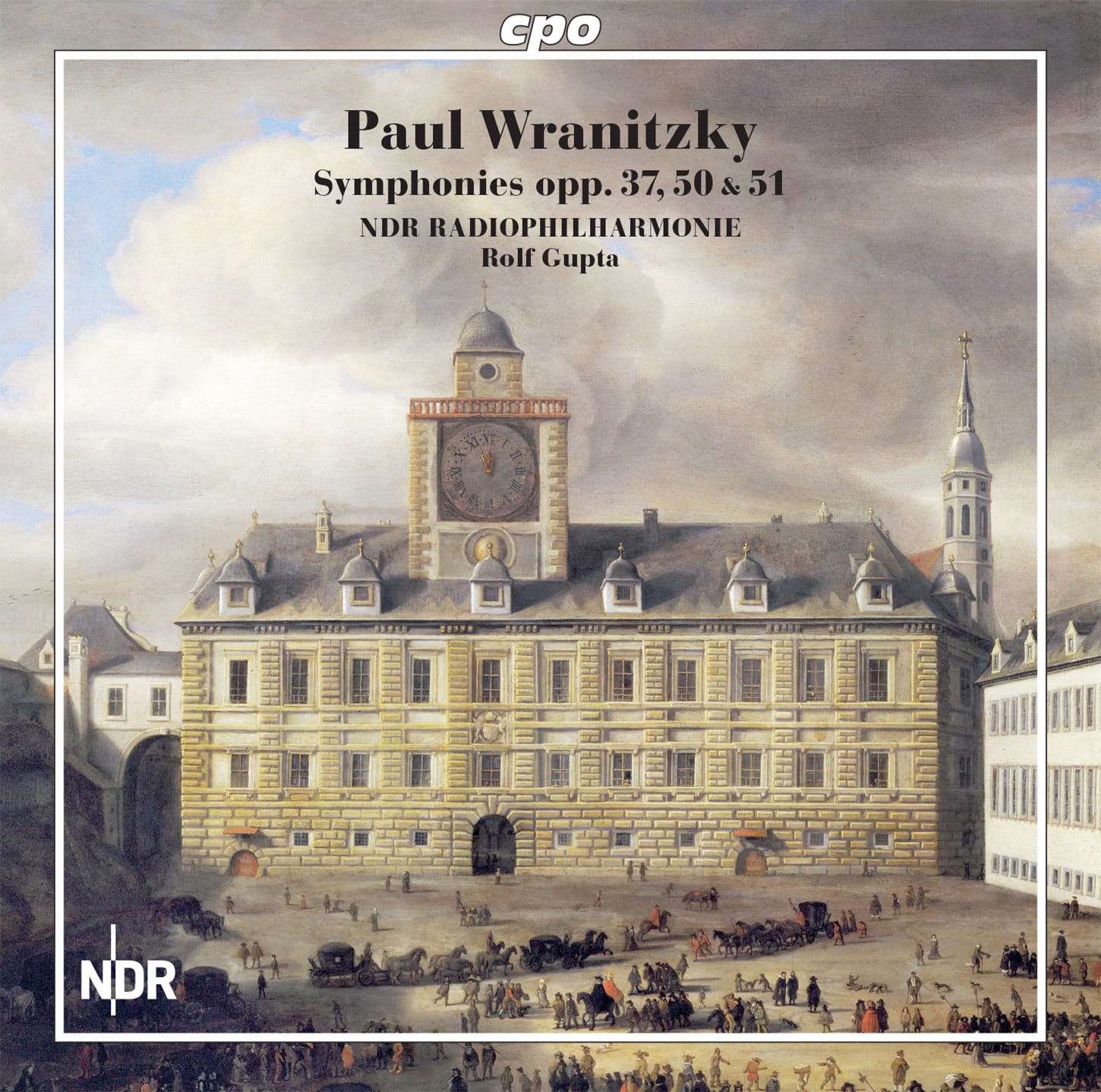
This is Classical Explorer‘s seventh post on Wranitzky,by my count, from ballet (Das listinge Bauernmädchen), to music for plays, to various symphony releases.
We start with one of the late symphonic, Op. 50 in G-Major: according to current research, Paul Wranitzky composed at least 47 symphonies; Opp. 50 and 51 (which ends the disc) were published in late 1804 by Wranitzky’s main publisher, André, in Offenbach am Main.
While there is a Haydn model here (and Papa peeks out in the lighter moments) it is Beethoven whose shadow is greater in the first movement of Op. 50, both in the Poco Adagio opening and in the Allegro molto that follows. Nice to have the exposition repeat, too (2″41):
The Andante is t least initially, lighter, a Haydn/Beethoven hybrid perhaps. Or maybe, just pure Wraiitsky. The writing also reminds us of Wranitzky’s affinity for woodwind (and indeed horns):
The third movement offers more of the delicious woodwind writing (here, oboe is predominant in the Trio, a section marked in the score as “Alternativo”!). There is some some Beehovenian unpredictability around metic placement of tutti accents:
There’s a delight in the sheer accuracy of the NDR Radiophilhamonie Hamburg (The North German Radio Philharmonic, Hamburg), especially in their scalic work. This runs throughout the symphony, but seems particularly clear in the finale. Also, sections of this movement seem to me very close to he finale of Beethoven’s First Symphony:
The Symphony in D major, op. 37, was published by the same publisher in November 1799. Wanitzky’s use of material is interesting: thematic groups are not as clear-cut as in Beethoven, for example, with themes more malleable as to context and appearance. There are delights galore here,
…the Andante shows tendencies towards a Serenade; but it keeps on getting interrupted. Some lovely flute playing here, including a “Papageno” phrase-end on the flute that is n unmissable reference to Mozart’s Zauberflöte:
The third movement pre-dates Beethoven’s conversion of the Menuet into Scherzo: it has a distinctly fiery underbelly (the Menuetto is actually marked, “Presto”):
The finale is an ideal Haydn/Beethoven hybrid (link to YouTube), with moments of contrasts provided via a variant on the main theme. Again, some lovely woodwind moments (listen out for flute answered by a pair of bassoons bout two minutes in). the end is all trumpets, duos and valiant grandeur.
Finally, the A-Major Symphony, Op. 51, with nicely resonant series of chord at the opening, sliver of an Introduction (adagio,, a mere five bars). The Allegro molto vivace, though, is pure delight, horns popping away up high, strings jubilant. Perhaps the close feels a little sudden in this pefomance
The Andante is pure joy though, as the booklet notes point out, this is Wranitzky’s closest proximity to Haydn, particularly in the musical tuttis with they ascending phrase mound-offs. Some more beautiful oboe playing here, plus some internal sting figuration that is just perfectly nuanced by the NDR orchestra:
There is a concision to the writing of both the Allegretto third movement (whose Trio is pure delight), and the finale. Th Menuetto has lots of fun with acciccaturas; the finale holds its outrageous patch of scoring in is pocket until the very end:
Ralf Gupta brings out the best of the Hamburg orchestra; the recoding itself is simply superb. One of the best Wranitzky discs available.
The Amazon link is here; iDagio link here, Other streaming below:
This lovely disc is available at Amazon here.