


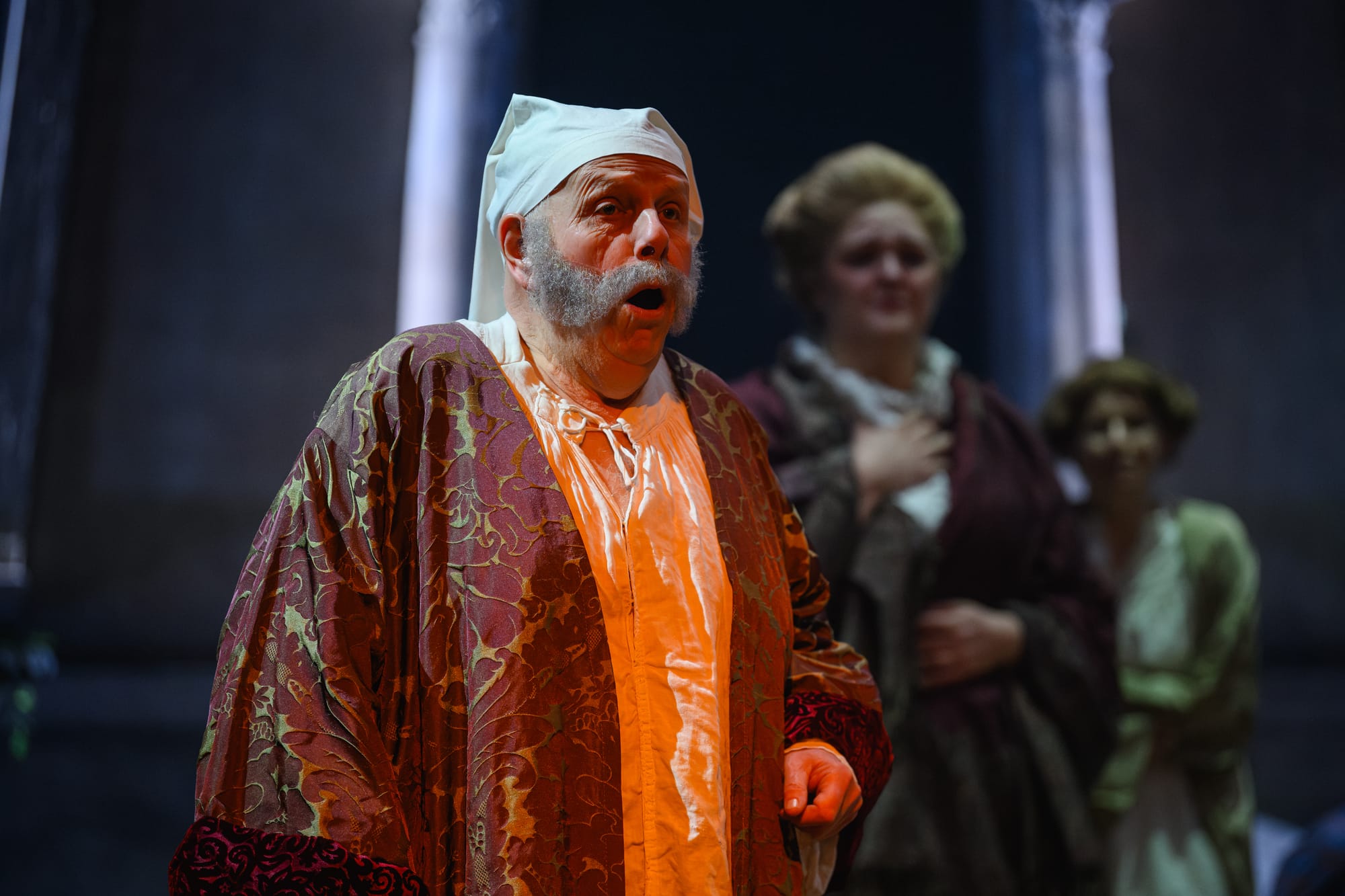
Owen Wingrave
Music: Benjamin Britten
Libretto: Myfanwy Piper, adapted from a story by Henry James
Cast and Production Staff:
Owen Wingave – Redmond Sanders; General Sir Philip – Adrian Thompson; Miss Wingrave – Avery Lafrentz; Mrs Coyle – Seohyun Go; Mr Coyle – Olver Williams; Mrs Julian – Manon Ogwen Parry; Kate Julian – Gabriella Giulita Noble; Lechmere – Tobias Sampos Santiaque
Director – Martin Lloyd-Evans; Set Designer – Laura Jane Stanfield; Costume Designer – Katie Higgins; Lighting – Zoe Ritchie; Video Designer – Kamila Przybylski.
Silk Street Theatre, Guildhall School of Music & Drama, 25 February 2026
The most famous result of collaboration between Benjamin Britten and Myfanwy Piper is The Turn of the Screw (1954), arguably Britten’s most successful opera and surely the one in which he experimented with musical process the most. Then there is Death in Venice (1973), a late masterpiece. In between (in temporal terms, very close to Death in Venice) came Owen Wingave (Op. 85, 1971). Both The Turn of the Screw and Owen Wingrave take Henry James as their starting point (Death in Venice is Thomas Mann); there is surely a non-coincidence verbal echo: Screw offers “a curious story‘”; Mrs Coyle, in Act 1 Scene 5 of Wingrave, speaks of “a curious heritage’.
But The Turn of the Screw is a far better piece than Wingrave. Britten’s late pacifist opera seems rather non-descript, particularly in regard to the vocal lines, while musically it seems like Britten raids his arsenal of stock gestures and in doing so inspired a multiplicity of gray operas from across the Pond. None of this is to detract from the excellence of the Guildhall performance, both vocally and instrumentally. The piece was heard in the reduced orchestration by David Matthews, who himself had assisted Britten from 1966-70, and who, with his brother Colin, helped with the original full score. The chamber version was premiered in 2007 at the Linbury Studio. There are 15 players (single woodwind, horn, trumpet – lots of military fanfares – trombone, two percussionists, piano, and string quartet) which in itself aligns the score with Screw (and, indeed, Albert Herring, recently seen at ENO: review). The confident strong contributions of leader Daisy Elliott were particularly noteworthy.
Set in 19th-Century England (identifiably so via Katie Higgins‘ carefully considered and beautifully realised costumes) at the Wingrave family’s estate, Paramore, we find the anti-war young Owen Wingrave in opposition to the rest of his family, which boasts a rich military history. So, like Peter Grimes, we have an outcast; Wingrave is set against his grandfather, General Sir Philip, his aunt (‘Miss Wingrave’) and his cousin Kate, who calls him coward and dares him to stay the night in a room haunted by a homicidal Wingrave ghost. Kate locks him in; Owen is later found dead.
Atmosphere is all, and credit to Laura Jane Stanfield for perfectly judged sets, perspectives occasionally askew to suggest tangential takes on reality, and Zoë Ritchie’s lighting, all enhanced by Kamila Przybylski’s video designs, skillful, spooky, and perfectly judged. The whole is overseen by director Martin Lloyd-Evans, who conveys story and atmosphere well. Stage transformations, too, are as slick as can be, from the classroom of the opening to the outside of the family dwelling.
It was an interesting idea to cast the experienced Adrian Thompson as General Sir Philip; many will already know Thompson’s recording of the Britten Op. 31 Serenade with another Thompson (Michael) on horn and the Bournemouth Sinfonietta under David Lloyd-Jones, a sterling account. The recording cannot however show Thompson’s stage presence, though, something very much in evidence here. He absolutely commanded the stage, completely at one with his character: a rather cardboard character, perhaps, but Sir Philip is not alone in that in this opera. And if anything he was outshone by the titular conscientious objector, Redmond Saunders, looking pretty obviously the right age (not always the case in opera!) and offering a voice of flexibility in tandem with superb acting ability. The titular part is remarkably agile, and Sanders has technique in spades. His similar-age opposite, Lechmere, was the incredibly energetic (and fine-voiced) Tobias Campos Santinaque, made quite the impression, too (I wish I had a fraction of that energy!). Avery Lafrenz was a powerful Miss Wingrave, almost intimidating at times.
The part of Mr (Spencer) Coyle, the military tutor, was taken with authority by Oliver Williams. Mrs Coyle is something of a maternal substitute to Owen; that sensitivity to both Wingrave and the fate of the estate was beautifully conveyed by Seohyun Go (who won the Guildhall Gold Medal last year (Classical Explorer was there); Parry and Sanders were also finalists – interestingly, as on that occasion it was Sanders who got my vote).
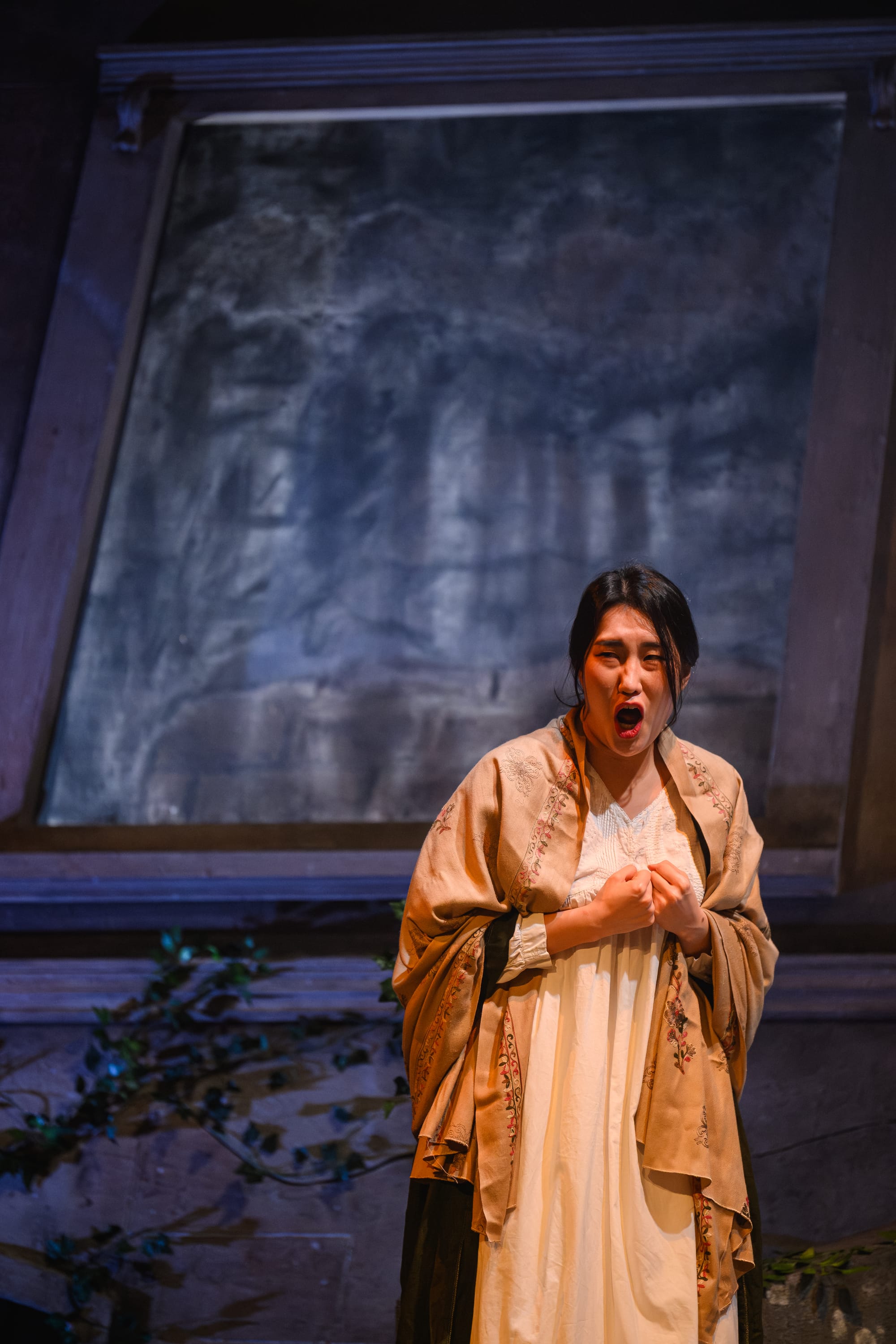
Mezzo Manon Ogwen Parry was a strong Mrs Julian in the second act. Kate Julian was persuasively sung and acted by Gabriella Giulietta Noble: along with Owen Wingrave himself, this character that drew me in the most.
It is a pleasure to report there was no weak link in the cast, though: Britten’s opera Owen Wingrave could not ask much more, and Dominic Wheeler’s experienced hand at the helm meant the score got its chance to shine. If the score itself is at best an ‘almost, but not quite,’ the performance was anything but. There is huge skill involved in this production, from the ground up. Not to mention some singers vey definitely worth watching.
© Photos by David Monteith-Hodge
Here’s a link to the Britten performance on YouTube (as playlist, hence the hyperlink).
The Hickox/Chandos recoding of this (the best modern one) is available at Amazon here, while this eight-CD set for £17.95 offers the composer conducing Wingrave, Budd, Herring, and Grimes. And here’s the iDagio link.