
Tansy Davies
The Passion of Mary Magdalene (2025)
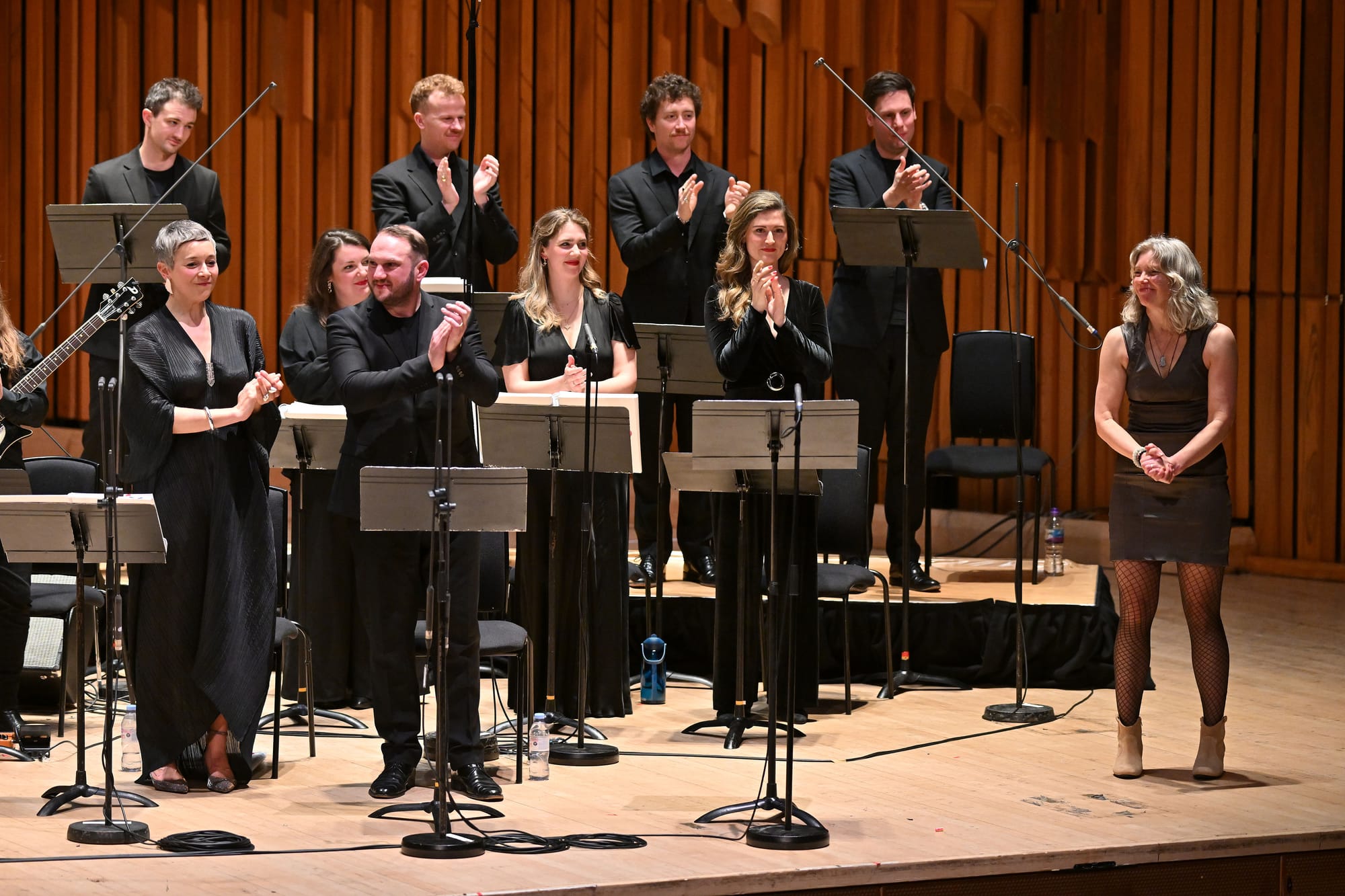
Anna Dennis Mary Magdalene; Markus Farnsworth Jesus; Dunedin Consort, John But (director)
Barbican Hall, London, 24 March, 2026
Tansy Davies’ works rarely fail to simulate: her opera Between Worlds focused on the Twin Towers attack, which I described at the time as ‘a personal triumph,’ while works such as Forest and Re-greening (given at Festival Hall in 2017, Philhamonia/Salonen and the National Youth Orchestra Prom, 2015, respectively) attest to a composer attuned to Nature. She is certainly not afraid to take on challenges: one such is Davies’ own take on the Gospel of Mary, heard alongside settings of poetry by Ruth Fainlight.
Co-commissioned by the Barbican, Dunedin Consort and the Edinburgh Festival (where it will be heard on August 8), The Passion of Mary Magdalene (2025) is divided to seven ‘climates”. That term seems not to be explained by Davies, but I assume refers back to the Byzantine tradition, which organises Holy Week services into a series of ‘climates’ (turning points in the narrative), also referred to as the rather more familiar ‘stations’. It is surely no coincidence that the number seven suffuses Christian writing (from seven days to the sevens of Relevation: the seven churches, seals, trumpets of the Apocalypse, bowls of wrath …). Mary Magdalene was a follower of Jesus and a witness (the ‘Holy Prostitute’ is a later accretion); again surely not coincidentally, she had seven ‘demons’ cast out of her by Jesus, as told in Luke. The carefully-constructed text seems to take a Christianist stance on Demons: it refers to Beelzebub as ‘the prince of demons,’ whereas modern Occultism sees Him as part of yet another seven: the Seven Princes of Hell, alongside Lucifer, Mammon, Asmodeus, Leviathan, Satan and Belphegor.
Davies underlines the intimacy of Mary Magdalene with the Nazarene prophet via the washing of Jesus’ feet with her hair with clear, and beautiful, sensuality. A Sophia Oracle of three female singers acts as Greek Chorus, characterised by a sense of ritualistic rhythmic unison (Ana Beard Fernandez, Sarah Anne Champion, Rosie Parker). This, coupled with sometimes asynchronous harpsichord pulsings, offers a hypnotic sense of wonder. Here is Davies’ Norns, her Fates (in the sense of the Latin ‘fatum,’ or ‘Divine utterance,’ or the Will of a God), her Moiræ. The parallel of the ‘Greekl chorus”with the function of the chorus in Bach’s Passions is clear, but Davies’ way is quieter. No less potent, though.
The two vocal soloists were exceptional. Marcus Farnsworth was Jesus, first found, after the Sophia Oracle’s Prologue, in dialogue with a Demon (the excellent counter-tenor Tom Lilburn). The Demon asks Jesus’ intentions (‘What are you doing here, Nazarene?’). ‘Shut up!’ is Jesus’ emphatic riposte, Farnsworth commanding from the first. He has the natural authority the part demands, presenting Jesus/Yeshua as both seer and Demon-slayer. Perhaps his finest moment was in partnership with viola player John Crockatt in the Seventh Climate (‘Sometimes the boulder is rolled away’; text from Fainlight’s The Angel), a moment of exquisite power as Jesus asks if he will ‘ever see the angel’s face’. Davies’ demands are many, and Farnsworth absolutely inhabited the role.
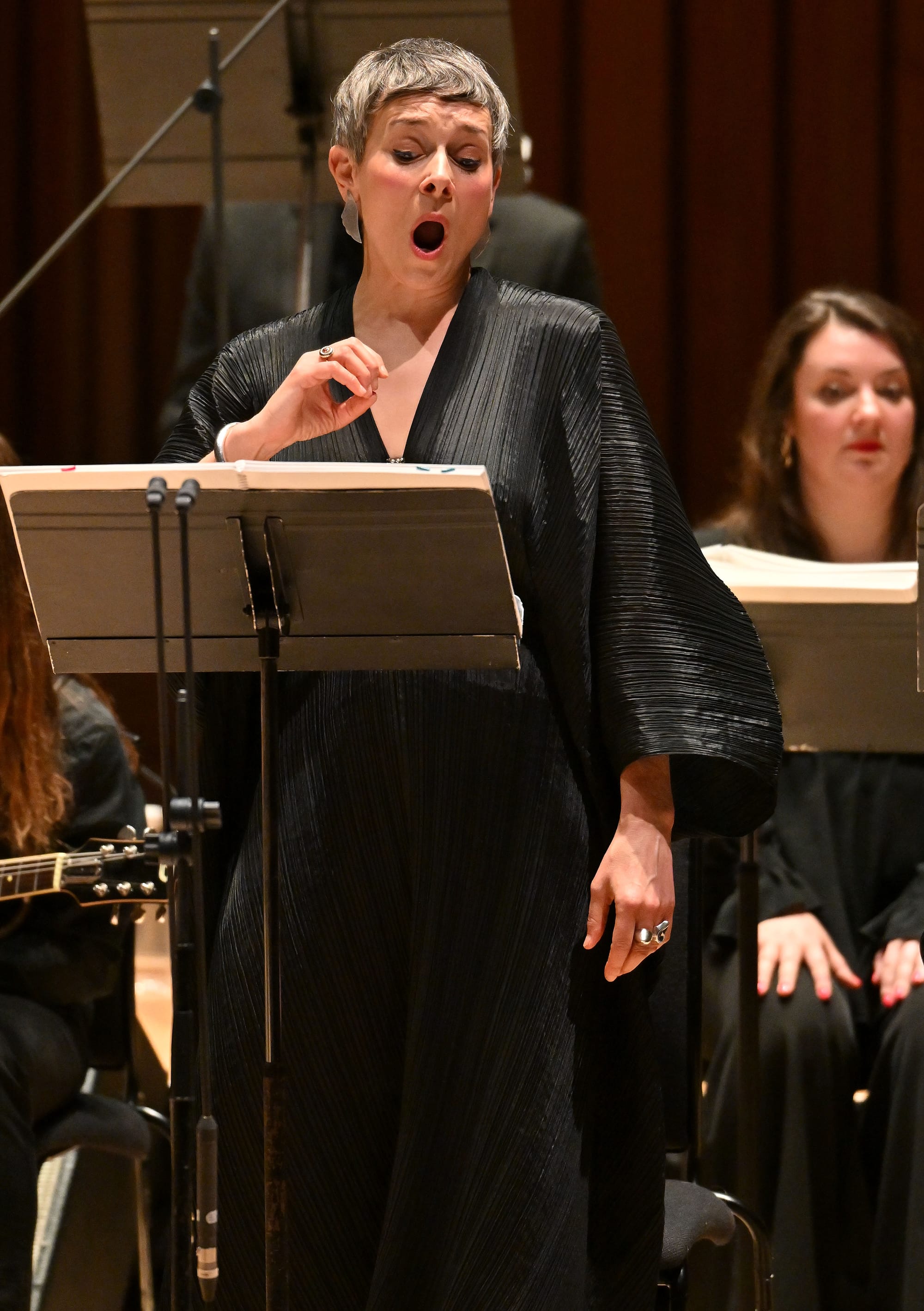
But it was Anna Dennis who offered the performance high point: her ‘Jesus, how much I love / Your beautiful body’ in the Fourth Climate (entitled, ‘Sex, feast and betrayal’) was positively seraphic, underpinned by strings perfectly balanced by the Dunedin Consort’s director, John Butt. Davies’ setting of this passage (words from Fainlight’s itself utterly magnificent, transcendentally beautiful FLESH and BLOOD, 2006) is luminescent. Dennis’s first entrance (‘I who was driven mad and cast out / from the walls of Syrian Babylon,’ text Fainright’s The Hebrew Sibyl) was so utterly pure of voice. Both leads delivered Davies’ angular writing as if it were the most natural thing in the world.
Prime, though, is Davies’ use of her instrumental forces, a Baroque ensemble bolstered by eclectic guitar (Sjors Van Der Mark), a Janus-headed ensemble looking backwards to the Baroque and forwards to the music of today and beyond. Davies’ scoring was more than deft: it peeled away layers of the text, a light shining beneath the words. There was use of dramatic gesture, but it always had its place in the grand scheme; and the us of period sonory is genius (the piece may alternatively be performed on modern instruments, too)/
Mary Magdalene’s life journey was not an easy one, what with those seven Demons and all, but cast as a light bearer of the Divine Feminine she has huge lessons for us all, right now. Tansy Davies implicitly offers Mary Magdalene’s own resurrection within today’s collective consciousness. Davies is right in her short booklet note to trace the Magdalene story back to Ancient Egypt and Isiis/Osiris; the messages this Mary brings, often coded, transcend traditional doctrinal limitations, while Davies’ own setting references known Passion templates while simultaneously destabilising them. From any perspective, I would suggest, this is required listening; it is more than a bonus that Davies’ music is both infinitely profound, and soul-meltingly beautiful. And at a time of global destabilisation, we need such a nexus of empowerment, transcendental truths, and a reminder that all of us, male or female by birth, should listen to the Divine Feminine within us. To hear it in a performance of such laser focus under Butt’s direction, itself a model of clarity, was a treat indeed.
Photos © Mark Allen


%201280x720.png?w=160&resize=160,160&ssl=1 "The Continuo Foundation awards £108,000 in its 12th round of grants")