
Graupner Lobet den Herrn, alle Heiden, GWV 113/23b
Rolle Lukas-Passion: Es wurden aber auch; Verdammliche Bosheit.
Kauffmann O ich elender Mensch, wer wird mich erlösen?
Telemann Ich muß auf dem Bergen weinen und heulen, TWV 1:851
Fasch Concerto for Flute and Oboe
Bach Du wahrer Gott und Davids Sohn, BWV 23
Such a cornucopia of talent on display here. The race for the post of Thomaskantor in Leipzig following the death of Johann Kuhnau (1660-1722) was a closely-fought one. Telemann was actually offered the post but decided to stay in Hamburg (maybe I shouldn’t spoil the outcome …) . Then Graupner was offered the post, but his employer in Darmstadt would not release him … finally, in Bronze position, Bach took it up. The rest, as they say, is history.
This is an idea that has already found its way to disc on Leipzig 1723, but to hear this realisation was nothing short of spectacular. The line-up of soloists could hardly be bettered today, and the members of the Academy of Ancient Music were clearly inspired by the occasion.
Christoph Graupner (1683-1760) has already fuelled a couple of Classical Explorer posts: Easter Cantatas and the opera, Antiochus und Stratonica, plus a disc of solo and “dialogue” cantatas on cpo. The Graupner cantata, heard first, was the highlight of the evening (sorry, JSB), while the excerpts from Rolle’s St Luke Passion had me wondering whether there is an alternative universe somewhere that has Rolle’s piece, not Bach’s St Matthew Passion, performed at Easter? Would that be such a bad thing? Very Sliding Doors … speculation, holes in history: either obstacles, or fuel for the curious. Most definitely the latter here.
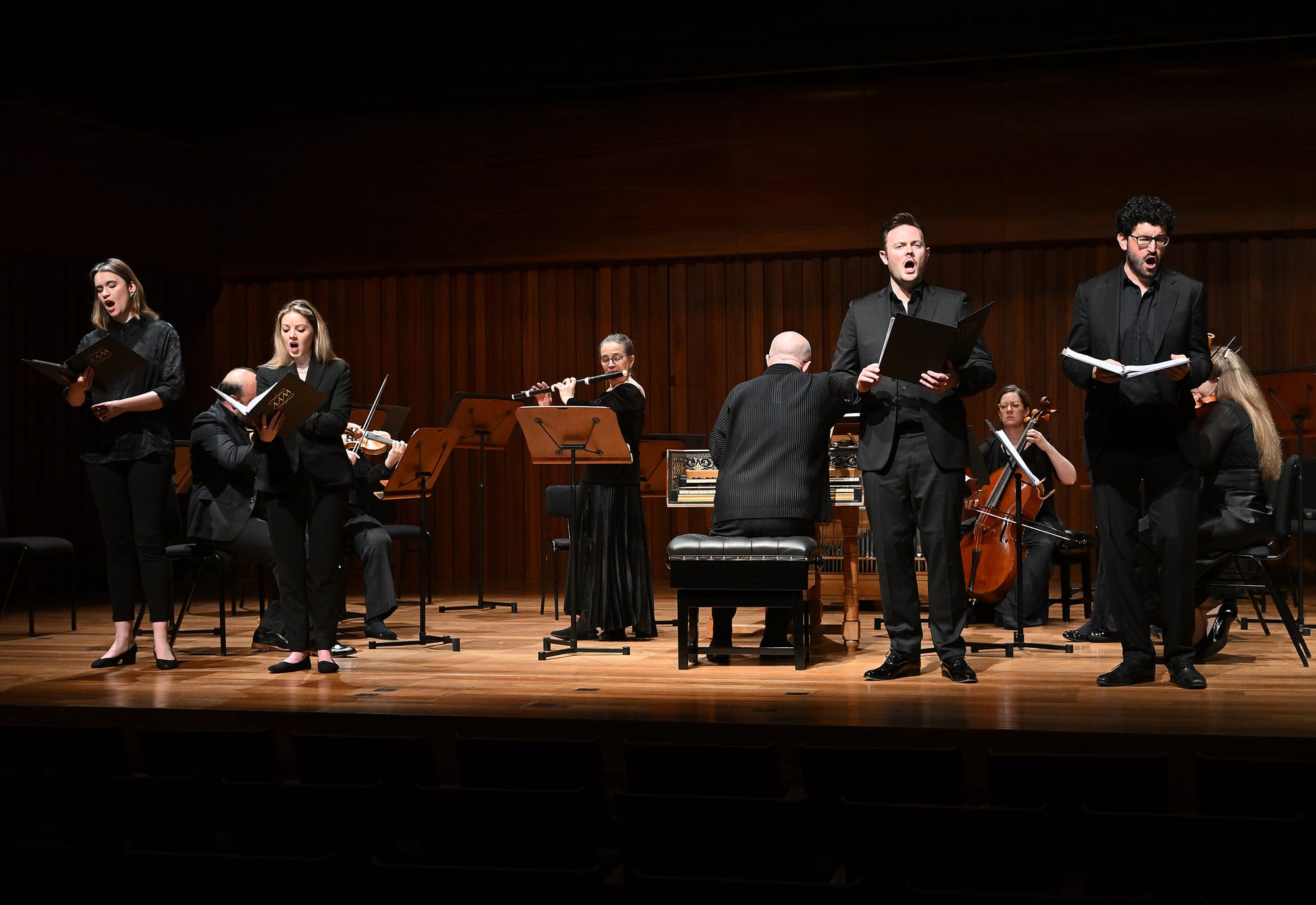
Choruses were taken throughout by the soloists as a group which tends to add intimacy to performances; all credit to our four for offering such a convincing case for this strategy.
Graupner’s audition took place on the Second Sunday after Epiphany (January 17, 1723). The opening chorus of the luxuriantly-scored cantata, Lobet den Herrn, alle Heiden, opened in a blaze of colour, trumpets and drums, at Milton Court, packing a real punch. Graupner’s fugato was clearly on display in this opening chorus. He pairs his soloists (soprano with alto; tenor with bass), the quietness and proximity of intervals offering a pleading vulnerability in the second section (‘Denn seine Gnade und Wahrheit’; For his mercy and truth) before offering other soloistic combinations and a blissfully polyphonic Alleluia. He should have got the job on this ending alone.
Here’s Capella Jenensis, on the above-mentioned disc:
Helen Charlston, very much a known and loved quantity (Dido; with Florilegium at Wigmore Hall; , offered a perfect mix of line, dramatic awareness and perfect diction throughout: her recitative, ‘So fast gläubt Sulamith’ (Thus firmly does the Sholamite), offering particular emotional weight to ‘Kein Unfall kann ihr schaden’ (no calamity can harm her). How effective, too, Graupner’s interjection for “chorus” (In all distress and suffering / she finds rest in the bosom of his mercy).
Again, here’s the recording:
Graupner’s gift to Charlston was an aria with oboe obbligato (Leo Duarte), “Ein Christ, der Christum liebet” (A Christian who loves Christ). Fine though Duarte’s contribution was, it was Charlston’s melismas that impressed, delivered with such seeming ease. And her approach to the aria’s final resolving note was perfectly judged.
Nick Pritchard is no stranger to Baroque music of the church, and of evangelists; again, fine diction here, coupled with a notably bright upper register. Graupner’s genius comes forth again in the tenor aria, ‘Gleich wie die Waage wanket’ (As a weighing balance tilts), an infectiously jaunty number garlanded by a pair of oboes (Duarte and Lars Henriksson). Intriguingly, Graupner uses the upper strings as the bass line on occasion here; as a result the texture seems to lighten.
Ben Kazez is the soloist least familiar to me, but his voice is perfect for this repertoire, firm but focused. Graupner’s link between the recitative ‘Wohl dem der sich in allein’ (Blessed is the man who entrusts) and the aria ‘Auf! Suchet zu empfangen’ (Up! seek to receive) was unutterably sleek, and the repetition of “kann wieter nichts” (can desire nothing further) was perfectly judged, both by Graupner and Kazez. The final chorus, “Sei Seele, still und diene” (Soul, be still and serve) was absolutely radiant, the combined soloists taking the chorale while the orchestra referenced dance tropes all around.
Both Matthew and Luke Passions by Christian Friedrich Rolle have been released on the cpo label. From the Lukas-Passion, ‘Es wurden aber auch” (And there were also two other) and ‘Verdammliche Bosheit” (Condemnable weakness), which follow each other late on in the passion, after a chorale, “Wie heftig unsre Sünden,”. The recitative heard here was specifically Nick Pritchard in Evangelist mode, narrating the story perfectly, with Kazez as Jesus (the famous line, ‘Father , forgive them, for they know not what they do,’ set in a remarkably Bachian style by Rolle). Skipping a chorus, the text here led straight to the soprano aria, “Verdammliche Bosheit” in a performance that, from the orchestra, was near-operatic. Cummings judged the contrast between the outgoing opening and the triple-time, slower and gentler ‘Doch ich selbst, unschuldi’s Lamm’ (But I myself, innocent Lamb) before drama returns with mention of ‘Zittern und Zagen’ (trembling and shaming). Pierce’s upper register is perfectly clean, but not sharp-sounding. In isolation, though, the aria has an underwhelming ending (designed to lead straight into a Recitative and Arioso in the Passion, is why).
It was good to hear Rowan Pierce again: she has previously impressed in Our Mother at Stone’s Nest, Purcell’s King Arthur, and Zauberflöte at Covent Garden, amongst others.
The complete sacred works of Georg Friedrich Kauffmann (1679-1735) fit on one compact disc, but it would appear the one that needed to count, didn’t. At least, not as far as the Burghers of Leipzig were concerned: but what beauty in the opening aria of the cantata, ‘O ich elender Mensch’ (O wretched man), the music heavy yet beautiful, a pair of oboes dialoguing with violin while Helen Charlston intoned her woe. ‘Who will redeem me from the body of this death?’ is the question she subsequently asks, Charlston gifting us a perfect vocal trill in the process.
Here’s the performance from the cpo recording of that movement:
Conductor: Michael Schönheit Orchestra: Merseburger Hofmusik
Although there is a bass solo component to Kauffmann’s cantata, it is the alto who dominates. Kauffmann is not to be rushed: the ensuing recitative (alto) unfolds completely in its own time, Charlston’s lines, sometimes melismatic, stunningly beautiful. This is followed by an aria and chorale garlanded by two recorders and bassoon. In fairness to the jury, this does sound like an exercise in which Kauffmann threw everything into the mix; nice that he unites alto and bass in the next recitative, alternating pairs of lines before a bass aria, “Die Gerechten werden weggerafft für dein Ungluck” (The righteous will be swept away from misfortune). Kazez was beyond criticism, but the harmonies here felt rather dull, frankly. In purest demonstration of how a performance can rescue a piece, Charlston’s entry in the ensuing shared recitative was radiant, and the final “Choral” for alto, bass, oboe and trombones (hidden away there at the back) was so beautiful.
It does seem strange how the opening of this cantata is so impressive and yet not so much in its latter stages. Small wonder, then, that the job was not to be his ….
Performed with strings, organ and bassoon with obbligato flute, Telemann’s Ich muß auf den Bergen weinen und heulen (I will weep and wait for the mountains) is like so much Telemann: cleanly written, beautiful, fluent; and then he hits you with a sudden twist (here on the word ‘klagen’ – to lament). There is more than a hint of a minuet about this first aria (and another use of upper strings offering a bassline, curiously). The tenor-accompanied recitative had the AAM strings moving between halo and harmonic scythe; and how special Pritchard made the phrase “sein Tempel war”.
Telemann makes us feel the burden in the bass aria “Gott ist ein rechter Richter” (God is a righteous judge). The lower registers are just so busy in this aria, as if the light cannot get a look in; balancing this, the soprano aria with flute obbligato, “Des Himmels Longmuth dauert lange” (Heaven’s long suffering endures). Pierce can fling out the highest notes, beyond doubt, her tone positively glistening, balancing the warmer flute of Rachel Brown; even more impressive was Telemann’s shard-sharp staccatos in strings, the mobile flute and glorious melody of the soprano aria, ‘Ja Sodom muß sich selbst verdammen’ (Indeed, Sodom must condemn herself)
Perhaps it is the juxtaposition of two long recitatives in this cantata, one for tenor, one for alto, that persuaded me Charlston is the finer, more involving musician. But when all four singers came together in the final Chorale, the effect was perfect. Telemann’s piece really is genius: to think, this is the 851st entry in just this volume of the Telemann catalogue! (TWV I:851).
Here’s a performance by Cappella Jenensis again, with rolling score:
Soprano: Isabel Schicketanz; Alto: Stefan Kunath; Tenor: Florian Sievers; Bass: Martin Schicketanz Ælbgut Capella Jenensis
Johann Friedrich Fasch (1688-1758) needs more performances. His B minor concerto acted as interlude, with Duarte and Brown as fine soloists. No doubting the minor mode of the first movement; and what a sense of conversation there was between the two soloists. And how rapid the lower instruments at times, too. A Largo contained lovely, shaded violin lines, and the entry of the flute was just entirely natural. Chamber music at its finest. The finale, an Allegro, was fascinating, firstly from a technical level (how they can play together so fast) and then on a compositional one: Fasch’s use of drone. A fabulous piece; much more than a palette-cleanser.
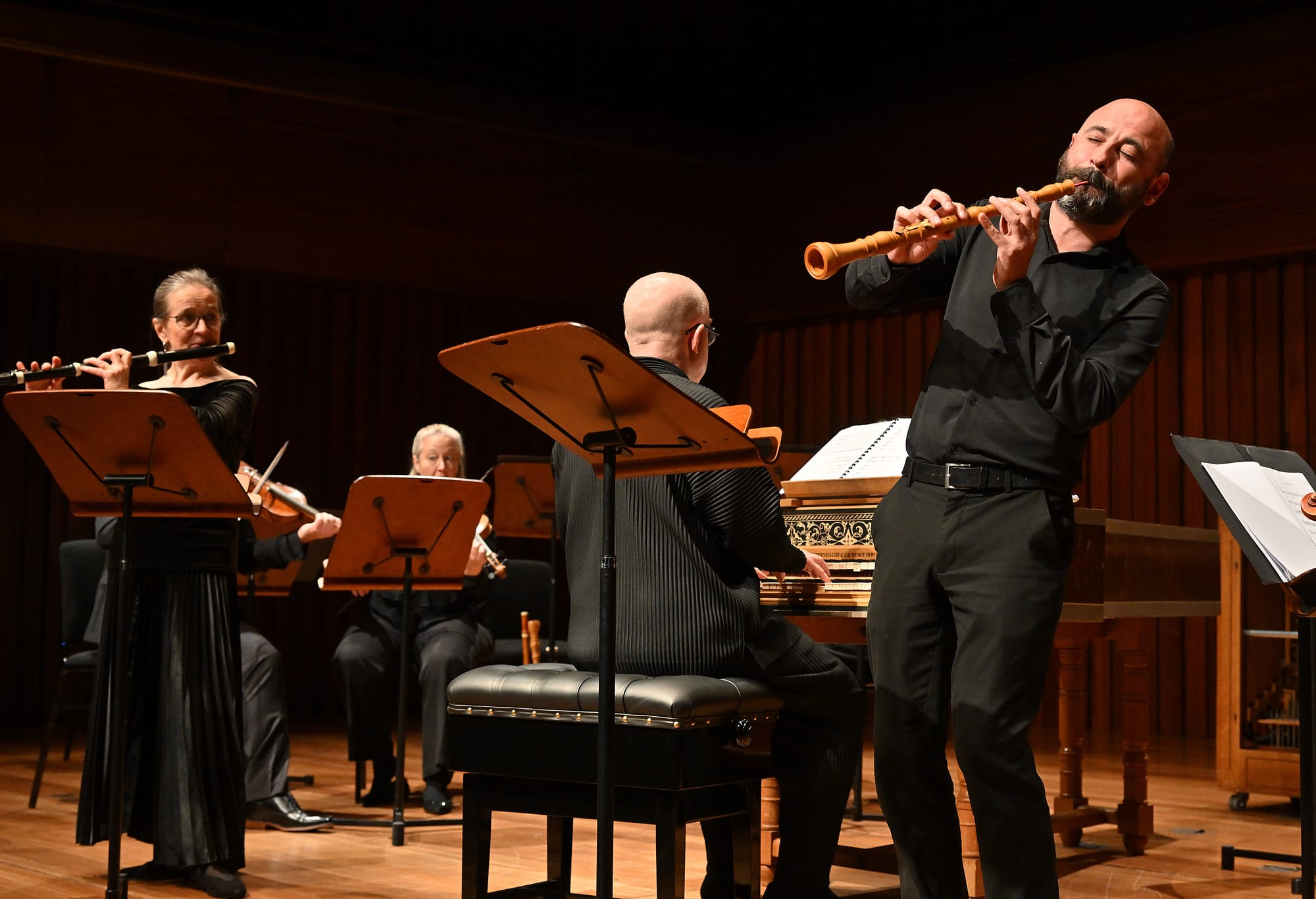
Johann Friedrich Fasch (1688-1758) needs more performances. His B minor concerto acted as interlude, with Duarte and Brown as fine soloists. No doubting the minor mode of the first movement; and what a sense of conversation there was between the two soloists. And how rapid the lower instruments at times, too. A Largo contained lovely, shaded violin lines, and the entry of the flute was just entirely natural. Chamber music at its finest. The finale, an Allegro, was fascinating, firstly from a technical level (how they can play together so fast) and then on a compositional one: Fasch’s use of drone. A fabulous piece; much more than a palette-cleanser.
Finally, JSB himself, the Cantata, BWV 23, Du wahrer Gott und Davids Sohn (Thou true God and David’s son), performed along with BWV 22 as Bach’s test pieces (probably BWV 22 prior to the sermon, and BWV 23 after). Duets abound in the opening aria, for soprano and alto, but also for two oboes. The text is that for Quinquagesima Sunday, that of the blind man of Jericho and Jesus’ subsequent healing of him. Nice that this movement is also in B-minor, an Adagio. And in the subsequent tenor recitative, Bach proved he can do harmonic twists, too.
Certainly, there is no doubting we are in Bach’s manor. His stamp is everywhere, and the chorus that follows, ‘Aller Augen warten, Herr’ (All eyes wait, Lord) is one of expectant joy while including complex counterpoint along with obbligato oboe. The chorale is remarkable, strings and oboe in woeful alternation (Christ, lamb of God, is taking away the sins of the world). This is extraordinary music, for sure.
Here’s a performance by the Netherlands Bach Society:
Netherlands Bach Society Sigiswald Kuijken, violoncello da spalla and direction Miriam Feuersinger, soprano Damien Guillon, alto Wolfram Lattke, tenor Christian Immler, bass 0:00 Du Wahrer Gott (Aria) 7:19 Ach! Gehe nicht vorüber (Recitativ) 8:43 Aller Augen warten, Herr (Chorus) 14:03 Christe, du Lamm Gottes (Chorale)
The AAM was almost flawless throughout under Cummings; the soloists were absolutely top flight.
So did the right man win? Graupner makes me doubt the outcome, and Rolle makes my mouth water at what might have been. Telemann is, was, and ever shall be, while Fasch, who applied in the first instance but who instead took up a position in Zerbst, where he was to remain, remains as entertaining as ever.
Bach wasn’t even their first choice, anyway ….
Photos © Mark Allen


.jpg?w=160&resize=160,160&ssl=1 "Only love can bear the burden of truth: Ben Parry & Garth Bardsley on their new opera that premieres at Snape this Saturday")