
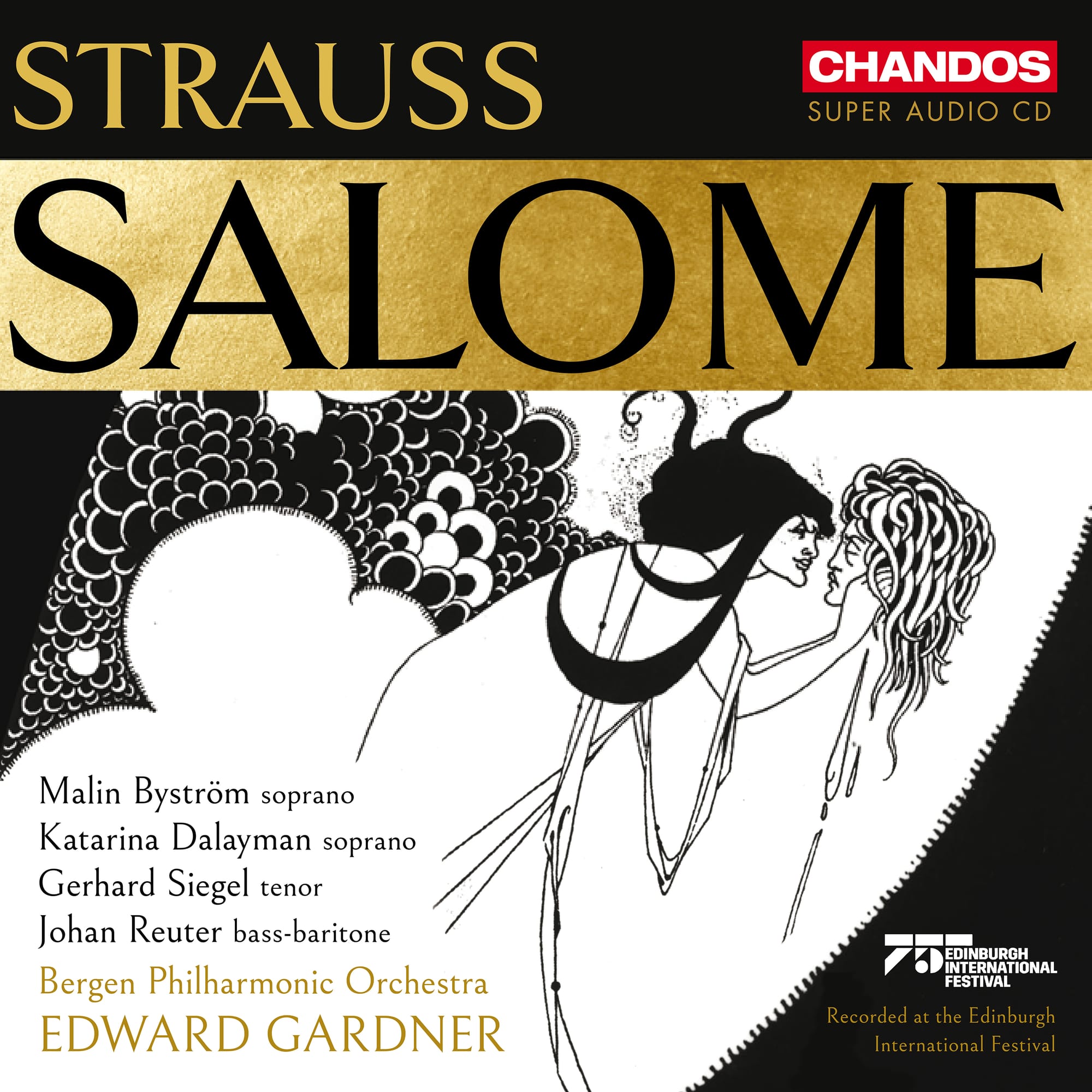
The East End Salome from Regents Opera recently complements Chandos’ releases of Salome and Elektra nicely. Salome today, Elektra to follow …
Conductor Edward Gardner realises the score in vivid colours – for him, the orchestra is the very heart of the experience. And how he realises Strauss’ injection of dance into the opera early on, as if paving a way to the final “Dance of the Seven Veils,” while the transition between scenes three and four is a Straussian tone-poem in itself; and the long scene between Herod and Herodias is, from the orchestra, positively kaleidoscopic. He also ensures the ensuing ensemble (those two, four Jews and First Nazarene) is spectacularly balanced and ideally paced – helped by the Chandos engineers – while Salome’s Dance is superb: how the oboe teases its phrases.
Amazing to think this is live (from the 2022 Edinburgh Festival).Every detail counts, from staccato bassoon against silky strings to harp flecks. Gardner ensures there is a dark undercurrent to the most vibrant waltz rhythm, while the very close of the opera is absolutely terrifying thanks to the Bergen players.
Gardner’s cast is perfectly chosen, right from the of the young Syrian Captain of the Guard Narraboth, tenor Bror Magnus Tødenes, the soldiers, and Herodes’ Page (mezzo Hanna Hipp).
Wonderful to have Malin Byström as Salome, a true Wagnerian soprano who absolutely lives Salome’s urges. (The synopsis in the light of Regents Opera did make me laugh: “Salome appears, eager to escape her stepfather’s birthday dinner” brought back memories of questions to the audience pre-opera “Have you seen Herod”?).
We previously met Byström as Tosca at Dutch National Opera in Barrie Kosky’s staging (pitted against Netrebko’s Tosca in this post), partnering Jonas Kaufmann in Puccini’s La fancuilla del West as part of the Sony disc, Love Affairs, while she shone in the 2019 Covent Garden Don Giovanni.
Byström’s voice isn’t just powerful, though: it contains a vortex of dark emotions. She does have the low register (although perhaps Kirsty Taylor-Stokes had a stronger low register). But how we believe Byström when she asks to touch Jochanaan’s body. her indefatigable vocal strength is key to her successful portrayal, the steely glint at the top remarkable. And how chilling is her final call for John’s head on a platter, and Gardner’s response:
Her great final monologue “Es ist kein Laut” (There is no sound) is breathtaking, beginning from near-silence and rising to palpable hysteria. And the opera’s final moments are breathtaking, Byström in full free flight, the orchestra on fire. Even the orchestral dissonant free-for-all after Herod’s “Man tòre dieses Weib!” (Kill this woman) makes sense, the very final gestures cruelly telling their own story of finality.
The perfect distancing of Jochanaan (who is down a well at the time) in the second scene is perfectly judged by the Chandos engineers. John the Baptist is sung by Copenhagen-born Johan Reuter, imposing from his first “Wo ist er?” (Where is he?). The combination of Byström, Reuter and Gardner is electric, Gardner responding to Strauss’ supreme scoring brilliantly: Salome’s music glints with a celestially seductive edge against the heaver statements of Jochanaan:
And just like we believe Salome’s lust via Byström, so we believe Reuter’s delivery of John the Baptist’s ripostes: “Tochter Sodoms” is a favourite (daughter of Sodom); and how Reuter’s voice reflects the inner glow of the momentous arrival of Jesus when he tells Salome to go and “seek him,” that “he isn a boat in the sea of Galillee, with his disciples, a passage that rises to a glowing climax at “throw thyself at His feet, and ask of Him the remission of your sins” (bücke dich an seinen Füßen, daß er dir deine Sünde vergebe,” a passage that ends in the ost remarkable synthesis of dissonance juxtaposed with shards of consonance, a descending line as if a ray from Heaven.
Tenor Gerhard Siegel is Herod (Herod Antipas, tetrarch of Judea, to give him his full title). His angst when he comes in search of Salome is palpable, tempered by his wife Herodias, here heard in luxury with Katarina Dalayman . With my thoughts on Wozzeck this weekend at Southbank, Herod’ musings on the moon stood out (Wie der Mond heute Nacht aussieht! Ist es nicht ein seltsames Bild?”; The moon has a strange look tonight …). Siegel is very believable, too, in his entreaties to Salome to dance for him (“Tanz für mich, Salome …”) and in his hallucination of the great “black bird” that hovers over his terrace. And yet, his ecstasy immediately post-dance doesn’t quite work …
Byström and Reuter, though, are one perfectly cast pair. Katarina Dalayman is perfectly imposing; and how effective the brief “duet” of Herodias and Jochanaan is one oft eh many highlights of this performance (it’s not quite a duet in the traditional sense, as John pontificates on Jesus, while Herodias simultaneously rails against Salome’s dance – too late, of course).
I do like Chandos’ translation: Jochanaan’s “Weiche von mir!” (scene 3), literally “Far from me” is translated with a Biblical slant as “Get thee behind me”. But is Salome the incarnation of Satan? Lilith, Queen of Harlots, perhaps?.
A remarkable recording – a new modern standard. for Salome Amazon listing is here. iDagio here, rest below.


%20Graham%20Boulton.jpeg?w=160&resize=160,160&ssl=1 "Celebrating John Joubert at Royal Birmingham Conservatoire in advance of his 2027 centenary")