


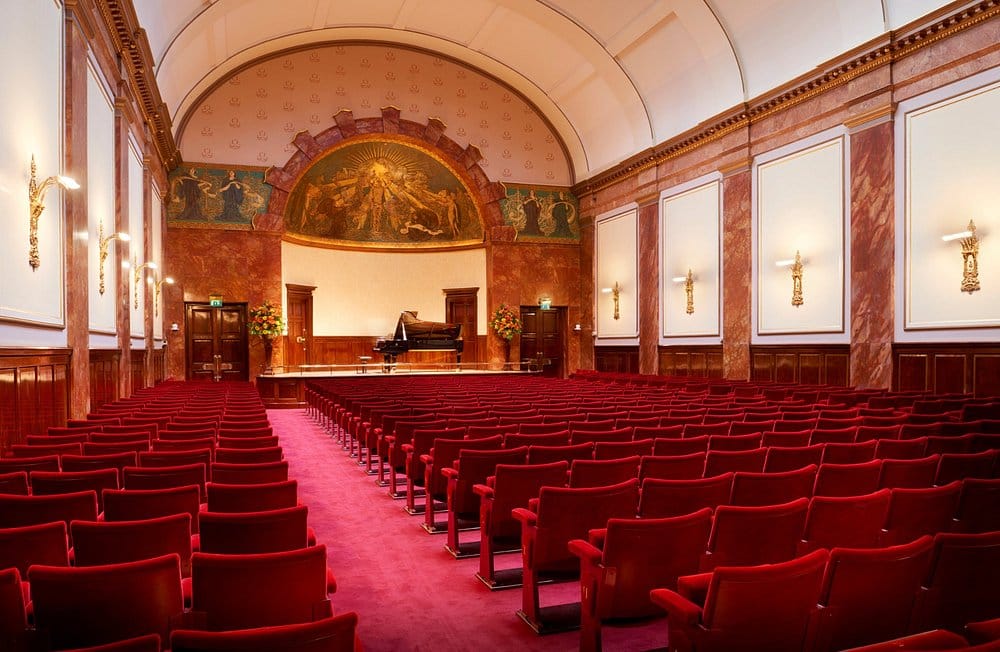
Happy “birth”- day to Wigmore Hall (inasmuch as bricks and mortar are birthed). On the hall’s actual 125th anniversary, it was Lise Davidsen and the equally astonishing collaborative pianist James Baillieu who did the honours: Schubert provided the dots.
‘Honours’ is the operative word: after the interval (free drinks for those that wished), John Gilhooly was presented with Honorary Membership of the Royal Philharmonic Society by HRH The Duke of Kent, KG. Wigmore Hall is a world-renowned institution of consistent excellence – I have literally lost count of the concerts I have heard there.
So how to celebrate? An all-Schubert programme makes perfect sense: Schubert Lieder (and indeed chamber music) has naturally been a constant throughout the Wigmore’s history. And Lise Davidsen is a huge name in the operatic firmament, while her Lieder activity also has a fine reputation: as her Live at the Met Decca release confirmed (again, with James Bailieu). Hearing such a massive voice in Wigmore Hall was always going to be interesting (I sat very near her once while she sang, and unless you’ve done that you probably have only a small idea of just how huge). The acoustic is a graveyard for many, especially pianists, it seems, who tend to over-project. And certainty, ther ewas the feeling that Davidsen’s voice was just too big. Here’s the rub: it was the quieter, more intimate songs where the magic lay. Perhaps not what one might expect, but when she went interior, time stopped,

The programme itself was brilliantly chosen: each half had a narrative song in which the singer has to carry the voices of various protagonists: Der Zwerg (The Dwarf) in the first half, Der Erlkönig (The Erlking) in the second. Nature, and its relation to the Divine (and therefore the Christian God) was Theseus’ thread. So many aspects of Schubert’s craft and Weltanschauung were here, from the echt-Romanticism of Goethe’s Wilhelm Meister to Gretchen and her spinning wheel (which together with Der Zwerg, formed a mini-group focused on obsessive love at different stages of maturation).
Streams, rivers, the movement of water (the element of emotion) are all part of the Romantics’ repository of images- and therefore Schubert’s core armoury, and that is exactly where the evening began: A setting of poetry by Franz von Schober (1796-1882), Am Bach im Frühling, D 361 (By the stream in Spring, sometimes, admittedly rarely, seen as Op. 198/1) of 1816, it opens gently (and how Baillieu can bring Schubert’s writing to life, offering a first-encounter freshness). There is a substantial change at the third stanza, which is more declamatory, beautifully done by Davidsen. Her voice is very present and focused, perfect for this song. Over to one of Schubert’s most famous songs, Ganymed, and one of the composer’s own favourite poets, Goethe. This was interesting: Baillieu seemed a touch heavy at he opening; yet Davidsen was surprisingly featherlight. How perfect Baillieu’s nightingale (‘Ruft drein die Nachtigall’ are the words: The nightingale calls out to me). I did miss some of the spiritual ecstasy of this song, though, and the closing ‘Alliebender Vater!’ lost some of its climactic import.
Matthaus von Collin (1779-1824) provided the text for the truly great song Der Zwerg (in my humble, as great as Erlkönig). This was the first of the obsession/jealousy songs, and Davidsen delineated the voices wonderfully. Schubert/von Collin announce the voice in words (‘er spricht’ – he speaks) and Davidsen was stunning. The detail Bailieu brought was equally impressive: the three quaver-anacrusis then downbeat was one moment ominous, one moment the strong arm of Fate. Complementing this was Margaret and her spinning wheel, Goethe’s Gretchen am Spinnrade, Baillieu perfectly even in his depiction of the wheel; and how well they both prepared and executed the shift to the light at ‘Sein hoher Gang, sein edler Gestalt’ (his proud bearing, his noble form). It was at the moment of that (imagined) kiss, though, that the acoustic issue made itself known: here’s a voice that fills the Met in New York easily (when I heard her at Covent Garden once I wondered if that space was too small for her!).
Clever that the close of that pair of songs enabled a breather for the musicians before returning for Goethe’s Mignons Gesang, Kennst du das Land (Mignon of Goethe’s Bildungsroman, Wilhelm Meisters Lehrjahre, published in 1795/6) and three songs from Schubert’s 1808 Gesänge aus Wilhelm Meister. Another example of just how effective Davidsen can be at the lower dynamic levels, how she cherished the echt-Romantic image of the land where lemons blossom (‘wo die Zitronen blühn’). Much less known, surely, is ‘Heiss mich nicht reden,’ the second of the 1826 Gesänge aus Wilhelm Meister, D 877, a song which took Davidsen to her lower reaches of her range (she worked with it well). The third song of that set, ‘So lasst mich scheinen’ (So let me seem) was characterised be a lovely sense of rocking, ongoing rhythm, enabled by Baillieu’s rock-solid rhythmic sense, over which Davidsen spun Schubert’s glorious melody, The performance was appropriately prayer-like, while the perfect alignment between pianist and singer (in that order) was writ large at the opening of ‘Nur wer die Sehnsucht kennt,’ the fourth song of the set, Davidsen perfectly reflecting Baillieu’s phrasing. Finally for the first half, Death meeting a maiden, another dialogue. Davidsen’s entreaty (‘I am still young, go, please go!’) was entirely believable, her Death as commanding as any Wagnerian Erda. What a way to close.
It is quite a way from there to Der Musensohn, with its frisky piano frolicking through fields and woods (as Goethe’s words tell us). The song was as it should be: breathless, full of vivacity. A lovely Luftpause in there, too, just before the last line. Another less familiar song is Lachen und Weinen (Laughter and Tears) of around 1823 (D 777), but in its lightness (and its loveliness) it was the perfect prolongation of Musensohn. Bailiieu’s way with the tricky decorations of the piano part was as nimble as can be. Suleika I is better known (and perhaps better known through its first line, ‘Was bedeutet die Bewegung?’; What does this stirring mean?). The curlicues in the piano were the perfect way into this glory: was Baillieu deliberately making parallels in the left hand between this and Der Zwerg? Given the careful programming here, probably. More intimacies from Davidsen before an imposing opening out.
Davidsen spoke of gratitude, of reminders of what we have in our lives. And, by extension, of their loss, of longing. Goethe’s Auf dem See is the poetic text for the song D 543 (1817), another song with a pronounced inter-stanza shift. Again, the house balked a touch at Davidsen’s decibel challenge, but how special to hear Davidsen and Baillieu in the gem Der blinde Knabe, again the height fo intimacy for thai song after Colley Cibber and translated into German by Craigher de Jachelutta. Baillieu it was who shone here, creating luminous miracles of texture over which Davidsen could float her music.
Du bist der Ruh’ , D 776 (Rückert, 1823: You are repose) is a miracle of so-called ‘simplicity’. The almost Mozartian piano part with its gentle movement was the perfect stage for Davidsen’s tale, Just one little bump at the beginning of a phrase, hardly anything to write home about; the song was the perfect contrast to the operatic scene (almost) that is Die Allmacht (D 852, 1825). Davidsen herself talked about this song’s ambition: it is almost an excerpt from Schubert’s Tannhäuser (there’s a thought). Worth noting, too, Baillieu’s rapid left-hand scales, the epitome of perfection.
Then, darkness fell. Not literally, but musically: Die junge Nonne (D 828, 1825), Baillieu offering fine cross-handed playing, Davidsen conspiring to create another drama as the protagonist nun finds peace from the trials and travails of life, culminating with the most heartfelt ‘Alleluia’.
So to Erlking. Interesting that Baillieu played the single octave with two hands with different fingers on each repetition. Here, Davidsen’s voices were perhaps less differentiated, but there was no missing the dramatic trajectory towards the child’s death. Fitting that a Litany on All Souls’ Day followed: Am Tage aller Seelen (D 343, 1816), offering blissful solace, hymnic and yet with the most perfectly free decorations.
And after all that, the perfect first encore, a hymn to music: An die Musik, D 547. And a perfect complement, in An der Natur, D 372.
The perfect celebration of Wigmore 125 in amongst a whole host of notable events. A memorable evening.
Schubert – Am Bach im Frühling, D 361; Ganymed, D 544; Der Zwerg, D 771; Gretchen am Spinnrade, D 118; Mignons Gesang, ‘Kennst du das Land?,’ D 321; Gesänge aus Wilhelm Meister, D 877: Heiss mich nicht reden; So lasst mich scheinen; Nur wer die Sehnsucht kennt. Der Tod und das Mädchen, D 531.
Der Musensohn, D 764. Lachen und Weinen, D 777. Suleika I, D 720. Auf dem See, D 543. Der blinde Knabe, D 833. Du bist die Ruh‘, D 776. Die Allmacht, D 852. Die junge Nonne, D 828. Erlkönig, D 328. Am Tagen aller Seelen, D 343.
Lise Davidsen (soprano); James Baillieu (piano).
Wigmore Hall, London, 31 May 2026