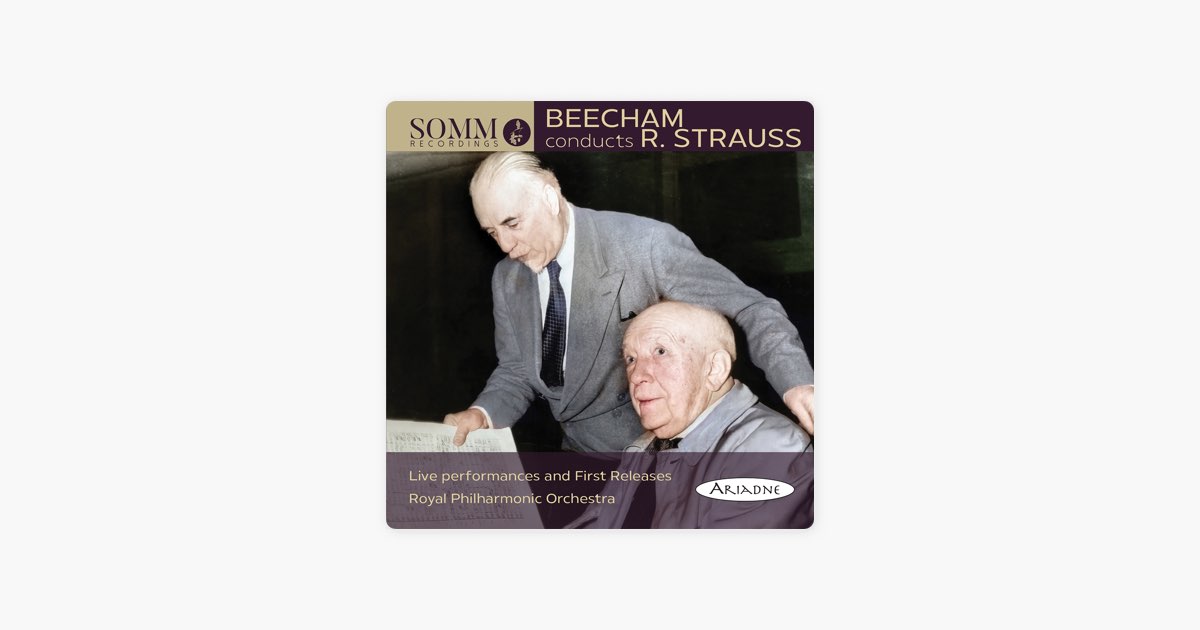

Macbeth, Op. 23 (1886-8) Richard Strauss’ first tone-poem, is not heard much. Norman del Mar devoted much space to it in his fine Strauss books, though, and that piqued my interest many, many years ago now. Good to hear this: Beecham’s enthusiastic rendition convinces us that Macbeth is absolutely worthy of our attention.
It does show signs of being something of a template: there is a Hero and a Heroine (Macbeth and Lady Macbeth), much as Strauss himself and his wife Pauline became the protagonists of Ein Heldenleben. Or perhaps that should be, anti-hero and anti-heroine. Beecham’s advocacy of Strauss’ music won him the approbation of the composer himself, and it is easy to hear why here. The Royal Philharmonic play like Gods for Beecham. Supporting this is the SOMM transfer by Lani Spahr of this live performance from the Royal Festival Hall in 1956. Beecham captures the youthful ardour of Strauss’ score to perfection:
Of course, in the catalogues, there is the Kempe Dresden performance (now on Warner, although I used the old EMI Classics box pressing), while Neeme Järvi makes a fine fist of it on Chandos, too:
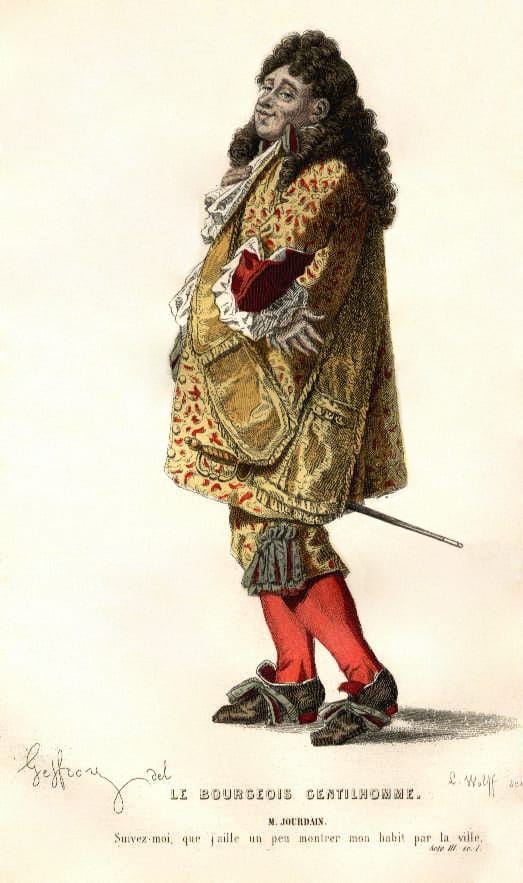
A sequence of six numbers from Le bourgeois gentillehomme, Op. 60 (1911-17) follows. We have seven of the nine sections. Hearing this is good for me: I remember as a youth tuning in to Radio 3 to hear the second piece on an orchestral concert relay. I figured the first, the Suite from Le bourgeois gentillehomme, was a mere prelude. Half an hour later I was still twiddling my thumbs, thinking that each movement was the last. So thanks to Sir Thomas for bringing me round to the charm of this piece, originally composed as incidental music to Molière’s play, which was coupled with an early version of Ariadne auf Naxos (the evening was too long and, to enable the opera to stand on its own, Strauss had to compose what we now know as the Prologue to explain the presence of the commedia dell’arte figures). the menuet is charming, The Fencing Master” brilliantly inventive and capricious:
How characterful the woodwind in the “Intermezzo,” how jolly the demeanour of “The Dinner”:
Nice that the booklet includes the personnel list for Macbeth, Gentilhomme and Salome: Alan Civil plays principal horn, Phillip Jones, principal trumpet, Jack Brymer, clarinet, and one Leonard Brain on oboe and heckelphone.
Good to have three Strauss favourites to complete the release: there is plenty of the dance to the final Gentilhomme movement (“The Dinner”), a tenuous link perhaps to the “Dance of the Seven Veils” from Salome. This, together with the incidental music and Macbeth, formed the first half of the RFH concert of October 17, 1956 (Heldenleben was in the second half). It is as slinky as one might hope. There is a tensile cord through this performance, which refuses to dwell unnecessarily and yet loses none of the lyricism of the long lines. The end is frenzied, yes, but disciplined, the applause immediate:
Don Juan, taken from a concert of January 18, 1955, is a beautifully nuanced performance as well as a powerful one. The more energetic sections are swift – propulsive, one might say – and all the more compelling for it:
It is the lyrical sections of that Don Juan that do resonate in the memory, though, despite the excellence of the horns’ great moments (they play so together – you can hear every note as it it were one player).
When it comes to Till Eulenspiegel, we are in core Beehcham territory: the wit, the shifts of emotion on a sixpence: the piece is almost cinematic. Taken from a concert on January 20, 1955, like Don Juan this was previously released by SOM and has been remastered for this release. The orchestra for Eulenspiegel is on world-beating form, the woodwind glinting, phrases bending in the wind. Beecham’s rubato is extraordinary, as is his complementary metrical discipline when required. The rhythmically tricky horn solo is exemplary (and its echo a third lower in third horn). A smashing performance, one of the finest available. What a sense of exhilaration there is towards the end. True, the recording highlights the timpani too much just before the scaffold section:
Warner was mentioned above: Warner Classics has released a huge Beecham box which is a treasure trove, but which includes Don Quixote, along with rarer items such as the suite from Die Bürger als Edelmann, Feuersnot Love Scene, and the “Träumerei am Kamin” from Intermezzo. We will return to this last, when we cover Naxos’ release of the whole of that opera from Berlin with Donald Runnicles conducting. Both SOMM and Warner are warmly welcomed. There is also a terrific “Dance of the Seven Veils,” RPO again but from September 1947 in a simply terrific remastering. And if you like Le bourgeois gentilhomme, you will 100% lap up the Edelmann suite, as light as a feather, while the hyoer-exultant “Liebesszene” from Feuersnot is the epitome of Strauss the true Romantic.
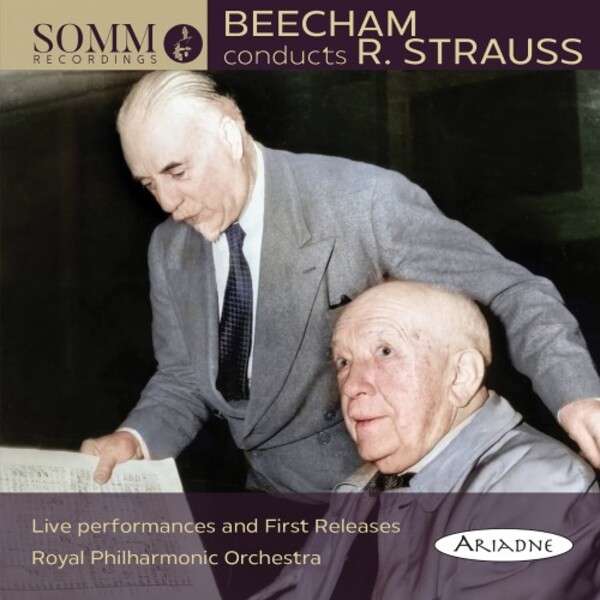
The SOMM disc is available on Amazon here, although Amazon seems to have got its knickers in a twist about the title of the listing; the Warner box here.