


Most recently seen in March in a stunning Tamerlano at Shorreditch Town Hall as part of the 2026 London Handel Festival, Douglas Cummings and the Academy of Ancient Music gave us Serse of 1738 (premiered at the King’s Theatre, London). It comes in a line of Serses, notably Cavalli’s Il Xerse (premiered in Venice in 1654 to a libretto by Niccolò Minato); Giovanni Bononcini set the opera in 1694 (libretto Silvio Stampiglia; as with Handel).
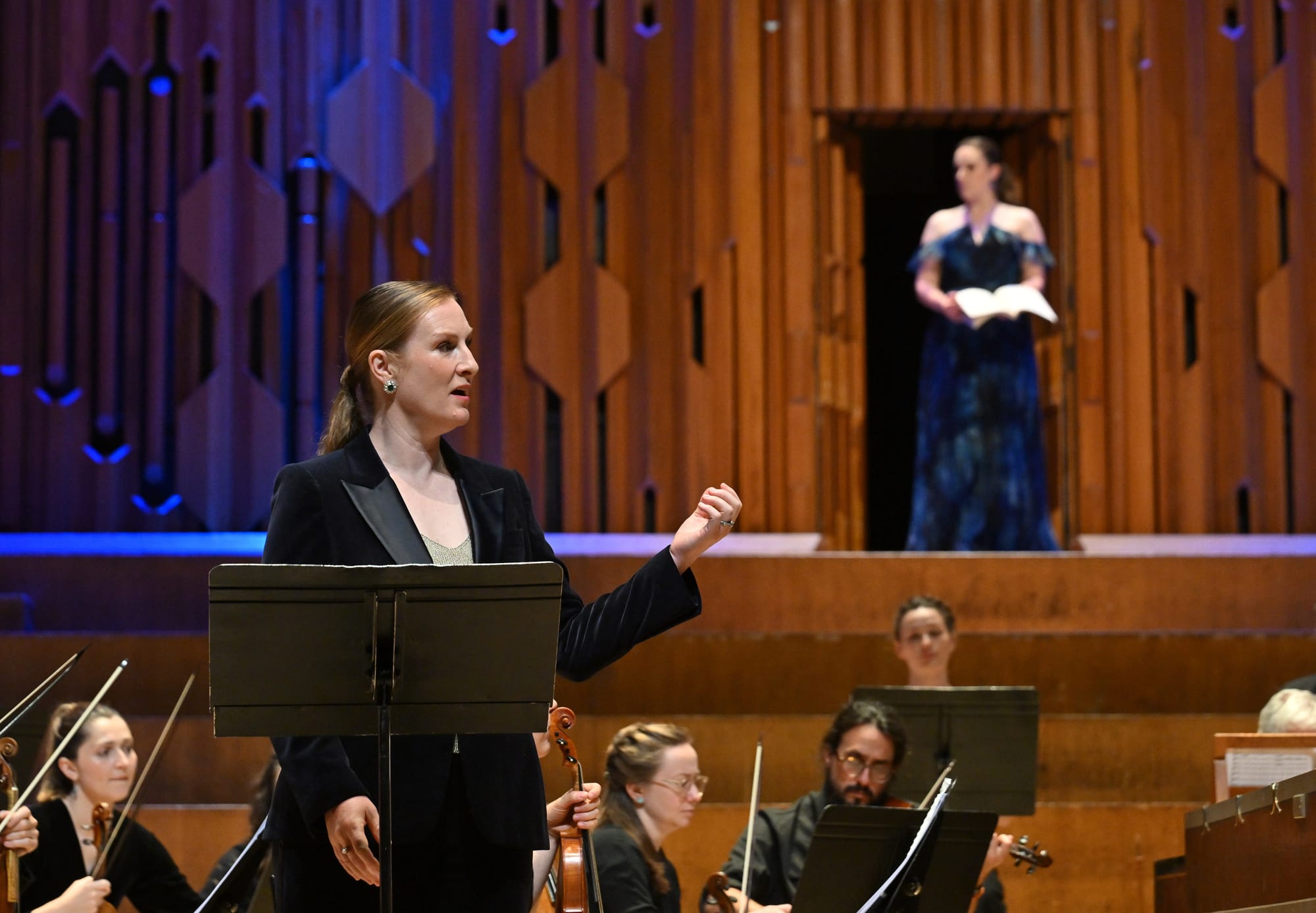
This Serse was a concert/semi-staged hybrid. We had the odd prop (flowers in act 2, distributed also to the AAM’s leader, Julia Kuhn), costumes and active comings and goings on and off stage. But the power lay in the music, one of Handel’s operatic gems.
The stripped-down dramaturgy did not help the score’s balancing comedic elements (which in fairness are less than in Cavalli’s Xerse). But Thomas Chenhall, a name new to me, absolutely made the most of his role of Elviro, which comes into its own in the second act and his interactions with Amastre. A fine baritone as well as actor, Chenhall, who made his international debut in 2019 at Wexford and is most definitely a name to watch. He will joining the opera studio at the Opéra National du Rhin, Strasbourg, which could well be mutually enriching.
Set in Persia in around 470 BC, Handel’s opera delights in interpersonal relationships and a very fluid plot, to the extent that the music flows in a very particular way. It also shares a trait with Bizet: as in Pearl Fishers, the big number is right at the beginning (there, the famous duet, here, ‘Ombra mai fu’). But with Handel’s Serse, there is no dramatic or musical diminuendo: the inspiration is constant throughout.
This is of course, a special aria in that it is a love song to a tree. Serse, the enamoured one, was taken by Paula Murrihy, who impressed immediately (Serse it is a soprano castrato role, originally taken by Gaetano Majorano, better known as “Caffarelli”). That sense of intimate resonance with her character was not quite sustained throughout the evening, however. Perhaps it was the august company: not only were there no duds in the cast, vocally the evening was pretty spectacular across the board. Murrihy certainly had the rhythmic buoyancy at her resolution to declare love (“Io le diro”), but the overall character of Serse seemed lightened. One could identify the emotion of one slighted in “Di tacere,” but it was difficult to fully live it along with the King. “Più che penso” was a little low voltage, sagging somewhat, and her concluding “Crude Furie” while technically brilliant, did not really have the invocational power to create the havoc she would visit on the planet (May the earth collapse, and the sun be eclipsed by my anger …). After hearing her recital disc with pianist Tanya Blaich, I Would Walk with My Love, I had hoped for more.
Louise Alder is born to sing Handel, as her arioso early on, “O voi, che penate” proved beyond doubt; and how agile she was in ‘Va godendo,” ornaments beautifully light in conversation with recorders and violins. How she spun a line in “Nemmen con l’ombre,” and when Handel requires voice and violins in unison, how she delivered (“Se l’idol mio” of act one, and her jealousy aria from the second act): Alder’s accuracy is second to none. As a side note, Alder can be seen and heard in another role in this same opera, as Atalanta, in a DVD/Bluray release of a performance from Frankfurt in January 2017.
But the clear star of the night was ex-OAE Rising Star mezzo Rebecca Leggett, in the trouser role of Arsamene. Her voice is beautiful, resonant and versatile, as her “Meglio in voi” demonstrated. Of all the singers, Leggett made the audience hang on every word, every emotion, and nowhere was that truer than in the dark aria of loss in the second act, “Quella che tutta fè,” arguably the stand-out moment of the night, Cummings finding shades and pianissimi from his strings that ideally underpinned Leggett’s smooth legato.
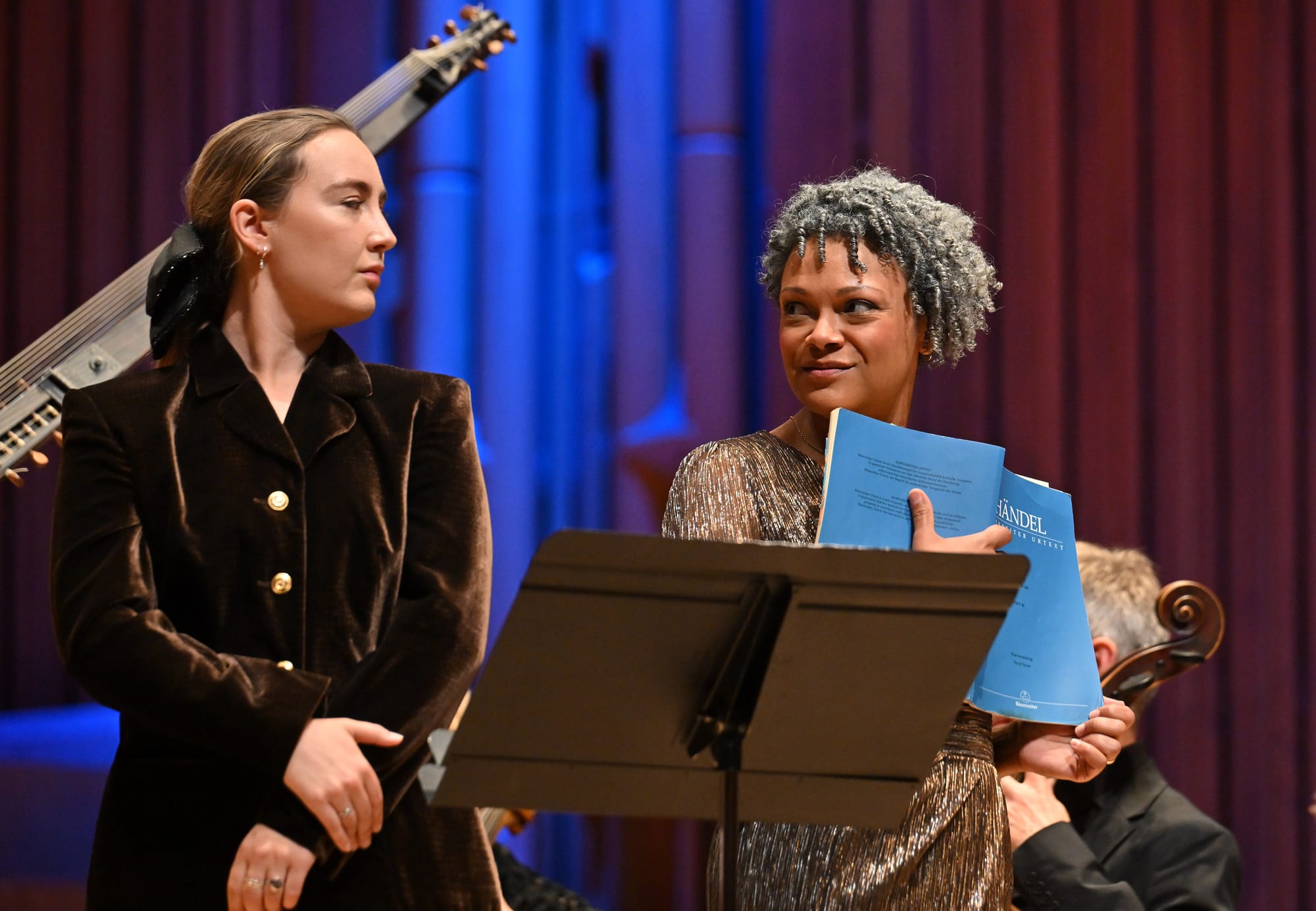
It is rather odd when a singer makes such an impression that when there is performative dip, it both surprises and hurts. Such was the case with contralto Claudia Huckle, who took the role of Amastre. She has the most amazingly beautiful voice that can carry so many emotions, and her act one “Se cangio spoglia” was a masterclass in agility and pitching as she sang of her resolute devotion to her love. But there were peaks and troughs of audibility as the night went on, finding form again later on.
It is Atalanta who closes act one, with her aria, ”Un cenno leggiadretto” (A graceful nod), given with great character by Scottish-born, Paris-resident soprano Rachel Redmond. Handel teases us with a ground in the second act for Atalanta (“A piangere ogn’ora”), and how beautifully Joseph Crouch on cello laid out the theme, repeating it then against Atalanta’s line. But it is not to be: Handel snatches it away by contrasting Atalanta’s lamentation against Elviro’s determined flower selling. She does get her moment in the sun, in the jaunty “Dirȁ, che amor per me” (He’ll say that love for me [hath not wounded his heart]), and how Redmond grasped the opportunity
There are more female singers here than males (which does not, of course, mean that there are more female roles!). No travesti for Luca Tittoto, a strong, resonant bass, whose “Soggetto al mio volare” showed a depth of experience in its command not just of the music, but also of dramatic presence. But the point here is in the interactions between singers, despite the large numbers of arias, and here was the performance’s true great strength. All the combinations worked so well, but perhaps the perfect illustration of everything in place was the act two duettino, launched by Serse’s “L’amerete?” and answered by Romilda’s “L’amerṑ,” two voices perfectly contrasted and yet both so perfectly Handelian in Murrihy and Alder. Another (very different) duettino is “Gran pena è gelosia,” between Serse and Amastre, “Fran pena è gelosia,” two very different voices, the warmth of Claudia Huckle’s contralto against the purer soprano of Murrihy, a real emotive highpoint of the opera, the AAM strings so powerful in their bare octaves.
Choruses were taken by the assembled cast (good to see David Blackadder’s and to hear his clarion tones gracing the chorus “Già la tomba”). The AAM was a small band of 21 players (including the excellent “second harpsichord” of Alastair Rose), with strings 4:4:2:2:1, indefatigable and always completely in style under Cummings’ athletic leadership. The subtitles were by Laurence Cummings and Stephanie Fayerman, and had their own little quirks (I am assuming they were also responsible for the pre-concert illuminated instruction, “To avoid the wrath of King Serse, please switch off your mobile phone”).
But there are a couple of gripes. The admission of swathes of latecomers was highly distracting, and there appears to be nothing in place to stop people filming on smartphones. Finally, the two young male singers who joined in the choruses, both confident, seem not to be listed in the programme.
Serse, HWV 40
Music: George Frederick Handel
Libretto: Adapted by unknown from a libretto by Silvio Stampiglia
Cast:
Serse – Paula Murrihy; Romilda – Louise Alder; Atalanta – Rachel Redmond; Arsamene – Rebecca Leggett; Amastre – Claudia Huckle; Ariodate – Luca Tittoto; Elviro – Thomas Chenhall
Barbican Hall, London 19 June 2026
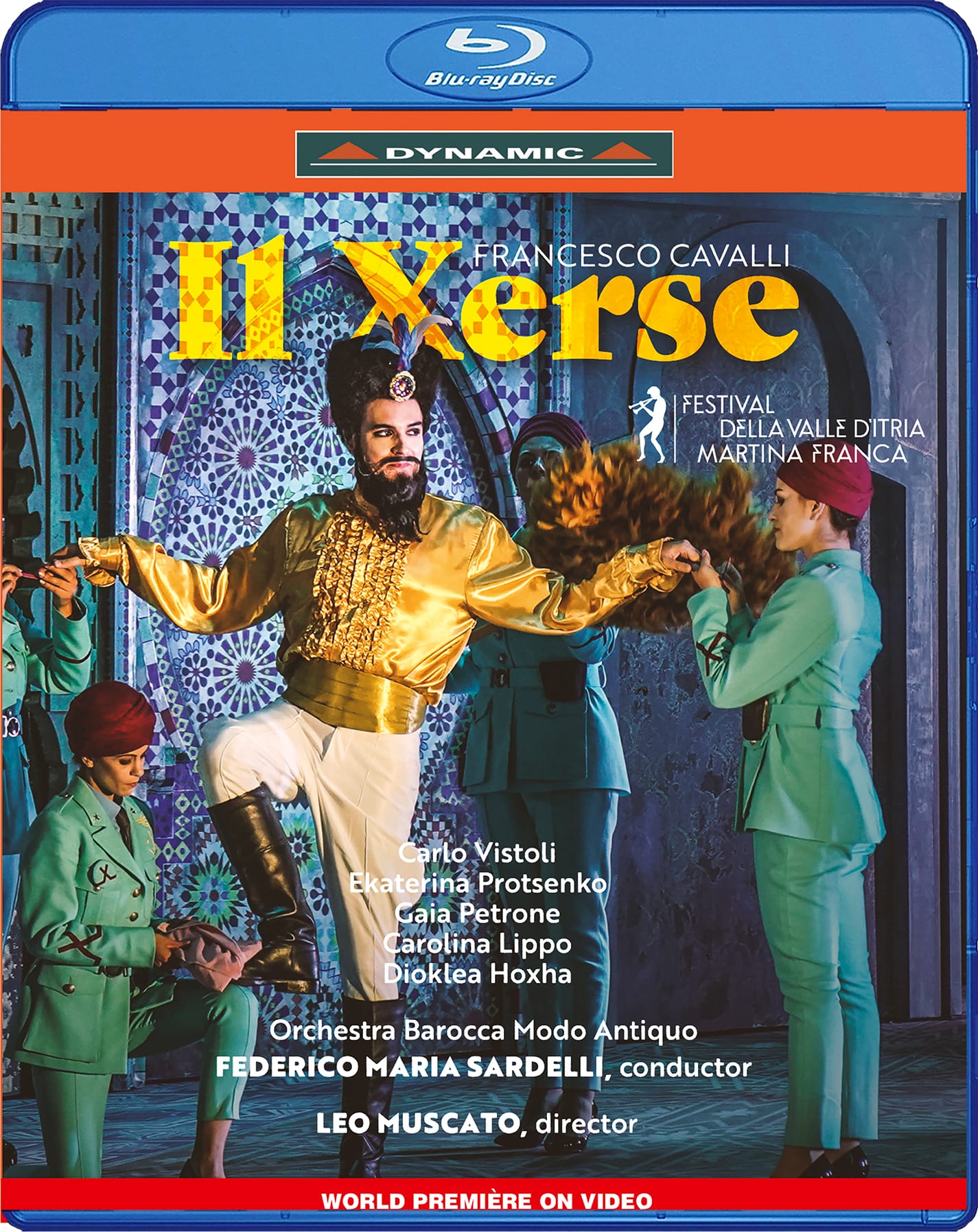
… and what of the other two Serses? Cavalli’s Il Xerse is available on DVD/Bluray via a performance at Martina Franca (Festival della Valle d’Itria Martina Franca) directed by Federico Maria Sardelli, which was the first in modern times:
Here’s Cavalli’s “Ombra mai fu”:
The comparison between this and Handel’s is instructive: yes, Cavalli’s does not have the enduring appeal of Handel, but somehow it is the perfect lead-in to this fabulous performance (based on the new critical edition of the score). Remember, Cavalli succeeded Monteverdi, and wore his crown as as the most influential composer of opera in mid-17th-century Venice. Cavalli’s plot is definitely entertaining and even more intricate – the comedy scene in act 2 is hilarious here. Cavalli’s opera was staged in Paris at the wedding of Louis XIV and Maria Theresa of Spain.
Be warned, though, there is a downside. Whenever a character has an aside (cavalli includes lots of them), they clap to start the aside and then clap again to finish it. Other characters freeze in betweem too,. The Freezing is no problem, but the clapping gets decidedly un-clever after a few occurances. That said, counter-tenor Carlo Vistoli is exceptional as Xerse, and leads another fine, even cast. The performance is beautifully sprung, rhythmically. The tragedy is there, too: in Cavalli’s version, it is Xerse who has the great final aria (not Romilda: in Handel, it is “Caro voi siete all’alma,” You are dear to my soul). Here’s Cavalli:
.. and here’s Lucia Popp as Romilda in the Handel, in 1965:
Finally, there’s the Bononocini Xerse (premiered 1694), out of which of course “Ombra mai fu” is the only regular except. Bononcini’s setting is lovely, the preceding recitative absolutely beautiful, the aria aria itself opening somewhat like Handel’s, just moving in a different direction after the initial descent. This is Bartoli, live, and with the first page of the score displayed:
The AAM continues its marvellous work with Handel. You can purchase the Cavalli on Amazon here (or rent it as a streaming video for £4.49 here)


%20Graham%20Boulton.jpeg?w=160&resize=160,160&ssl=1 "Celebrating John Joubert at Royal Birmingham Conservatoire in advance of his 2027 centenary")