


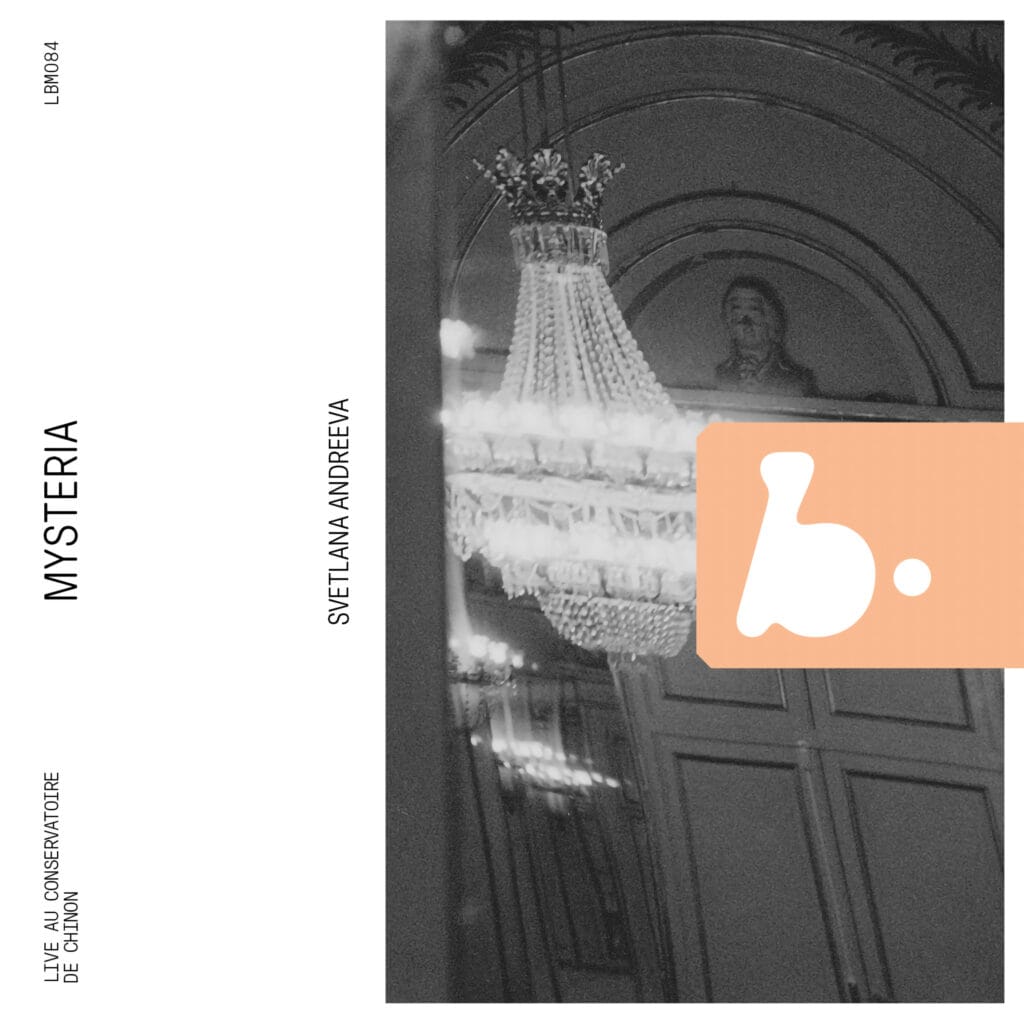
Ukrainian pianist Svetlana Andreeva (born Dzhankoy, a small town in Crimea) offers a beautiful programme of music, spellbindingly played. Age 15, Andreeva enrolled in the Central Music School of the Moscow Tchaikovsky Conservatory, later studying at the coservatory itself. Graduating in 2012, Andreeva now lives in Germany.
Andreeva won the 16th Competition in Orléans, France (in 2024: I was privileged to cover the previous one: my report appeared in the June 2022 edition of International Piano). Here, she intends her programme to reflect a medieval mystery play, a symmetrical stricture with prologue and epilogue and four “acts”; the recording is live from the Conservatoire du Chemin, Caen. So it is that the music emerges from Janäček’s mists … if you play only the hard disc. The actual intended prologue is available digitally, Serendipity for piano and electronics, by Aigerim Seilova (available via QR code in the booklet), itself swirling, and somewhat Scirabinesque to my ears, crowned by a descending chord sequence perhaps indebted to Messiaen:
She plays the music of Leoš Janäček well, here In The Mists. The first movements finds a beautiful balance between sweet tone and tumult. Andreeva’s sound warm but allowing of every detail:
Andreeva makes less than some of the music’s harmonic twists, but this does give the third movement, an Andantino, a charming simplicity:
… and here’s the finale, beautifully improvisational in effect, the music descending into silence often, reinventing itself each time:
The first “contrast ” to the programme’s outlying pillars is Scriabin, the “White Mass” sonata (No. 7), Andreeva’s performance is exceptional: she captures the flightiness, but also the strength. The left-hand anacrusis figure is clearly used as an anchor in this performance, perhaps a touch over-emphasised at times, but this remains a superb account of a sonata not heard often enough in recital:
This offers is the first of two pillars within two pillars: Andreeva’s “Black Mass” Sonata (No. 9) is also here, separated by a newer piece, Les litanies de l’ombre by Thierry Escaich (1991 – the set work for that year’s final recitals at the Paris Conservatoire). According to the composer himself, mysticism is part of the equation:
What strikes one upon listening is this violent incessant combat between mysticism and sensuality, between a Gregorian melody—and fake Gregorian at that—and polymodal colours, and a ‘theme series’ gradually taking form in much more moving harmonies and irrational rhythms reinforcing the unstable mood of the whole. Here, everything is stated in a wild, breathless, convulsive way. The opposition of contrasting sound worlds is both brutal and continuous. When they are not in confrontation, interrupting each other—like the abrupt eruptions of the introductory period sounding like premonitions of the later evolution—, these worlds are superimposed and combine, prompting writing by super- imposed strata that make the execution of the work particularly arduous.
The great final progression, for example, based on the obstinate persistence of a solemn chorale derived from the Dies iræ, witnesses, in the instrument’s middle register, Gregorian reminiscences distorting in a hazy counterpoint whereas, in a high third level a sort of danse macabre arises in a completely different tempo. Hence very frequent polyrhythrnic writing necessitated by the handling of the discourse. What one retains primarily, once the performance of the work is over, is an architecture based on two long formal progressions, the first falling back to its climax on an anthem evoked like a distant memory, whereas the second will lead to a sort of sound storm where all the ‘thematic characters’ flood in before leaving again, bloodless, under the pealing of an unchanging, bewitching knell.
Andreeva’s fearless performance is exceptional, not only conveying the power, but also the magnificent interiority of the “mysteries”. Listen also to her control of touch, so varied, including in a sort of “scampering toccata” where her staccat is magnificent; and she inderstands Escaich’s vocabulary so well:
The Scriabin “Messe noire” (Black Mass) Sonata (No. 9) is heard in an hypnotic performance, gloweing. Here is the dark mystery as opposed to teh flickering candle flame of the Seventh Sonata. Perhaps the trills could do with a little more infernal energy: like in late Beethoven, trills become generators of energy as opposed to decorations; arguably here even more so given the untethering of tonality. Here’s the film of Andreeva’s performance, from the competition:
The second outlying pillar is Szymanowski’s Masques, which sounds very Scriabin-adjacent while reaching out to the mysteries of Ravel’s Gaspard. Here it is repeated notes, not trills, that take on that charge of internal energy:
Adveeva does identify Szymanowski’s language perfectly, and is especially effective in the second movement, highlighting the contrasts:
The finale seems a close relative to Debussy’s “Minstrels” from Préludes, Book I here, at least initially.
Finally, the “postlude,” Selova’s Blackout for piano and electronics, which was awarded the André Chevillion–Yvonne Bonnaud Composition Prize at the 2024 International Piano Competition of Orléans. It fits teh ethos of Andreeva’s album perfectly, too; and notice how the use of electronics is subtle and sophisticated, an integral part of the experience that never calls attention to itself unnecessarily:
Incidentally, a performance by Adveeva of Masques is available from the Paderewski Piano Competition (the second and third movements start at 8″12 and 13″55 respectively):
I’d love to hear Andreeva in recital, she clearly has such alignment with this repertoire. An important disc.
The recording is available at Amazon here.


.png?w=670&resize=670,446&ssl=1 "Make some noise to save the School of Music: Musicians gather in mass demonstration to protest proposed axing of Cardiff University’s School of Music on Saturday 22 February")