


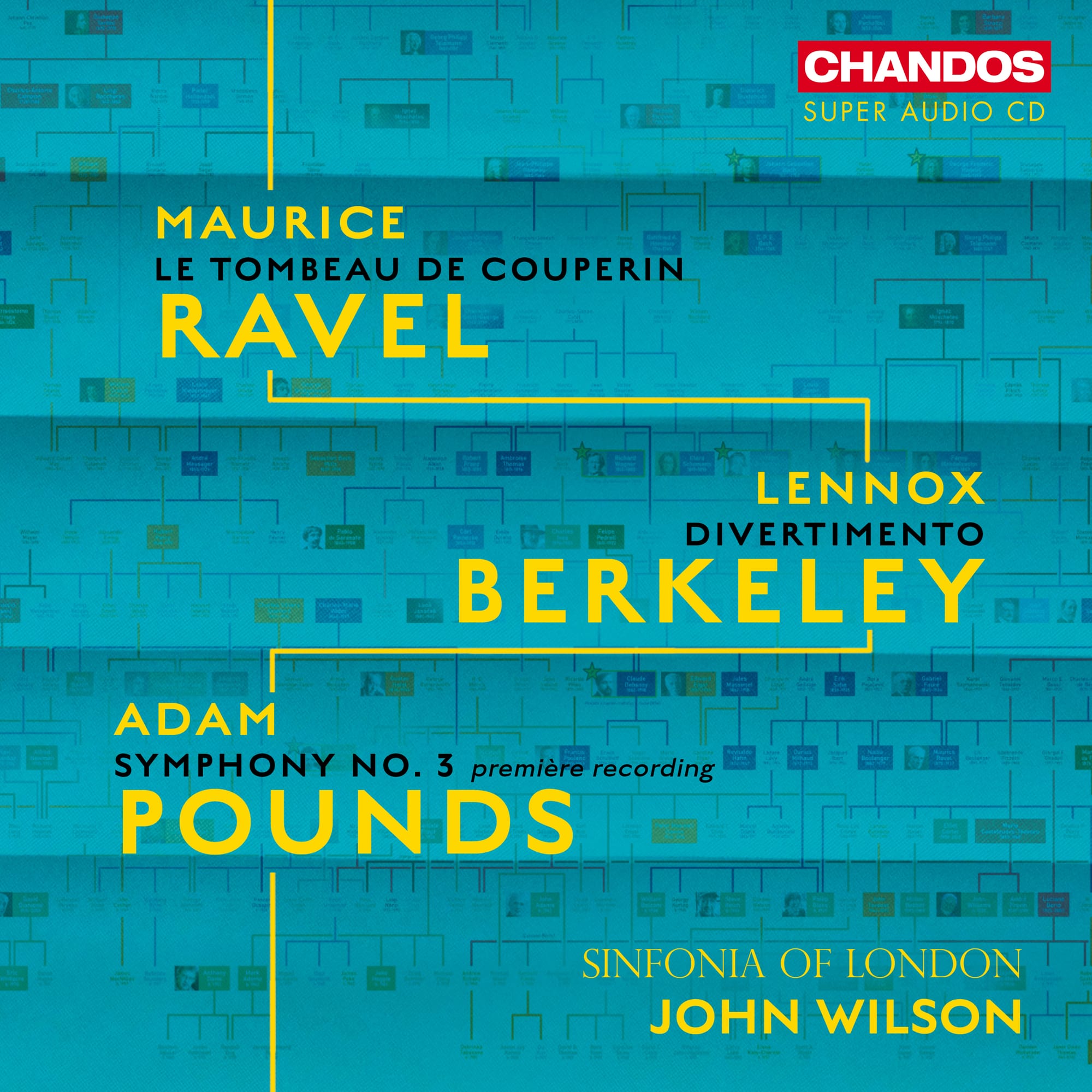
You think you know Ravel’s Le tombeau de Couperin? Wait until you hear this! John Wilson and Sinfonia of London illuminate every bar of the score afresh. In a score I’ve heard a kazillion times, the is so much I hadn’t heard before just in the first movement: and that final upward gesture is pure magic:
The “Forlane” is a proper Allegretto (it’s often too slow), and the spirit of the dance is everywhere in the characterful winds:
This is a joy to listen to: the recording is as faultless as the playing (Brian Pidgeon, producer; Ralph Couzens, sound engineer; Church of St Augustine, Kilbirn, London, November 2922). The Menuet contains a wonderful sense of Gallic nostalgia, ad is again imbued with the most miraculous colours. Here, there is space aplenty for the lines to sing.
… while the finale contrasts high energy against snake-charmer oboe (sadly there is no personnel list):
There are connections between the composers here: Ravel was a mentor to Lennox Berkeley, and Berkeley to Pounds.
Berkeley met Ravel a number of times in the 1920s, working as an interpreter and tour-guide whilst Ravel was in London. Ravel advised him to study with Nadia Boulanger, which he did, between 1926 and 1932. Commissioned by Sir Arthur Bliss for the BBC Symphony Orchestra in 1942, the Divertimento, Op. 18 (1943, dedicated to Boulanger) initially received a mixed reception, but has since found many supporters (including Pounds). The critic Peter Dickinson felt it showed an
… instinctive and unimpassioned creativeness associated with the French aesthetic, but by no means restricted to it.
The Divertimento was premiered in the same concert as Britten’s Serenade for Tenor, Horn and Strings at Wigmore Hall
The carefree opening (Prelude: Moderato) certainly has a French flavour initially, but soon twists to a more individual flavour. Its a fascinating balance:
The Nocturne is beautiful, launched by a fabulous bassoon solo that cedes to French horn. Interrupted by a string fanfare figure that launches the acidic Scherzo, the two movements contrast beautifully, the latter showing off the Sinfonia of London’s clear virtuosity:
The finale is as jaunty as can be, with a rather nice woodwind softening at the Poco meno vivo around two minutes in:
Finally, a work by a lesser-known composer, Adam Pounds (born 1954), who studied privately with Berkeley in London during the late 1970s.
His Third Symphony was written in 2021 and is a response to the national lockdowns in 2020 and 2021 prompted by the Covid-19 pandemic. Pounds states that the piece captures the …
… sadness, humour, determination and defiance
of the time. It is dedicated to Sinfonia of London and John Wilson.
The darkness of the opening stands in huge contrast to the bright whiplash oft he close of Berkeley’s Divertimento. Although the first movement alternates tempi, the Largos stand at its heart, an oboe solo piercing the emotions. When it does get faster, dissonance precludes frivolity. The performance is astonishing: the rhythms bite, clashes thrill. Adam Pounds’ music is quite the discovery for me:
There’s more than a touch of Roald Dahl about the “Tempo di Waltz (!)” : as the notes suggest, this is a danse macabre, heard in a performance that is as slick as it is unsettling:
The Elegy is a “homage to Anton Bruckner” while being dedicated to those who lost their lives in the recent pandemic. The tread of string pizzicato presumably nods towards the great Austrian, as does the sense of both breadth and structure:
There is a quiet authority to Wilson’s reading of that movement that is most impressive and moving in itself. The finale’s march possibly invokes Shostakovich, as Mervyn Cooke’s characteristically brilliant notes suggest (they are a model of their kind). Listen to the trumpet contrinuation early on. Again, there are real contrasts here on a larger level (the central Largo):
You can also hear Pounds as guitarist on this disc of sonatas performed on flute and guitar.
Amazingly this disc is selling at Amazon for @£2.32!! iDagio here; other streaming below.


.jpg?w=160&resize=160,160&ssl=1 "By turns illuminating & compelling: the Royal Liverpool Philharmonic Orchestra on terrific form in Britten & Vaughan Williams at the BBC Proms")