
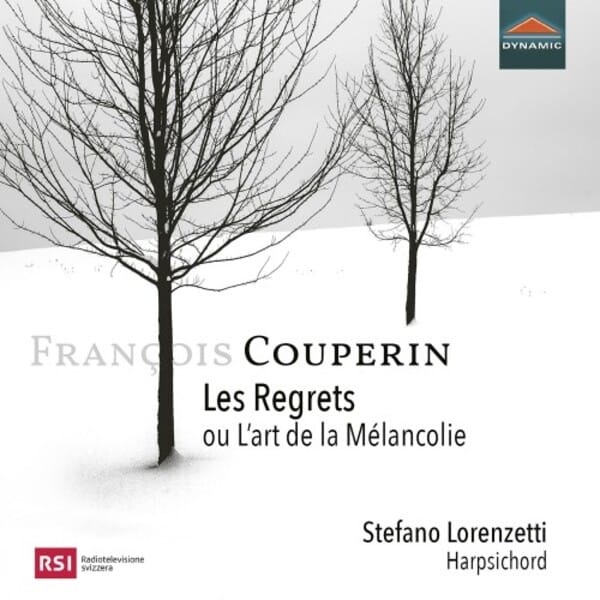
Music by François Couperin today, a perfect complement to a previous post on the harpsichord music of Louis Couperin at Wigmore Hall by Jean Rondeau (linked in to his monumental box of Louis’ keyboard works on Erato).
Here we are on the Dynamic label, for a disc of music by François Couperin “Le Grand” (1668-1733) with music from the core of François’ output: the Ordres, or suites, from L’art de toucher le clavecin.
François was terrifically important, and most immediately he went on to influence Rameau. He was appointed organiste du roi to Louis XIV on December 26, 1693, and his star remained in the ascendent with his introduction of Italian elements into the prevailing French scene. Like many composers of his time, penned a treatise (L’art de toucher le clavecin) which included eight préludes and an allemande.
Here’s a promo video by Lorenzetti, which includes a “particularly suggestive phrase” by Couperin
If there is a great distance between grammar and declamation, there is infinite distance between written music and a good performance
Lorenzetti also suggests that François’ music is a prime example of Ars est celare artem (Art concealing art).
Lorenzetti takes the eight Preludes from L’Art de toucher le clavecin and builds a suite around them using pieces form the first and second books of pieces for the harpsichord, intending to concentrate on the melancholic aspect of the French Baroque – the dark shadow behind the brightness oft he Sun King.
It is good to present the first two tracks here: a Prélude (the first from L’art de toucher le clavecin) used to introduce the titular track, “Les Régrets” (from the third Ordre of the first book of Pièces de clavecin). The juxtaposition works well, and Lorenzetti finds expressive agogics in the latter without being stilted:
The recording of the harpsichord is a touch dull for this repertoire, though, the instrument itself identified as “French harpsichord by Tony Chinnery, Vicchio, 1986).
The playing itself has great strengths, though, not least in La favorite, a “Chaconne à deux thèmes”, the second piece of Lorenzetti’s first suite, and a piece of grandeur that complements the melancholic “Les Regrets”. Both these pieces hail from the third Ordre from the first book. The first moves to the more sophisticated second naturally:
The second prelude seems to tap into the melancholy of “Les Regrets” perfectly; the first piece of this little suite is the slight melancholic elegance of “Les Idées Heureuses” (Book 1, Ordre 2) heard in a beautiful performance; unfortunately the brightness and fanfare aspects of “La Diligente” are all but negated by the dullness of the harpsichord, so any exuberance of those descending scales is negated:
My, how the Troisième Prélude makes its mark, imaginative, questing, restless in its G-Minorness:
The ornamentation to “Lenchanteresse” could be more exuberant, though. This is such rich music – not for nothing did Couperin opt for the term “ordre” over “suite,” freeing him from expectation of movement order. We hear Couperin’s supreme imagination in its (deceptively) simplest terms in “La fleurie, ou la tendre Nanette” – listen out for the use of a harpsichord here:
The fourth Prélude is almost whispered, so that the simplest descending scale makes a huge impact. It sits in huge contrast to “Le Révail-matin” (The Morning Wake-Up Call), abuzz with frenetic activity and brilliantly played by Lorenzetti:
One of teh finest pieces here is the Fifth Prelude, full of remarkable harmonies as if the player tries to extricate himself from the darkness of the prevailing melancholy
“Le Logivière” is an allemande that seems itself on a search, resltess yet slow, the alternating left- and right-hand articulations strangely poignant here. It stands in contrast to the Allemande “L’Ausoniene” of the next :suite, which commands real dignity:
Interestingly here Lorenzetti comes closest to the “Allemande-Courante-Sarabande-Gigue” Baroque suite structure: he follows that allemande with the “Seconda Courante” from Ordre 8 of the second book (a remarkably forward-looking piece) and the “Sarabande l’Unique”, also from Ordre 8 of the second book, sonorous (or as sonorous as this harpsichord gets), even luxuriant:
The ornate Seventh Prélude seems to allow for an emotive step back. I would though like a bit more flow to “Les Bergeries” (Livre 2, ordre 6). I do like the toccata-like flow and the muted stop of the final Prélude, though:
If one piece exemplifies Couperin’s melancholy, it is the penultimate track, “Les Juméles” (The Opera Glasses). If you’re wondering about the titles, this Masters thesis does a pretty good job of going through them all. There are some lovely “twangy” dissonances here:
The title of “L’Atalante” can be traced back to a usage by Denis Gaultier in his 56-piece La Rhétorique des Dieux. It is, though, a fairly relentless way to end …
The harpsichord music of François Couperin is generally agreed to be his crowning achievement, and by zeroing in on one of its aspects, Lorenzetti creates an interesting, informative perspective. Returning to Louis Couperin’s music via Jean Rondeau and his Erato compleete set was a bit of a relief in terms of sound quality, though, his instrument rich and yet clear, the perfect balance. That’s what’s missing here.
This disc is available at Amazon here.;iDagio here.


.jpg?w=160&resize=160,160&ssl=1 "Only love can bear the burden of truth: Ben Parry & Garth Bardsley on their new opera that premieres at Snape this Saturday")