

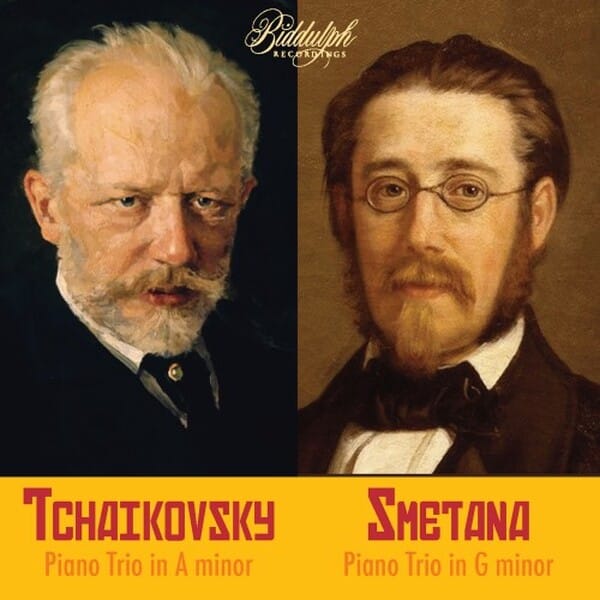
Tchaikovsky’s Piano Trio is a vast work as chamber pieces go, end-weghted to a vast set of variations. Dedicated to the composer’s close friend the pianist Nikolai Rubinstein, the work carries a great weight on its shoulders.
This performance was released on Vox (founded in New York in 1945 by George Mendelssohn-Bartholdy, a relation of the great composer). This Tchaikovsky was released on the newly-developed LP medium. As with the Smetana, it features the violinist Louis Kaufman (1905-1994), who led studio orchestras in the 1930s and early 1940s – you can hear his solos in Gone with the Wind, Casablanca and more. He also made the first recording of Vivaldi’s Four Seasons; he also premiered the Barber Violin Concerto. He is joined by cellist Karl Reher (1913-76), who studied with Emanuel Feuermann in Berlin – he was invited by Klemperer to join the Los Angeles Philharmonic – his recordings include acting as the an additional cellist to the renowned Hollywood Quartet for the Schubert String Quintet and Schoenberg’s Verklärte Nacht. The pianist is Baltimore-born, Curtuis-trained Theodore Saidenberg (1908-1986), chamber partner of many great musicians, including Heifetz and Stern.
The Biddulph pressing is brilliant, maintaining so much piano tone, while both strings have presence (even in pizzicato):
The performance of the Tchaikovsky is astonishing throughout: Saidenberg’s agility in the variations is jaw-dropping, while both Kaufman and Reher’s expressivity is off the charts. Here’s the variations – but in a much inferior transfer. The Biddulph is streets ahead in clarity – one really hears the nuances of Saidenberg’s timbral range, for instance on Biddulph. There is grandeur here, too:
Do bear in mind that this performance includes (composer-approved) cuts and so is “swifter” than most other performances – and with those cuts, resists comparisons. It also sits as a supplemental performance in a collection, but a fascinating one. Saidenberg’s light pianism in the finale is a joy, and the sense of intense chamber music throughout makes for a gripping performance. The climax carries real force, Kaufman and Reher’s tone tensile, Saidenberg’s chordal contributions resolute.
Like Tchaikovsky’s work, Smetana’s was an in memoriam, this time for the composer’s daughter, Bedřiška. In contrast to Tchaikovsky’s expansiveness, Smetana’s work si concise. And how wonderful to have Rudolf Firkušný as pianist. Kaufman is the linking factor, with Willem van den Berg on cello.
The first movement of Smetana’s Trio, Moderato assai, is less than ten minutes long but traverses huge emotional terrain. It predates the Tchaikovsky (1955, revised 1857; the Tchaikovsky is 1882):
Firkušný is in sovereign mode here, Kaufman every inch his equal, while can den Burg (principal cellist of the San Francisco Symphony from 1924) offers steadfast contributions. The piece contains moments of extreme, and very Czech, beauty in the first movement – which is as slow as the piece gets. The sound is less full – these are 78 Vox transfers, not LP, even though they were issued a year after the LP Tchaikovsky.
The second movement is marked “Allegro, ma non agitato,” and again contains moments of fine lyricism:
Along with the Czech accent, there is a pronounced overall serenity to Smetana’s G-Minor Trio that complements the heartfelt pain and angst of the Tchaikovsky perfectly – Biddupph chose the programme carefully and well. The finale is a Presto, vibrant with energy – this is a proper Presto, as it should be, with Firkušný’s fleetness of finger an object lesson in piano playing. And how van den Burg’s cello sings when the tempo slows; Kaufman’s response is heart-breakingly sweet:
A terrific release, available at Amazon here.


%201280x720.png?w=160&resize=160,160&ssl=1 "The Continuo Foundation awards £108,000 in its 12th round of grants")