


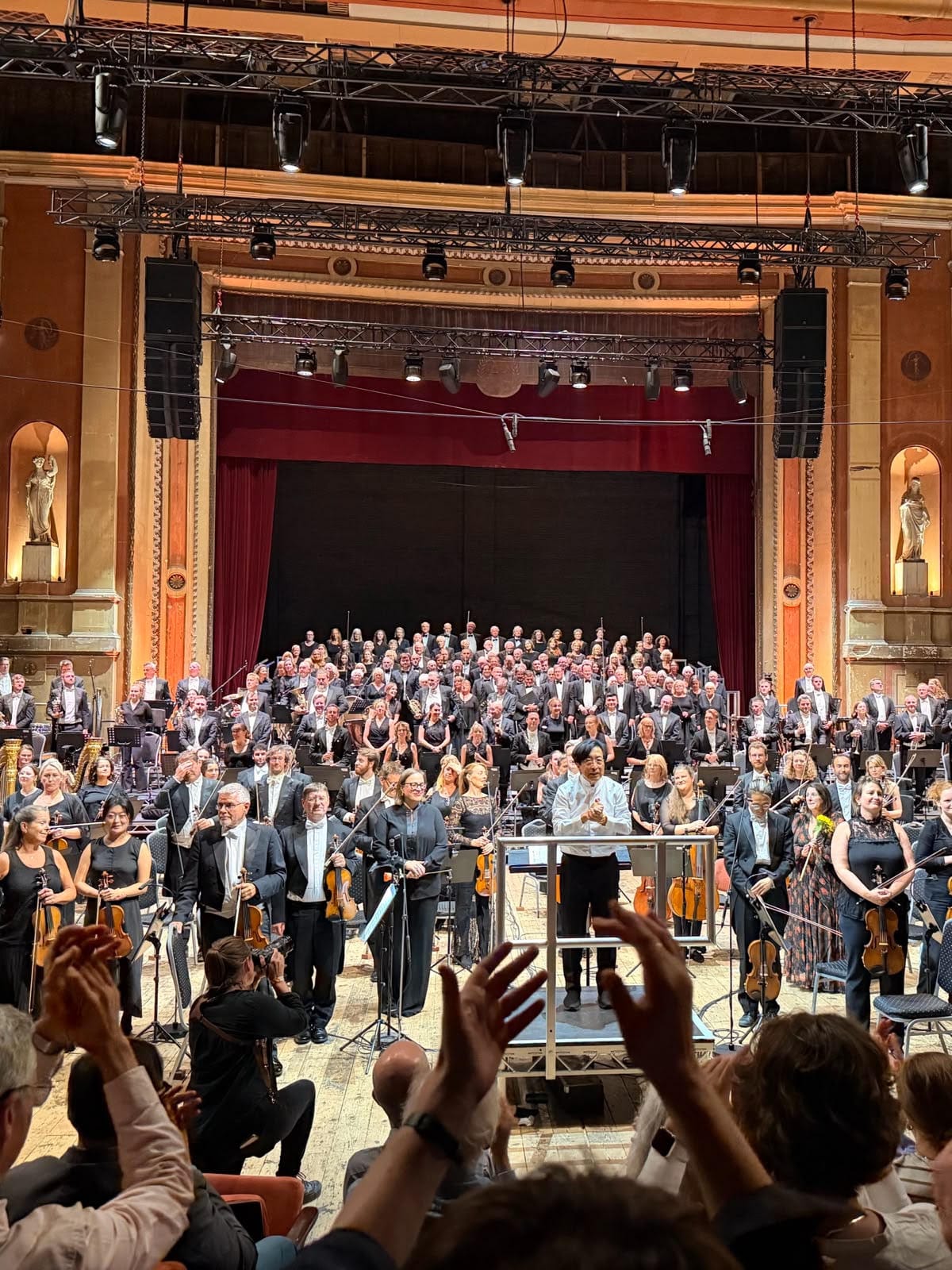
Mahler: Symphony No. 2, ‘Resurrection’ Elizabeth Watts (soprano); Jennifer Johnston (mezzo); Brighton Festival Chorus; Royal Philharmonic Orchestra / Mandle Cheung (conductor). Alexandra Palace Theatre, London, 21. 08.2026
Interviewing Mandle Cheung revealed a tech entrepreneur housing a caged artist now coming fully, internationally, out into the open. Cheung’s Mahler journey, begun in Canada, continues with the “Resurrection,” a great symphonic canvas that offers a journey from the darkness of the first movement (reacting to the death of the hero of the ‘Titan’ symphony perhaps, the First) to the religious apotheosis of the close, a setting of Klopstock. Cheung performed Mahler’s “Resurrection” in Toronto, Canada, on June 24 this year, with the Mandle Philharmonic Choir and Orchestra, and soloists soprano Lesley Bouza and mezzo-soprano Alex Hetherington.
That was an outdoor performance, performed under the night sky (see this article). Mahler’s Second Symphony is a huge work, requiring huge forces. If performed indoors, it also requires a concert hall that can cope: here in the UK, the usual Alexandra Palace capacity of some 750 audience was reduced to around 600 because of the size of the orchestra. The Alexandra Palace Theatre acoustic itself seemed to have problems with Mahler’s outbursts at times, not quite able to contain a combination of detail and sheer volume (the first movement’s climactic grinding, brass-drenched dissonances a case in point).
Cheung opted for a string layout that bunched first and second violins to the left, with violas to his extreme right, cellos therefore at a 45 degree angle to his right, and double-basses behind to the right. This weights the lower frequencies to one side – bunches them – which can cause violin pitch to rise. Placing the violas nearest the audience does lend them substantially greater weight, though, heard to fine effect at times here.
There was also a spoken introduction by Cheung who was, like the off-stage brass and percussion later, invisible to the audience. I remain unconvinced the speech added too much to the event – the music should speak for itself – but it did create a sense of occasion, with Cheung referring, rightly, to the Second Symphony’s ‘apocalyptic force’ and seeing it in a lineage that began with Beethoven’s Ninth Symphony, arriving at Mahler via Berlioz’ Symphonie fantastique. Cheung went on to outline each movement’s individual character.
He also obeyed Mahler’s instruction for a pause after the first movement during which he left the stage (allowing for the entrance of the Brighton Festival Chorus). That points towards a diligence, an awareness that the score is the Alpha and the Omega of Mahler interpretation.
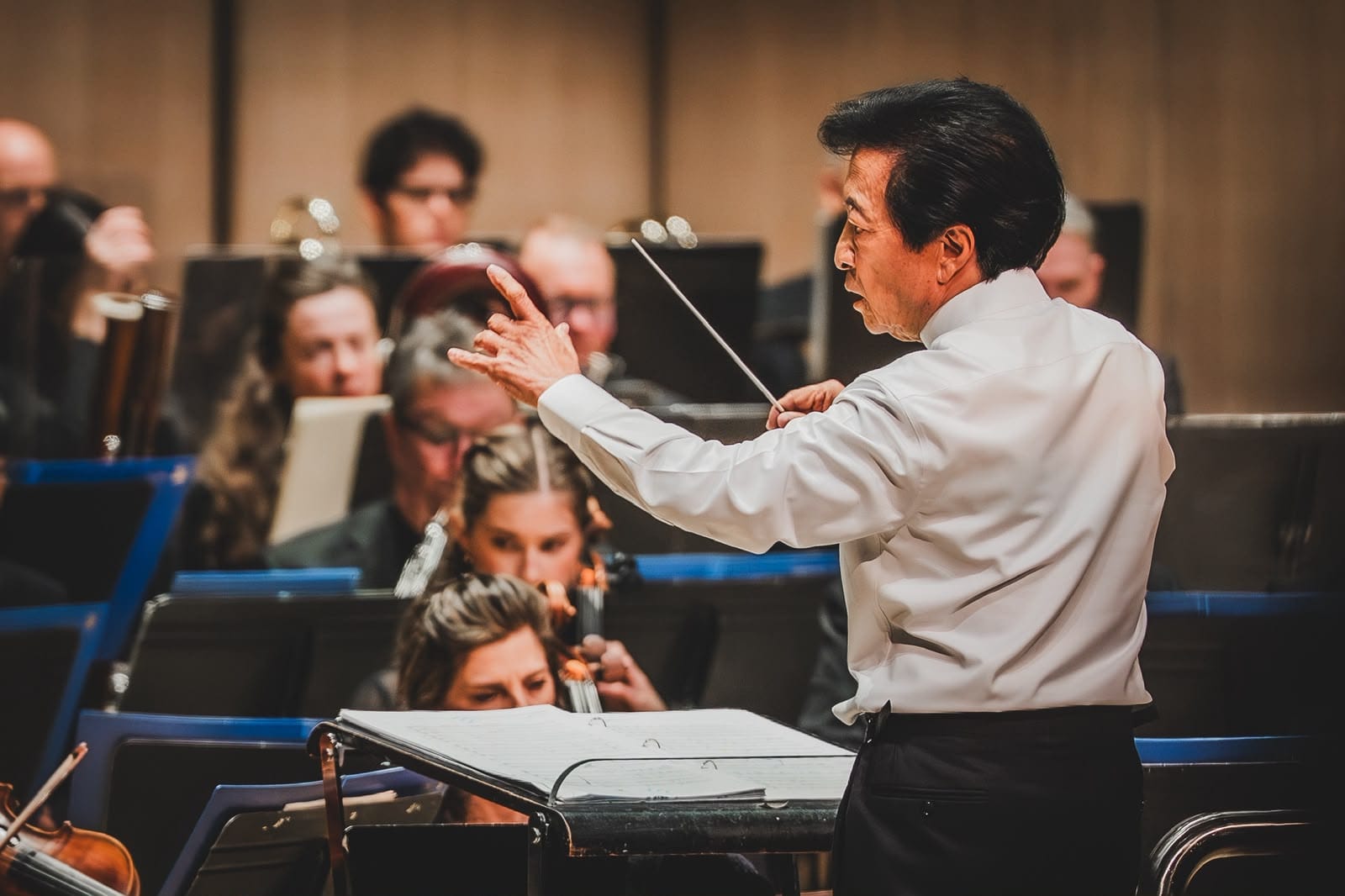
The Royal Philharmonic Orchestra did indeed give their all throughout the evening, but there were moments of definite instability, especially during the third movement, ‘In ruhig fließender Bewegnung’. Occasional moments of uncertainty in the earlier parts of the first movement were balanced by the growing confidence later on in this movement’s vast edifice. Brass in particular excelled, strong both as a unit, and offering some fine trumpet playing (Matthew Williams leading that section). The first movement as a whole was a touch relentless; and yet moments of repose, which should hold a coiled spring underneath them, found the music sagging a little. A moment of pure beauty in the strings at ‘Sehg mäßig und zurückhalten’ was marred by bad ensemble in the horns’ delicate entry; against this, in Cheung’s credit column, was an ability to manage Mahler’s tempo juxtapositions well. The return of the movement opening was effective and satisfying; and, best of all, a clearly well-rehearsed use of string portamento was revelatory,
The second movement “Ländler”, holding the occasional moment of uncertainty, perhaps needed to relax more to allow for contrasts with the outbursts; but the cello ‘song’ worked, a moment of lovely lyricism. A pity the string pizzicato passage sounded rather dry in the Alexandra Palace Theatre acoustic, as the performance itself was delightful. I did like Cheung’s initial approach to the third movement, fast in response to Mahler’s tempo indication, woodwind especially characterful (particularly the pair of clarinets, Katherine Lacy and Emily Meredith). Here, though, those first and second violin exchanges could really have benefitted from antiphonal layout. Notwithstanding the moments of instability, this was a dynamic movement, Neil Hitt’s timpani a recurring, primal element.
Mezzo Jennifer Johnston stood up early in anticipation of ‘Urlicht’: there was little to no inter-movement gap before the Wunderhorn setting launched with a stunningly, searingly beautiful ‘O Röschen rot’ from the singer. Cheung offered daring pauses, the tension now running through the silence, the trumpets beautifully controlled in their echo-like dialogue with the voice. Throughout, Johnston’s phrasing was utterly perfect.
The finale entered like a battering ram. One of the most impressive aspects of the account was the handling of the off-stage aspects in this most visionary of edifices, perfectly distanced. The four off-stage horns – who, as Mahler asks, returned to the stage later on in the movement – were particularly laudable, especially in the group attack on the horn top C (horn in F: a sounding F natural).
Interpretatively, the distension of the final two beats of a bar is always tricky: it needs to sound natural (think Bruno Walter) and Cheung almost achieved that here. Mahler’s occasional juxtapositions of strata (almost Ivesian) were a highlight, certainly, as was the creaminess of the brass section in chorale mode. A special mention, too, for first trombone Tom Berry’s plangent solos (to a melodic line that will later house the words, “O glaube, mein Herz, o glaube’), while the percussion department as a whole realised the famous percussion crescendos magnificently.
The Brighton chorus was quiet at their entry on ‘Auferstehn’ after the ‘grosse Appell,’ but perhaps not the ppp requested. Both vocal soloists excelled, Johnston now joined by the radiantly-voiced Elizabeth Watts. The close was indeed rousing, a sonic spiritual charge that found Cheung marshalling his forces with authority.
All credit to the many instrumental soloists, including the leader Duncan Riddell, whose solos were ever impeccably Mahlerisch. Cheung’s scaling of Mahler’s Second is an impressive feat in its own right, for sure: and it will surely deepen over time.
Interesting to note that the Royal Philharmonic Orchestra will return to this score in the venue that was for Cheung otherwise engaged by the Proms, the Royal Albert Hall, in April 2027 where the orchestra is joined by the Philharmonia Chorus, soloists Miah Persson and Beth Taylor, and conducted by Vassily Petrenko; on that occasion, the symphony will be coupled with Arvo Pärt’s Kanon Pokajanen: Ode VII.
As to Mandle Cheung, his Mahler Eighth Symphony at Roy Thomson Hall in Toronto, in November this year, is eagerly awaited.


.jpg?w=160&resize=160,160&ssl=1 "Intriguing connections in Anja Bihlmaier & BBC Philharmonic's Prom including Mahler's Das Lied von der Erde with Jamie Barton & Clay Hilley, yet perhaps better heard on BBC Sounds")