


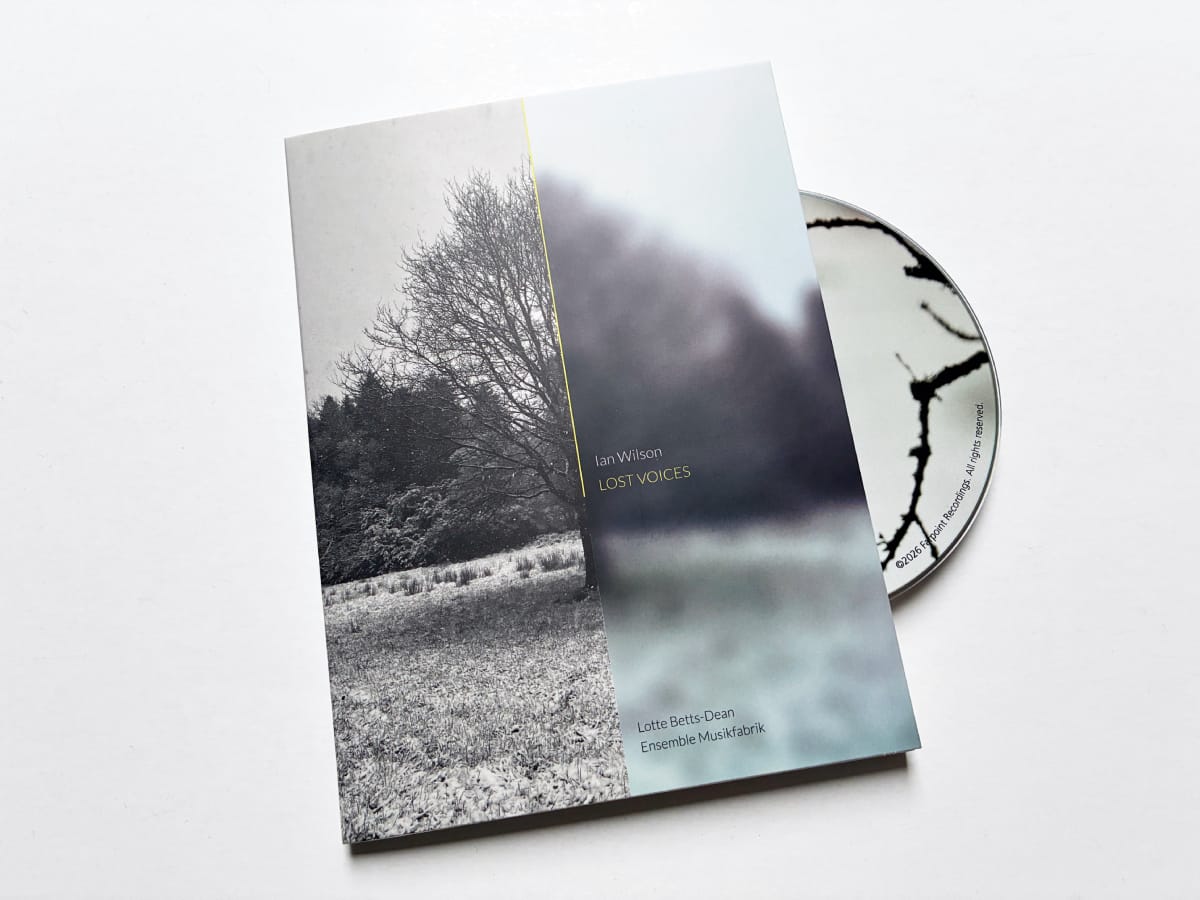
Anyone who thinks Modernist music can’t be beautiful in and of itself should hear this. Hushed, caressing, Ian Wilson’s Voces amissae (Lost Voices) is a contemporary masterpiece.
Lost Voices sets poetry by Serbian poet Dragina Adamovič (1925-2000; Wilson actually divides his life between Ireland and Belgrade) alongside quotations from interviews with people who had been “silenced” in one way or another. Originally, the idea was to write for Dutch soprano Nora Fischer, but Fischer was having vocal problems at he time. Despite this, Fischer wished to be involved, and the theme of “lost voices” was settled upon. Voices can be lost in many ways of course, not just physically: people can be silenced, and both Fischer and Wilson talked to people whose voices were unheard for a number of reasons: Fischer talked to those who were quiet for through politics, homelessness, or violence; Wilson concentrated on medical reasons, including a young lade who had a post-partum str0ke, an older lady with motor neurone disease, and the English singer Sheila Chandra, who suffered from “burning mouth syndrome,” which ended her singing career, due to complications to a medical procedure in 2009.
I like booklet annotator Tim Rutherford-Johnson’s statement that,
… correspondingly, Wilson’s music sits at the hesitant edge before music
Wilson sets a sequence of tales, separated by instrumental interludes that sometimes themselves sit in a liminal space between (quiet) noise and music. The poems’ what Rutherford-Johnson calls “suppressed terror” fits the work’s concept of ‘political silencing” perfectly. He quotes the line:
The fish-eyed man / He followed my every step
from Under the Volcano (Pod staklom vulkana) No. 2). Wilson responds to Adamovič’s poetry with chant-like settings, “shadowed” by an instrument. Apparently Adamovič’s work has found some obscurity, making her another lost voice; until now. Wilson rescues her, using her movements as structural anchors.
The poetry itself is remarkable: the closing lines of No. 2, continuing on from the above, is
And there behind the narrow gates / A candle was burning in praise of nothing
Lost Voices extends over 50 harrowing, compelling minutes. The performance here, which as far as I can tell is beyond criticism, was recorded live at Ensemble Musikfabrik Studio in Mediapark, Cologne, Germany on December 16, 2024. The precision of performance is utterly remarkable: so clean, the ‘live’ element presumably helping the performance’s focus and enabling a sense of overall trajectory, The soprano here is the wonderful Lotte Betts-Dean.
Wilson and Adamović are the perfect fit: both pithy, enigmatic. Both whisper rather than shout, Adamović’s pain internalised, potent. The transcribed texts, too, contain quiet pain:
What’s happening to me? How did I get here? I’m striving to think
Is the spoken, almost whispered opening, answered by a pitchless sound that extends like wind on a barren plateau; out of this a string line appears. Like the music, the text exists in a liminal state. Out of this emerges the fish-eyed (unblinking) man, the text suggesting surveillance, scrutiny (we don’t get to know if the man is real or a part of the protagonist’s psyche). Betts-Dean is astonishing in her haunted delivery: blanched, numb. Wilson’s “shadowing” of the vocal line via instruments is a visceral reflection of the fish-eyed man following every step. And yet against this is composed stasis, a reflection of the pointlessness reflected in this nihilistic text, while the “narrow gates” speak of constraint.
The music dissolves into airy sound; rhythm at last appears before the first collected quote (After the operation …”), a rhythm that becomes a relentless ticking against the narrator’s blanched telling of post-op pain after the operation goes wrong, resulting in the ability to only hold the most rudimentary of conversations.
The soundworld turns silvery for the second interview, and a very poetic one:
Muscles rigid as a rock surrounding the magical place where sadness meets ecstasy … each rigid muscle showing me a burden I am carrying, that is not mine to hold
Interruptive percussion, potent in its quiet dynamic, undercuts what I hear as the sense of blanched disbelief from the protagonist. The premise is mirrored in the next text, which is the sebdon Adamovic poem:
A ship with lowered sails / Enters the night / Chaos and screams in the ship: One chimney is smoking
Here, the silence of the ship’s exterior (no sails, like the lack of wind in Calm Sea and prosperous Voyage, is a bad thing) is contrasted agains the tumult of the panicked interior. The image of the single chimney seems important: is this one of several chimneys? Is the ship moving on minimum power? Or is the chimney’s smoke the voice of the music itself? Wilson’s music brilliantly conveys the stasis of the opening and the rising of chaos, achieved through minimal means (a musical swell).
It is fascinating how Wilson changes the musical language when shifting to the interviews; that sense of shadowing becomes more and more harrowing as the piece goes on (“I won several competitions …”). Within the quotations, there is a quotation (the protagonist says “You say you want to sing?”) and the music takes on a charge of electricity; the response a barely audible “My mouth closed”
While relentless nihilism might sound unappealing, her it is incredibly touching: Wilson allows us into an observation window filled with compassion from which we can observe and empathise with protagonists whose own emotions are often numbed into near non-existence
My silence is marvellously untouchable to you. All your screams and swearing vanish in this black hole I have become.
Amongst this is the desperate optimism of the next protagonist, six months into a hospital stay and possessed of almost no communication ability (yes, no, and “the possibilities are endless”). “I must achieve my goals,” set in the simplest reflection of intent (ascending scales) takes on huge poignancy when the achieved higher pitches slide via glissando, like raindrops on a window.
Interlude six is unforgettable, half-heard voices, a German folk song (or so it seems) sung in the distance against those tickings, still quiet but also now in the foreground,
For “the fish-eyed man” to “the purple-eyed woman”: a gaze altered by trauma, possibly? She “puts a loaf in the kiln”: a different type of oven. Alchemy? or cremation? The collision of bread (as a means of life) and Golgotha (a place of death), solidifies the Biblical slant here, before an occluded , if not silenced voice (behindthe black wall”. The music is suddenly resonant, sound almost like seagulls surround long (again shadowed) lines. The music is at once diamantine and haunted, a remarkable amalgam.
A solo pizzicato cello can speak volumes here – as it does in Interlude 7 – before Betts-Dean doubles the pizzicato against throbbing percussion for, “I noticed my hand was being weird” – a powerful text on the effects of a stroke (I was terrified I would never … read him a story again … now I’m regretting not speaking more”). The ongoing pizzicato continues through Interlude 8 (It’s the phones”)
The final Adamovič is harrowing, blanched – Interlude 9 is sea sounds with a dark drum thumping.
The piece does end on a note of optimism, as the protagonist starts to find her voice (“Interview 9 – “Vocabulary”).
Sound engineer David Stalling should certainly take a bow too – this is impeccably engineered.
Here’s what might well be this performance, unless the piece was performed on two consecutive nights: this was “streamed live” on December 17, 2024; the date given for the live performance on the product is December 16. Wilson’s piece is here preceded by Allain Gaussin’s Satori (1998) for solo clarinet, performed by Carol McGonnell. The members of MusikFabrik are Dirk Rothbrust and Yukari Yagi, percussion; Axel Porath, Hannah Weirich, and Justyna Sliwa, violas;
Dirk Wietheger, cello, conducted by the composer:
0:55 Allain Gaussin – Satori 17:10 Ian Wilson – Voces amissae
This disc is available direct from Farpoint Recordings in physical format, download, or unlimited streaming options. The physical product is beautifully produced.

.png?w=670&resize=670,446&ssl=1 "A declaration of love to a composer who, in many ways, transformed my path as a “classical” musician: pianist Vanessa Wagner on Philip Glass' Etudes")