


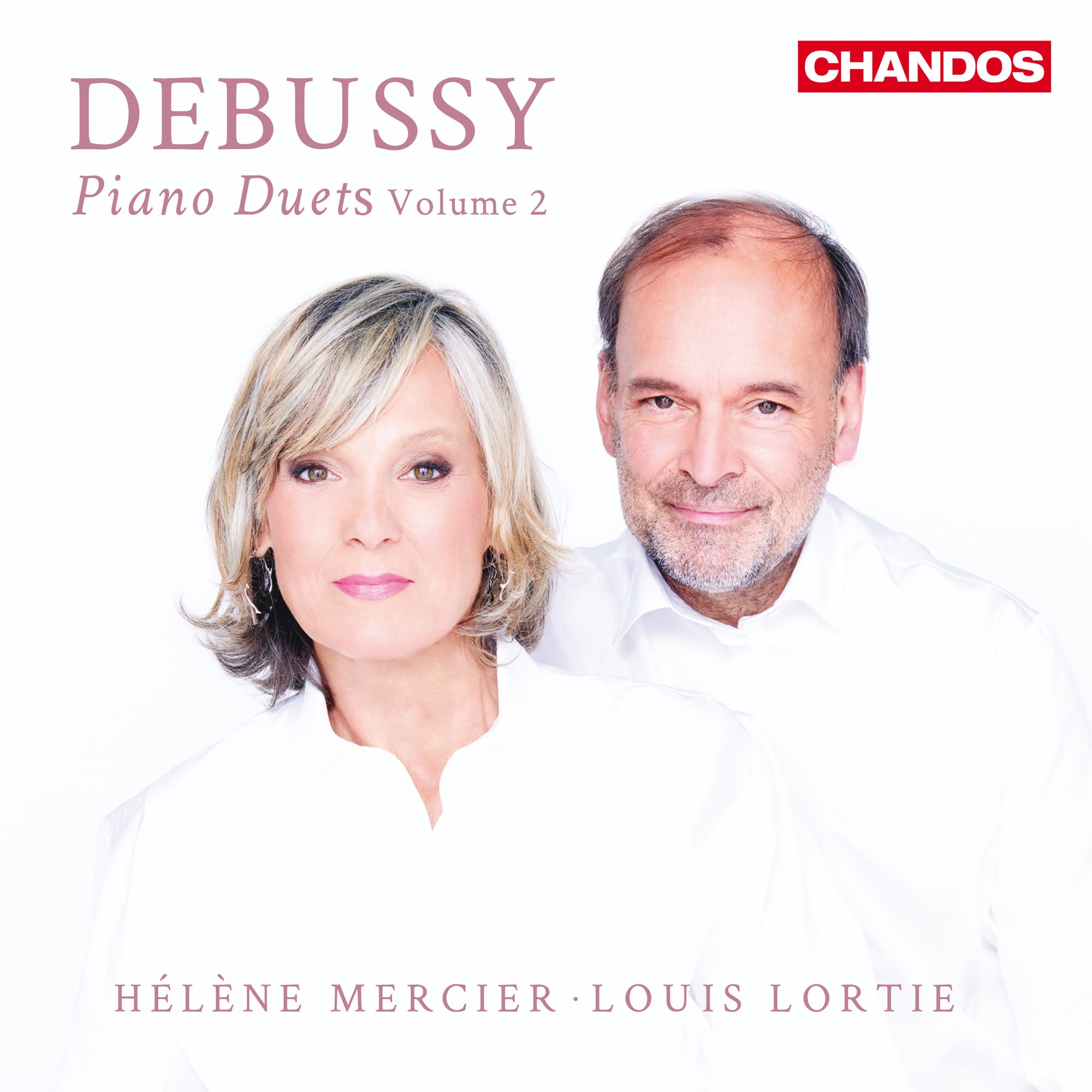
Volume Two of Hélène Mercier and Louis Lortie’s series of Debussy piano duets on Chandos launches with one of the most famous openings of all, that of the Prélude de l’après-midi d’une faune, after Mallarmé, and in a transcription for two pianos four hands by the composer. It is, as one might expect, sensitively handled, and Mercier and Lortie, a duo for many years, play as one. We have previously included Lortie on Chandos via Volume Seven of his Chopin cycle.
One can hear the orchestral thinking of the pianists in the delineation of strands and the timbral variety. More, listen to the glow of the harmonies towards the end followed by the tread of the descending lower mid0range line:
Over to Suite bergamasque, and the famous “Clair de lune,” daringly slow, offering beautifully caught half-lights; the transcriber is one Henri Dutilleux; it cedes to the more sophisticated, later harmonies of Nocturnes, in Ravel’s transcription. The orchestral version is of course, beyond compare, and as both Mercier and Lortie are Montréal-raised, here’s the Orchestre Symphonique de Montréal, under Charles Dutoit:
.00:00 – No. 1 Nuages (“Clouds”) 07:54 – No. 2 Fêtes (“Festivals”) 14:13 – No. 3 Sirènes (“Sirens”)
The clouds of “Nuages” do indeed shift slowly. This is masterly playing, not only the touch but the awareness of resonance of each note a vital part of the success:
No-one surely can eclipse Previn and the LSO in the orchestral “Fètes”, but Mercier and Lortie still give a lovely impression of the whirligig excitement:
“Sirènes” could hardly be as mysterious as in the orchestral version, but Mercier and Lortie make it work in terms of their overall conception.
IN terms of the orchestral versions, I would recommend also a rather beautiful performance on a set of “French Music” in teh on paper unlikely hands of the SWR (Südwestfunk) Orchestra, Baden-Baden under Hans Rosbaud, released as a 4-CD set on SWR Classic. Disc 1 opens with a stunning Faune, but it is the shifting colours of “Nuages” that is so memorable:
“Fêtes” glows through time (the Nocturne recordings date from 1956):
The set is astonishing: that disc alone continues with the rarer Marche écossaise sur un thème populaire (brilliantly lively)and the Berceuse héroïque before a full performance of La mer. The second disc is Rabel (Alborada and Mother Goose) and Rousssel (including the Third Symphony); the third disc includes Messiaen’s Chronochromie and two rare works by Milhaud and Ibert – L’homme et son désir and Le Chevalier entrant, respectively, while the fourth and final disc pits Honegger’s Third Symphony ahainst Marcel Mihalovici’s Second Symphony and Partita.
Bak to Chandos: rather more forgotten is Lindaraja for two pianos, and its origins are just as murky. There are elements of Debussy’s Iberian mode in the quasi-improvisatory opening. Those Spanish rhythms emerge gradually, as if from a fog. Habanera is here (Debussy was an admirer of Carmen and surely also knew Chabrier’s 1888Habanera, originally for piano and orchestrated by the composer):. Lindarajs is a little masterpiece. It is named after a garden and fountain the Alhambra Palace in Spain:
Here’s the Chabrier, with score:
A movement from Estampes next, “La Soirée dans Granade” arranged for piano diet by Jacques Durand and Léon Roques; rather neatly, it begins with a “Mouvement de Habanera”. Smoky, and yet so detailed, this is a performance of high atmospherics but also of profound depth:
Debussy transcribed his two dances (Deux Danses: a “Danse sacrée” and a “Danse profane”) for harp and strings for two pianos in 1904. The piece was commissioned the firm of Pleyel as they had recently manufactured a double harp (which had a seperate string for every note). Of course, the harp is a vital part of Impressionism (I am minded of a concert at Aix in 2025 which foregrounded this aspect). The two dances contrast beautifully (sacred and profane, in that order). Here’s the slightly more outward-facing “Danse profane” with its superbly calibrated repeated notes in this performance:
The early Rêverie (1890) is heard in a transcription by Anglo-French pianist/composer Henry Woollett (1864-1936, a pupil of Massenet and Pugno and teacher to André Caplet). Almost prayer-like at times, The warmth of the Bösendorfer pianos used suits this well, and it certainly sits in high contrast to the sudden light (“blanc”!) of the opening of En blanc et noir:
How the Primo (Lortie here) sparkled in this first movement. But the jewel in this En blanc et noir is the stunning second movement, “Au Lieutenant Jacques Chariot,” so varied, from “sombre” to “joyeux,” just as Debussy asks:
The final movement is dedicated to Stravinsky ({à mon ami Igor Stravinsky), a virtuoso close, jittery to begin with, the whole piece a cornucopia of shifting emotions within its overall “Scherzando” marking:
Finally, Le plus que lente transcribed for piano duet by Roques. This is a teasingly tender version:
Interesting to hear the composer in this piece, via a Welte-Mignon piano roll of 1913, released by the enterprising Pieran label (worth buying for the Mary Garden songs, too, from 1904 Paris G & T’s):
.
Rather neatly there is no overlap with Chandos’ release of Jeux (in Bavouzet’s own version for two pianos) with Jean-Frédéric Guy (a terrific disc).
A wonderful disc, available at Amazon here, currently a snip at £8.34 (full 47% off!). The Rosbaud French Music box is here, at just under £30. The EMI GROC (Great Recordings of the Century) re-release of the Previn/LSO disc is here. Finally, the Bavouzet/Guy Chandos transcriptions disc is here. The Pierian might be more difficult to source in physical format (it’s catalogue number is PIERIAN 0001).