


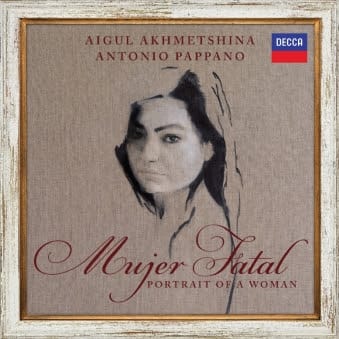
Broadly coinciding with Aigil Akhmetchina’s debut as Dalila at Covent Garden (which ran May 13-June 3), and released just a couple of weeks ago on 21 August 2026, Muher fatal – which means femme fatale – features the following repertoire:
Bizet: Adieux de l’hôtesse arabe, Op.21 No.4
Ravel: Vocalise-étude en forme de Habanera, M.51
Satie: Je te veux
Guastavino: La Rosa y el Sauce
Gardel: El Día Que Me Quieras
Montsalvatge: Cinco canciones negras
Tchaikovsky: None but the Lonely Heart, Op.6 No.6
Rimsky-Korsakov: The Nightingale and the Rose
Britten: Tell Me the Truth About Love
Weill: Speak Low
Bernstein: Lucky to be Me; Somewhere
Gershwin: The Man I Love
Velázquez: Bésame Mucho
Roussanova: Mujer Fatal
The title track is Mujer Fatal, a new work written especially for Akhmetshina and recorded here for the first time:
I had an idea for this album from the beginning, but in reality it came together slowly, like a puzzle, with each piece appearing along the way and the concept constantly evolving throughout the journey …. It began with a new piece written for me by composer Elena Roussanova with lyrics by Sheila del Bosque Fuentes, Mujer Fatal, a collaboration that grew out of my long journey with Carmen. Carmen has been one of the strongest artistic presences in my life over the past ten years, in many ways a true embodiment of the idea of the ‘femme fatale.’ Through her, I began to explore this world of passion, freedom, and contradiction, which later became the foundation of this album.
Warner’s accompanying notes tell the story of Akhmetshina:
Raised in a small village in Bashkortostan, Russia, where she sang folk songs as a child, Akhmetshina has taken an unlikely path to the world’s leading opera stages. After a serious accident early in her training left her temporarily unable to sing, she rebuilt her voice and went on to perform on the world’s biggest stages, making her breakout as the youngest Carmen ever at the Royal Opera House at just 21 and making London her home. She is now widely recognised as one of the defining voices of her generation, with The New York Times describing her as “the world’s reigning Carmen”, while in the UK critics hailed her as one of the finest Carmens seen at Covent Garden in decades.
To Akhmetshina, the idea of the ‘femme fatale’ can often feel like a cliché, a fixed image of a woman defined only by seduction or danger, and it was important for her to move beyond that:
”Mujer Fatal” is not a stereotype, but a reimagining, a woman in constant transformation, complex, emotional, strong and vulnerable at the same time. In this sense, the title becomes not a definition, but “an open space, a reflection of many possible identities and experiences.”
The songs here all explore the many faces of love and women,:
In Bizet and Ravel, there is sensuality and atmosphere. In Satie and Gardel, love feels direct and close. Tchaikovsky and Rimsky-Korsakov bring a sense of longing and memory, while Britten, Weill, Bernstein, and Gershwin introduce playfulness, irony, and ambiguity.
But at the centre of everything is Mujer fatal:
For me, it is not just a title, but the emotional core of the album. It brings together strength and vulnerability, passion and solitude, illusion and truth. All the other pieces can be seen as reflections of this idea, different moments of the same inner world.
The album marks ten years since Aigul Akhmetshina arrived in London and fulfils her long-held ambition to record with Antonio Pappano:
Working with Antonio Pappano was also a very personal milestone. It had been a dream of mine to record an album with him. He has been a guiding presence in my artistic journey, always supporting me with great care. I never expected the process to be so intimate. Often it was just the two of us, exploring the music, experimenting and shaping each piece together. Every take was different, always evolving, which made choosing the final versions both exciting and challenging.
The project also extends beyond music through a collaboration with London-based artist Teniqua Crawford, whose work was recently shown at the Venice Biennale and who created the original artwork for the album, which is a portrait of Aigul:
Meeting Teniqua Crawford shaped the visual language of the project in a very special way. There is a deep sensitivity in her work, in the way she observes and portrays women with honesty, vulnerability and strength at the same time. I didn’t want a fixed image, but a portrait that feels alive, something still forming and evolving, just like the idea of the woman in this album.”
These are brilliantly shaped, idiomatic performances from Akhmetshina, with Pappano a fine collaborator. It is interesting to hear Akhmetshina’s darkness in Bizet’s Adieux de l’hôtesse arabe, with its Carmen-like sensuality:
Interesting to compare this with the performance that appears on the 16-CD Warner Classics Bizet edition, the lighter Barbara Hendricks with Michel Dalbero::
… and then there’s Harmonia Munci’s complete Bizet Mélodies, with Marianne Croux, soprano, and Luca Montebagnoli, presented as part of a complete performance (with various singers and pianists) of the Vingt Mélodies, Op. 1. This three CD gatefold set is a must:
The French group is fascinating as it takes Ravel’s atmospheric Vocalise -étude en forme de habanera, its sinewy lines related to those of Bizet, and follows it by a characteristically pithy song by Satie, Je te veux, slinky, and in Akhmetchina’s version, decidedly sexy:
France and Russia are closely linked, and os it makes sense to cross over there for some rarely-heard Balakirev: “I loved him” (Ja lybila jega), a song that darkens as it progresses. Pappano’s contribution contains miracles of filigree, too:
Tchaikovsky’s None but the lonely heart, much more familiar with its heavenly melody, prolongs this set, followed by probably Rimsky-Korsakov’s most famous song, The Nightingale and the Rose: she shades the line of this song so beautifully:
Some may know Olga Borodina’s version of Minkov’s Landscape from The Crying Guitar on her disc, Bolero: A Spanish Songbook. Akhmetshina is if anything even more heart-breaking:
These songs are bookended by a selection of South American songs (after the initial Roussanova Mujer Fatal, specially written for Akhmetshina) and more popular songs by Bernstein, Gershwin, Weill and Britten. Here’s Muher fatal, full of longing:
Xavier Montsalvatge (1912-2002) is criminally neglected, but if we hear anything it is this set of five Canciones negras: two here, the second a lovely lullaby. Listen to Pappano’s tender opening, the melody laden with meaning:
Carlos Gustavino’s (1912-2000) music also needs to get out more; his La rosa y el sauce is more outward-facing:
Gardel’s more outward-facing El dia que me quiera, cedes to Velazquez’s famous Bésame mucho, here growing from Pappano’s quiet searching into Akhmetshina’s smoky longing:
The final group begins with Gershwin’s The Man I Love, its cabaret sleaziness directly relating to some of the first group. Two songs by Bernstein follow: “Lucky to Be Me” from On The Town, and “Somewhere” from West Side Story. The sparse writing for piano suits the desolation of an other dimension in the latter:
Ogden Nash provided the lyrics for Weill’s foxtrot Speak Low, which first appeared in the musical One Touch of Venus (1943). There was a hit single of this in 1944 by Guy Lombardi, which rather neatly also came out on Decca. Lombardi is joined by “his Royal Canadians”. I have to say, Lombardi’s voice is like velvet, and there’s a great trombone solo:
Parenthetically, here’s a clip from the movie, the moment the statue comes alive:
Finally, the only song I know that includes a reference to picking one’s nose: Britten’s “Tell Me The Truth About Love” from the Four Cabaret Songs.
It seems unbelievable that I wrote about Akhmetshina as part of the Jette Parker 20th Anniversary Gala at Covent Garden just four years ago; she also appeared (in a Carmen excerpt, unsurprisingly in retrospect) and as part of Decca’s Il Tenore, a celebration of Freddie De Tommaso.
This wonderful disc is available at Amazon here. The Warner Erato set is available for £33.97 here and the HM Bizet Mélodies here (amazing value at £20.50 for three CDs and extensive documentation)


.png?w=160&resize=160,160&ssl=1 "From Mozartian connections in Salzburg & Vienna, to London success: Joseph Wölfl's Duos for Harp and Piano from Duo Praxedis on Toccata Classics")