


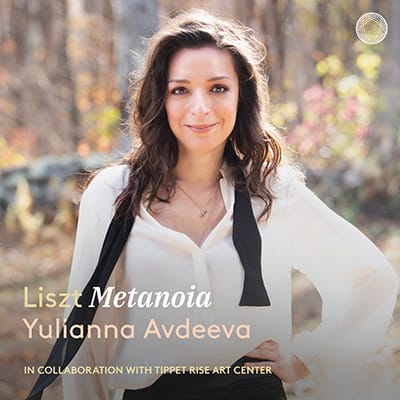
The term “Metanoia” makes sense as applied to Franz Liszt: it refers to a change of life direction in response to a spiritual event or conversion. And here we have the move from Liszt the womanising superstar virtuoso to the Abbé Liszt of his later years and his Christian devotion. This is not the first time the term has been used for a release: conductor Simone Mineses had a whole project called Metanoia, and I was lucky to hear the result in Rome some years ago
The programme therefore makes complete sense: we hear the before and the after, in alternation. Presenting the Liszt B-Minor Sonata in the context of the late music, but inlike Pollini, Adveeva presents the sonata first, so we hear the progression. With Pollini in his recital programmes, we heard late pieces such as Nuages gris first (typically a handful of them) and then the B-Minor Sonata stole in, its Modernism highlighted.
Avdeeva delights, too, in the Mephistophelian staccato of the fugal sections, with their diabolically laughing staccatos. Her achievement is not just the notes: she layers Liszt’s textures so intelligently, so the ear is led to the perfect place. Lines are perfectly projected, and the structure is laid out with high intelligence. This is a potent combination: could this be the Pollini-like grasp of structure combined with an ability to soften that Pollini was missing?
Her technique is astonishing: the climax is uncompromising in its focus and rock steady rhythm.
Avdveeva’s Sonata could hardly be more different than Pollini’s. It is strong and virtuoso, yes, but it is also intensely lyrical and full of half-lights. It has Pollini’s intelligence, but it has a soul that is far easier to pinpoint. Avdeeva is a pianist of high musicality, as a Brahms First Concerto with the LPO under Jurowski in 2014, as did a Prokofiev Eighth Sonata (one of the great sonatas, and very rarely played) alongside Chopin – the composer that brought her to fame, as winner of the 2010 Chopin Competition – at the Queen Elizabeth Hall in 2016.
The close of the Sonata curls round back to the opening like an ourobourus; out of that come the mysterious solo lines of La lugubre gondola II; for Avdeeva, the connections are emotional introspection. What a glorious world this is, and Avdeeva points out clearly around the 4-5 minute mark that this lyricism is close to the Sonata’s; the parallel seems even closer when the descending octaves that follow feel like an echo of the double-octaves of the Sonata:
The Bagatelle sans tonalité almost dances here, a scrap of the macabre; Nuages gris, with its strangely neutered G-Minorness, is a study in enigma.
The choice of Czardas macabre afterwards is perfect: a sort of deconstructed Mephisto Waltz, Avdeeva finds huge contrasts in its trajectory. Avdeeva’s shimmering textures are a miracle, a complete contrast to the grief-laden Wagner tribute, R. W. – Venezia:
One of Liszt’s shortest Hungarian Rhapsodies reminds us of the darker spaces available earlier. Hammer-repeated closely-scored chords close it off like so many full stops, while Unstern! – Sinistre acts as a bare-bones response, the repetitions there insistent. And yet its chordal sense of repose towards the end links it to the final piece, St Frances’s second Legend. While this reveals perhaps a slightly less level of resonance between interpreter and music, it remains a fine performance:
A remarkable disc, so carefully thought through, and including performances of such intense musicality it feels as if we are in an earlier, Golden Age of pianism.
This disc is available from Amazon here.


.jpg?w=160&resize=160,160&ssl=1 "BBC Proms: Bach's Mass writ large as Arcangelo give us choral bravura at Royal Albert Hall")