


Sibelius’ Fourth Symphony is often seen as a “pencil sketch” of a piece (as opposed to watercolours or oil paintings of the Fifth Symphony!). It came after Sibelius had been on the operating table (for a tumour on his throat). Shorn of his beloved cigarettes and alcohol, Sibelius took retreat in Koli.

As Andrew Mellow says in The Northern Silence, the Fourth Symphony is …
… an elusive masterpiece that breaks down, time and time again, in to a silence that lays Sibelius’ emotions bare. What music we do hear is ranged as if out of reach, echoing and glinting here and there, moving at unquantifiable speeds – wholly intangible.
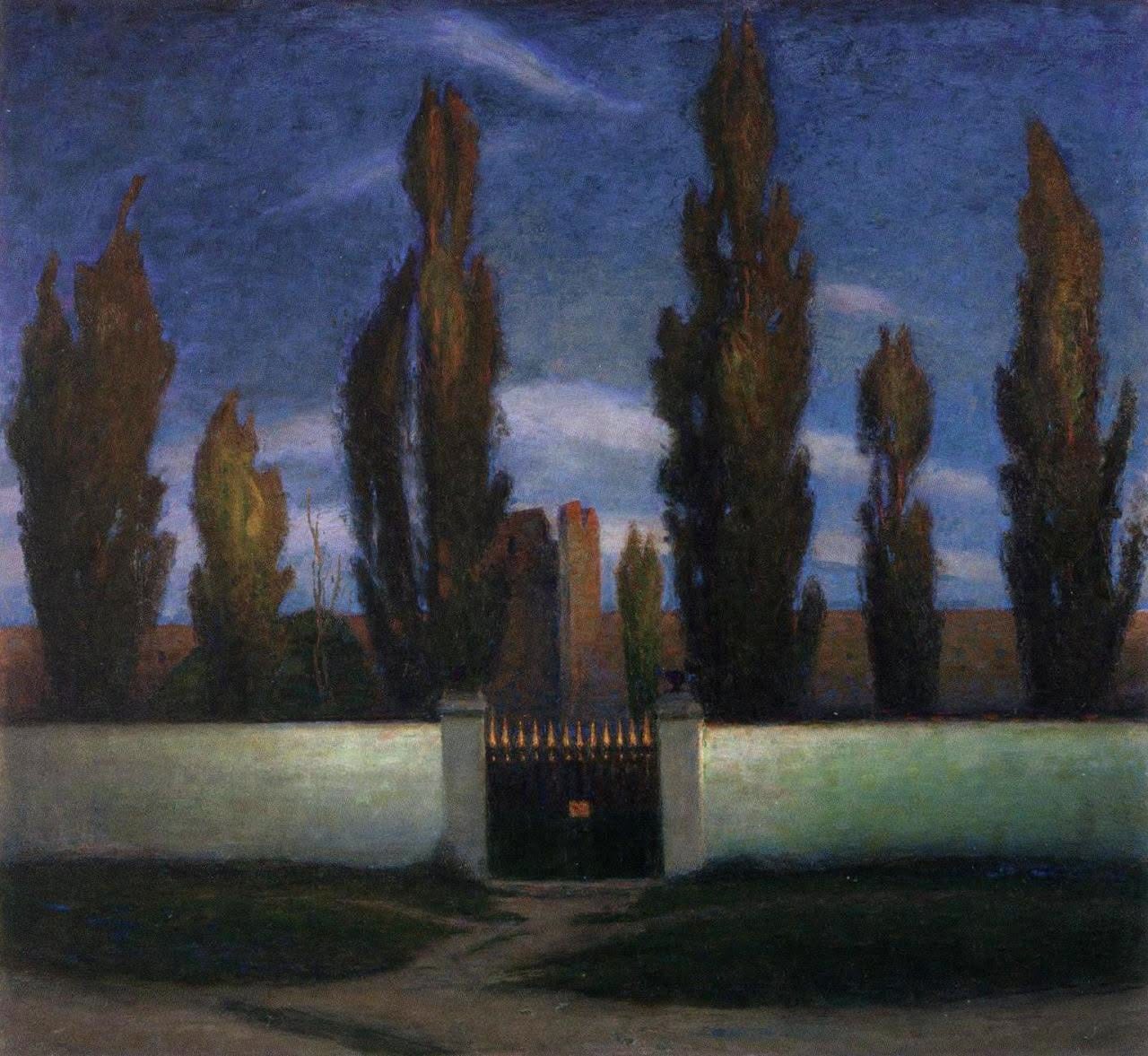
Mellor compares the symphony to the painting The Silence by Richard Berg (1858-1919) of 1893, which offers a glimpse of a graveyard behind a line of trees:
The opening Tempo molto moderato, quasi adagio exemplifies this sketchy bleakness – even the second movement Allegro molto vivace seems only on a journey to express itself fully without ever arriving:
This moves to the most extraordinary slow movement (Il tempo largo), a fractured shadow of a piece that exists perhaps in fuller form in a parallel reality:
The finale, Allegro, comes closest to glimpses of the fuller-fat Sibelius of the Fifth Symphony. But they are only glimpses – whenever the music seems more saturated, it implodes into silence, or near-silence.
While we have considered the Fourth as part of two complete Sibelius symphony traversals (Mäkelä, more outward-facing than Rouvali, and Vänskä on BIS best of these three in his resonance).
The Wood Nymph is an early work (Op. 15, 1894/5) and has much ore of a sense of momentum and directionality. Iy is a work of “inaudible metamorphosis” (Mellor) but it is also a tale of medieval forests and adventure, or so it seems with all those fanfares. There is much more repetition here in this tale of seduction linked to a symbolist poem by Viktor Rydberg. In a nutshell, a young man, Björn, wanders into the forest and is seduced and driven to despair by a skogsrå (wood nymph). This interesting blog post goes into some detail as to the legend. Rouvali’s is a fine performance, vivid in its colouring now. Interesting to trace the wood nymph in music, from Dvořák’s Rusalka through Sibelius to Novák’s Toman and the Wood Nymph (1906/7). Here’s the Sibelius and Novák; particularly impressive is how Rouvali paces the closing funeral march of his Sibelius, and how it blazes. This is one of Rouvali’s finest performances (I find him rather uneven and sometimes rather insipid, but nothing to complain about here):
Finally, the famous Valse triste. It doesn’t quite soothe (it is a dream of a dying mother in a play by Järnefelt), but the impression of a memory of a waltz in a remembered ball is strong and somehow almost soothing:
I quoted Andrew Mellow earlier from his book The Northern Silence – it is he who pens this disc’s excellent booklet notes.
The disc is available at Amazon here. Streaming below.