


“One should never composer operas”
Gian Carlo Menotti (1911-2007), composer of over 25 operas
Opera Double Bill: Bernstein, Menotti at Guildhall. Soloists; Chorus & Orchestra; Dominic Wheeler (conductor). Silk Street Theatre, Guildhall School of Music & Drama, London, 2.11.2026
Bernstein Trouble in Tahiti (1952)
Menotti Amelia al ballo (1936, UK premiere)
Bernstein
Creatives:
Director – Ashley Dean;
Assistant Directors – Eleanor Strutt & Daisie Sitlani;
Designer – Adam Wiltshire;
Lighting Designer – Nic Farman;
Assistant Lighting Designer – Howard James Shakespeare;
Movement & Intimacy Coordinator – Victoria Newlyn
Cast, Bernstein:
Cast:
Dinah – Cecily Shaw;
Sam – Twm Tegid;
Jazz Trio: Laura LeVoir, Thomas Aminfar-Antoniw, Gennady Grebenchuk
Cast, Menotti:
Amelia – Zoë Jackson;
Amante – Sebastian Hill;
Marito – Twm Tegid;
L’amica – Marianne Ruel;
Il Commissario di Polizia – Yonwaba Mbo;
Prima Cameriera – Beth Stirling;
Seconda Cameriera – Ellie Stamp;
Carabinieri – James Emerson & Gennady Grebenchuk
Menotti’s Amelia di Ballo here receives its UK premiere, but it enjoys regular if infrequent outings in Europe – and what makes it all the more interesting is the couplings of the various evenings. The Bernstein/Menotti here takes some beating because of its investigation of differently skewed relationship dynamics: in Verona in October 2026, it was coupled with Stravinsky’s ballet Jeu de cartes; at the US-China Institute of Bard College, it appeared with Gianni Schicchi (also 2026), to give but two examples. Here, it was heard with Leonard Bernstein’s Trouble in Tahiti, a one-act, seven-scene study of a fractured relationship first performed in 1952. Neatly, too, both composers provide their own libretto.
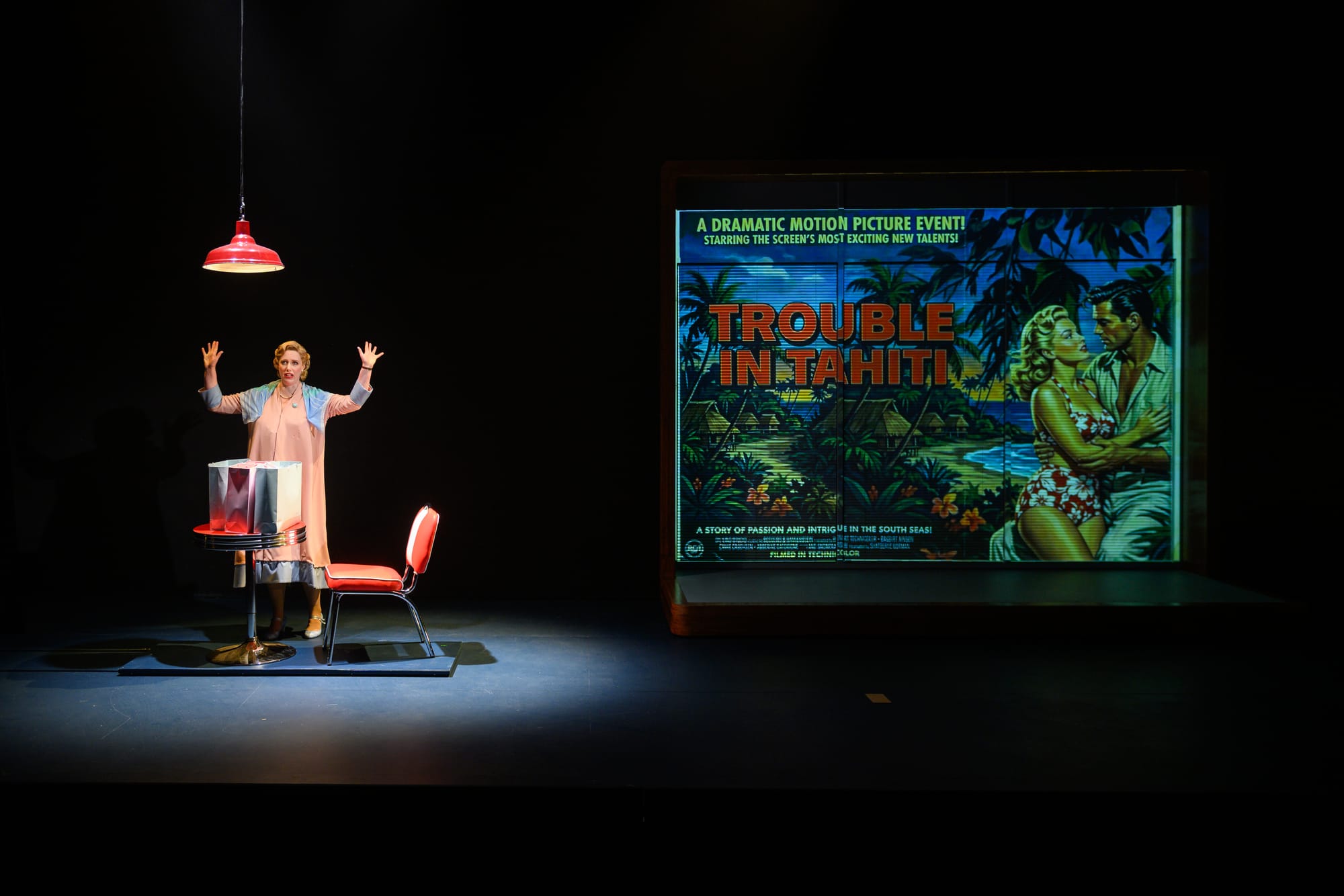
Ironically, Bernstein worked on Trouble in Tahiti during his own honeymoon, basing the story, a study in marital dysfunction, on his own parents’ marriage. The opera is centred around Dinah and Sam but also includes a work boss, a shrink, and a jazz vocal trio referred to by Bernstein as ‘A Greek chorus born of the radio commercial’. They open the opera, here the beautifully balanced trio of Laura LeVoir, Thomas Aminfar-Antoniw and Gennady Grebenchuk. Every word was beautifully enunciated, leading to a lovely blossoming of that most heavenly of swords, ‘Suburbia’. The music is pure Bernstein, jazz with spicy seasoning. The music screamed the 1950s as much as the beautifully compact and effective sets by Adam Wiltshire that underlined the contrast between the veneer of the American Dream and the eternal tribulations of relationships.
Space is brilliantly used to suggest separation that is not just physical – Ashley Dean is clearly a fine director (who was previously involved with the excellent coupling of Pauline Viardot’s Cendrillon and Bizet’s Le Docteur Miracle here, among others) who marshalls his forces – lighting (Nic Farmen), movement (Victoria Newlyn, also Intimact Co-Ordinator) – to perfection. Nothing seems crowded; and yet there is the feeling of two is a crowd in the scenes with Sam and Dinah. Lighting heightens bared emotions (when Dinah visits the psychiatrist), sometimes using light (daylight) as a metaphorical spotlight on their dynamic (the crossing of Dinah and Sam on the street, almost as strangers, a dolorous waltz).
The use of projection for a vividly colourful poster for the movie Trouble in Tahiti is a high point visually (see header photo); musically, Dominic Wheeler ensured that Bernstein’s tightly-organised score came across in the best light, his young players giving their all (despite the dry as sawdust acoustic of the Silk Street Theatre).
Mezzo Cecily Shaw did well in Dinah’s big aria when she is with the psychiatrist, (‘I was standing in a garden’), but overall I found her voice a bit of a blank slate, somewhat neutral. She sings also on November 6, so maybe all will be more settled by then. Baritone Twm Tegid as Sam threw himself into the role; while we felt both major protagonists’ pain, it seemed more potent with Tegid (who will compete in the next Welsh Singer of the Year awards in Cardiff). Tegid is possessed of a large and expressive voice, but he also carries significant stage presence.
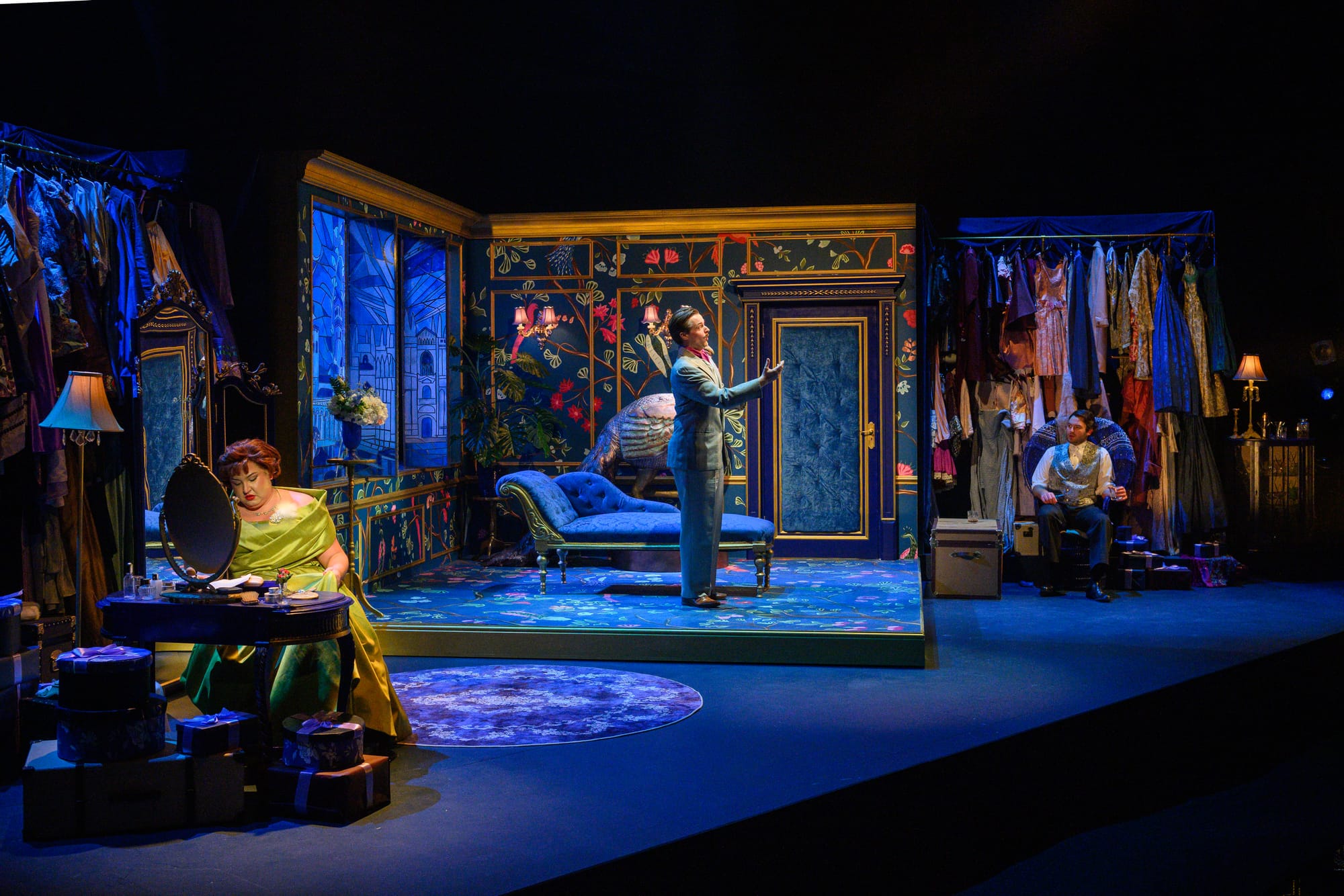
Bernstein’s score is a miracle – he knows exactly how to pace (and so does conductor Dominic Wheeler, come to that). But so is Menotti’s. The score of Amelia al ballo is sometimes seen to mark Menotti’s maturity as a composer, and it is masterly. Amelia is preparing to go to the first ball of the season. Unfortunately, her husband bursts in with proof she has a lover. It’s all about the ball, though – if he will still take her, she’ll tell him the name (he lives upstairs). Warning her lover – ‘Boobi’ he is called, affectionately and hilariously – from the balcony as her husband rushes to confront his rival, Amante slides down on a rope (to hilarious effect). A compromised pistol means the two men bond over a debate about the nature of love while Amelia gets ever more frustrated, breaking a vase over her husband’s head. The police arrive, and more chaos ensues: the lover is arrested, the husband goes to hospital, and Amelia finally goes to the ball – on the arm of the dashing Chief of Police!
The staging offers a far fuller space, with Milan Cathedral in the background sharing space with an overstuffed wardrobe. The atmosphere is totally different from the Bernstein, but as effectively conjured.
The scent of Puccini hangs over Menotti’s score; somewhat (and rightly) minimised by Wheeler so we heard more of Menotti’s own voice. Much of the score demands quick-fire delivery as the sounds from the pit froth over to the stage; all credit to each every singer for their pinpoint responses.
Again, the female lead felt a little unsettled, here Zoë Jackson. The distinctly Puccinian lines given to Marito in ‘Amelia cara’ made full effect with the strength and full tone of Tegid, though, and tenor Sebastian Hill delivered a strongly-voiced Amante.
Here is “Amelia cara,” in the Sanzogno/Scala recording, with Rolando Panerai:
Rather nicely, character names point to function: the lover is Amante (Sebastian Hill) and the husband is Marito (Twm Tegid). The finale finds a swathe of singers on stage (an unnamed ‘chorus’) and there are several smaller roles. The Police Commissioner is baritone Yonwaba Mbo who makes quite a mark in a short space; a special ford, too, for the ‘Seconda Cameriera’ Ellie Stamp, who delivers tons of character and mops up her (very, very) brief moments in the sun.
Most of all, the production – a UK premiere – pinpoints the opera buffa heart of Menotti’s little masterpiece. Given GSMD has previously staged Menotti’s The Telephone (coupled with Judith Weir’s Miss Fortune), one can only hope for more.
A most enjoyable evening, with the orchestra in fine form whether collectively as pinpoint ensemble or in individual solos. I would dearly like to hear the second cast, too … not to mention more Menotti.
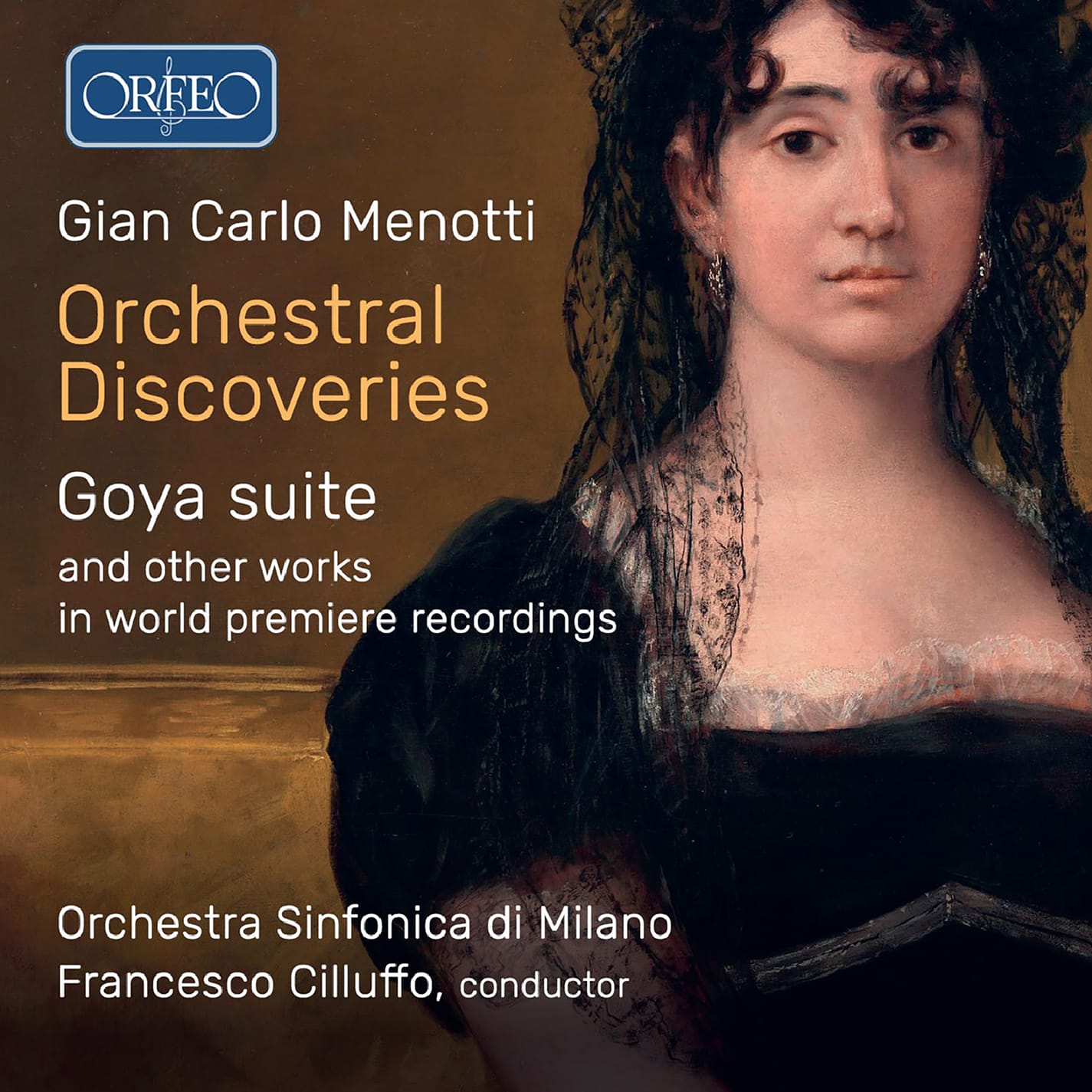
This is all very timely. The Guildhall puts on Menotti’s rarely-heard Amelia di Ballo; and along comes a disc of Menotti “orchestral discoveries’ on the Orfeo label with the Orchestra Sinfonica di Milano and Francesco Cilluffo.
A quick overview of the composer from the booklet, slightly edited:
Gian Carlo Menotti was born in Cadegliano Viconago, in the province of Varese, Italy in 1911, the sixth of ten children. A child prodigy, he started composing at the age of seven, and was encouraged and supported by his mother, who was a keen and talented amateur musician. Following the unexpected death of his father, Menotti’s mother moved the family to Colombia to help with their coffee importing business, and sent Giancarlo to the Curtis Institute of Music, in Philadelphia. The composer made his life in America, although he never gave up his Italian citizenship.
Menotti composed the first-ever opera for radio, The Old Maid and the Thief (1939, NBC); he won a Pulitzer Prize for The Consul.at Brandeis University, Mass.
Menotti seems to have an individually, recognisable voice, for sure; but does it change much across genres? The first movement of his Symphony No. 1 in A minor, “The Halcyon” could be an opera buffa overture. It is nicely light on its feet in this performance;
This is a World Premiere recording and is of the symphony’s original version. There are some lovely Stravinskian acerbic harmonies here, housed in a Neo-Classical world; and the final cadence is pure wit. The Adagio ma non troppo is beautiful, lyrical, a passacaglia with a jazz-inflected central section:
The finale is jolly in a Menotti-type way – happy dissonance if you will. We’re back in the theatre, surely, and perhaps it is Prokofiev who looks over our shoulder:
There were some cuts in the Ormandy premiere; the full score is recorded here. Here’s that 1976 premiere, taken down at Saratoga Performing Arts Center:
The disc’s opening Lewisohn Stadiom Fanfare (1965) is, perhaps unsurprisingly given the occasion, more born of Americana. The Lewisohn Stadium is the athletics field of the City College of New York and also hosted outdoor summer concerts of the New York Philharmonic, although this particular evening in 1965 was performed by the Met orchestra under Fausto Cleva. This Fanfare inaugurated the 47th season. :
As a bonus, here’s the 1963 Lewisohn concert complete, an all-Verdi affair with Jan Peerce, Maria Curtis-Verna and Jerome Hines:
I Vespri Siciliani: O tu Palermo- Hines 6:16. Ernani: Ernani involami…cabaletta- Curtis-Verna 12:22. Luisa Miller: Quando le sere al placido- Peerce 17:22. Simon Boccanegra: Il lacerato spirito- Hines 22:06. Un Ballo in Maschera: Teco io sto- Curtis-Verna, Peerce 30:25. Don Carlo: Ella giammai m’amo- Hines 38:17. Aida: Ritorna vincitor- Curtis-Verna 44:30. La Forza del Destino: O tu che in seno agli angeli- Peerce 51:28. La Forza del Destino: Final trio- Peerce, Curits-Verna, Hines
The Suite from the ballet Sebastian (1944) takes seven movements from a work that has been championed by such conductors as Dmitri Mitropoulos and Leopold Stokowski. Here’s the synopsis from the disc booklet, which begins by telling us that the setting features …
… 17th-century Venice, black magic, morbid family relations, forbidden love and self-sacrifice with a hint of religious connotation. The story focuses on Sebastian, the servant of a nobleman who is in love with a courtesan. As the nobleman’s two sisters plot the killing of the unbecoming object of their brother’s affection through black magic, it is Sebastian, also in love with the courtesan, who substitutes himself for the victim, dying in place of her
Nothing like a bit of black magic!. And listen to this spun-silk Barcarolle, the Milan strings in fine fettle:
The booklet notes suggest this anticipates “Monica’s Waltz” from Menotti’s opera The Medium. Here’s Renée Fleming:
It is complemented later by “Sebastian’s Dance,” a gentle valse triste whose restrait is punctuated by the timbre of a cor anglais; in between comes a “Street Fight” (in the manner of Prokofiev’s Romeo) and a most appealing “Cortège,” beautifully paced by Cilluffo, by some way the longest movement of the Suite:
There is extraordinary grandeur to the “Dance of the Wounded Courtesan”. Sebastian dies slowly to a stately Pavane (killed by the arrows of the two sisters). Cilliufo ensures the Milan orchestra’s sound darkens most profoundly here:
Finally, a suite from the opera Goya (1987) – the movement titles on the disc are not present in the score but are meant as guides. Written for Plácido Domingo, it was premiered at Washington National Opera in 1987. Originally written in English, it was translated into Spanish for a performance in Spoleto before appearing (in English) in Vienna in 2004, in revision. Conductor Rafael Frühbeck de Burgos conducted both premieres of opera and suite. The music is magnificently varied: listen to the deft touch of the opening of “Cayetana in the Inn” and the music’s shift to lyricism:
“The trie Duchess of Alba” is pure Menotti musical stagecraft while containing many of his musical signatures while including a spiky fugato. Some of this is gestural in the manner of a ballet, interestingly:
“Hallicinations I” are perhaps less heady than one might have imagined: they are Goya’s memories of his youth as he dies; “Love” is miraculously perfumed (again with a touch of spice), perhaps with the odd (very oblique) nod to act II of Tristan?:
There is real tenderness here, in the Suite’s final moves towards Goya’s death: “Illusions and Dreams” is heavy with sadness and yet contains moments of radiance, with the (here, beautifully judged) ascending string lines offering some hope:
A trumpet heralds Goya’s death – he is escorted into the next world by Cayetana’s ghost. We hear the Duchess of Alba’s theme, typical of Menotti’s brand of lyricism:
… is it too much to hope for a volume 2? There is so much Menotti to discover.
The disc can be purchased here; the Sanzogno Menotti can be found as a download on Amazon here. Streamings (various) below: