
Bruckner Christus factus est, WAB 11 (1884).
Mendelssohn Miserere (parody of Kyrie, MWV A 3, 1825).
Schubert Lacrimosa son io, D 131b (1815).
Bruckner Ave Maria, WAB 6 (1861).
Mendelssohn Do nobis pacem (parody of Verlieh uns Frieden gnädiglich, WoO5, 1825)
Mozart Mass in C-Minor, K 427/ K 417a (1782/3), with insert of Ave verum corpus, K 618 (1791).
A while back (2023), we covered Pygmalion under Raphaël Pichon at the Proms, using a similar format to the Requiem performance at the Barbican: Mozart’s familiar score contextualised by music around it. There was also the DVD/Bluray of Rameau’s opéra Hippolyte et Aricie.
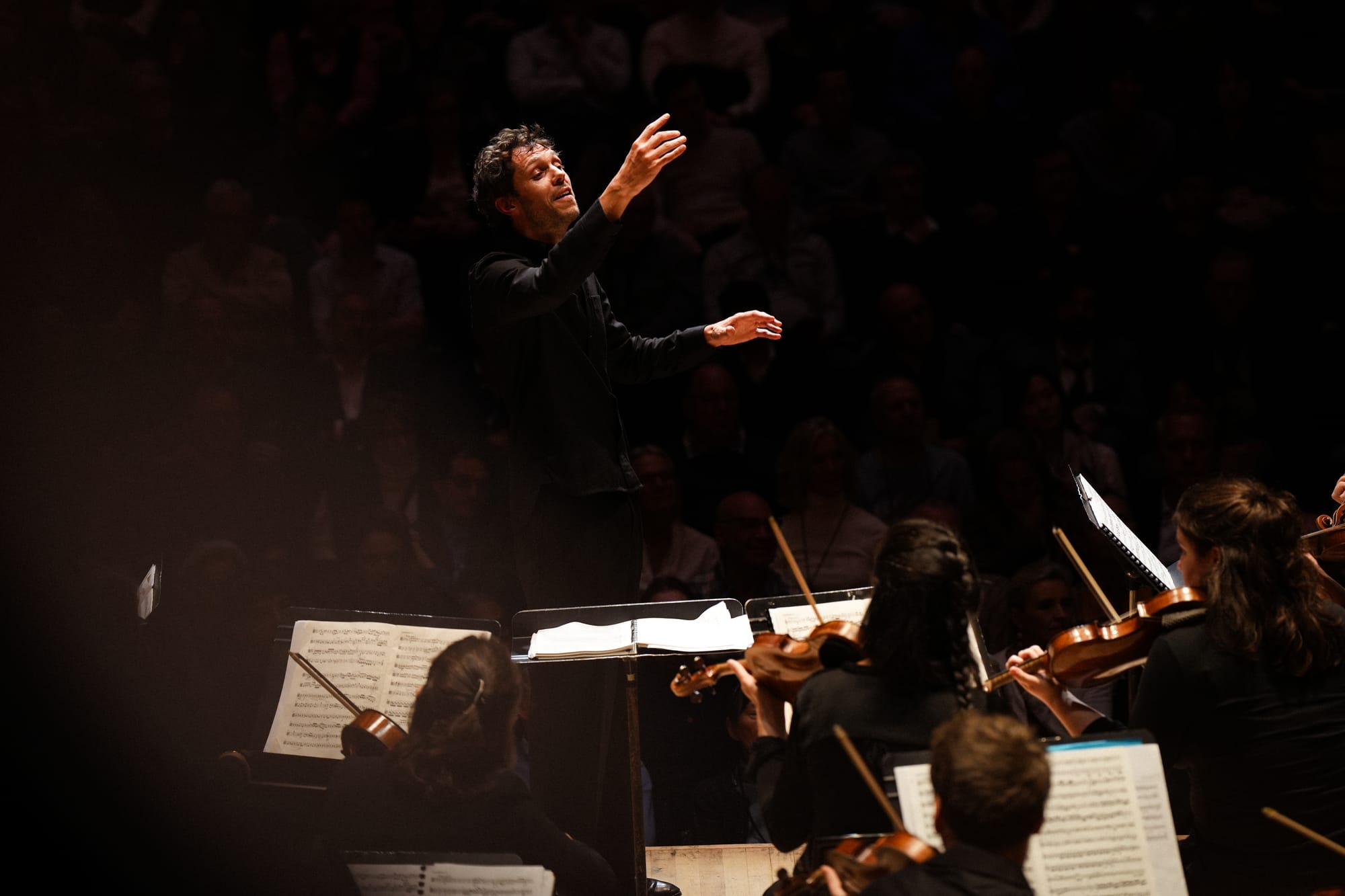
At the Barbican, Pygmalion presented a straight-through programme (starting at a very continental 8 pm) centred on Mozart’s Mass in C-Minor. By offering music around Mozart, we get to “place” him historically, as well as appreciate his debt to older musics: here, it was Bruckner, Mendelssohn (one advertised piece, Hora est, was jettisoned) and Schubert, plus an “insert” of Mozart’s own Ave verum corpus, K 618. All of these composers, in their different ways, looks back on older compositional techniques, from the canons of Schubert to the devotion of Bruckner (we would have heard a nod to polychoralism in Mendelssohn’s motet Hora est for four four-part choirs, had it not been excised). All of this allows the ear to focus on the aspect of Mozart’s Mass that honoured the tradition it came from – especially given the absence of interval. At last, a chance for proper concentration …
The Bruckner Christus factus est (Christ became obedient to us unto death) was deep and resonant; the concept of death on the cross (“mortem autem crucis”) brought fervent singing and Bruckner’s most chromatic moment. It took some of Mendelssohn’s most powerful music to equal this, the Miserere (a parody of the Kyrie, MWV A 3 to text from Psalm 51), a piece remarkably close to the world of Mozart’s Requiem to my ears (he was responding both to that and to Cherubini), And here we met the orchestra (Pygmalion) and the soloists. How eloquent the wind soloists; how perfectly together the strings; the soprano soloist Sophie Devieilhe establishing her credentials (if such were needed) with the purest of lines, while the choir caressed Mendelssohn’s lines.
It was effective the use of the Barbican Hall’s space for the three-part Schubert Lacrimosa son io, D 131b in A-Minor, a moment of pure magic for three unaccompanied voices with the first line heard emanating from the balcony. Dating from 1815, this piece was not published until 1892.
Here’s Pichon’s own recording, on Harmonia Mundi:
As Pychon rightly states in his accompanying essay to the concert, the arrival here on the word “Jesus” after Bruckner’s splitting of the choir up until then is revelatory (a “thrilling dramatic moment” is how he frames it, and there’s no arguing). The re-forming of the choir after the Schubert, its convergence on that word and the serene final “Amen” seem to bring together the music before it. It is not the final music before the Mozart Mass however: that falls to another Mendelssohn parody, Da nobis pacem (parody of Verlieh uns Frieden gnädiglich, WoO 5), beautifully paced by Pichon, and beautifully warm in sonority, too (period instruments rarely sound as inviting as this …).
… and so to the Mozart Mass in C-Minor, a performance os astonishing grandeir. The “prep” we, the audience, had been gifted via Bruckner, Mendelssohn and Schubert’s embracing of an ecclesiastical past only heightened appreciation of Mozart’s mastery in this regard, while keeping his individual voice intact. Hoe beautiful Devieilhe’s entrance (a very nasal “on” of “eleison” at one point, interestingly); how hushed the pianissimi Pychon extracts from his players – this was a full-spectrum dynamic performance. The “Kyrie” sounded all the more archaic and forceful in contrast.
The Gloria was resplendent with light. String articulation was perfect, while mezzo Xenia Puskarz Thomas excelled in her “Laudamus te,” rich and full and firm over the entire (large) range. But it was what might be termed “religious fizz” that so elevated this performance. Pichon’s achievement was to track the trajectory of this multi-segment movement so well, the Allegro aperto of the “Laudamus te” a breath of air, The minor-mode drama of the forthcoming Don Giovanni was certainly in the air in the “Gratias” while Devielhe and Thomas shone together in the “Domine Deus”.
String shards of sound initiated the relentless tread of the “Qui tollis,” dolorous in extremis; but it was the “Quoniam” that reminded us of stylistic Rückblicks , a preparation perhaps for the Two Armed Men of Zauberflöte before the tour de force of the “Cum sancto spiritu,” the rapid quavers a miracle of articulation from both choir and orchestra.
The Credo busts with Mozart’s signatures: hunting fanfares on strings – so tight here – and an unending vivacity. A word for Pygmalion’s wind soloists here, the epitome of grace in the “Et incarnatus est,” and the ideal lead-in to Devieillhe’s delivery of the text of this passage memorably described by Pichon as a “Nativity pastoral”. But it was the oboe solo of Jasu Moisio that was truly special.
The “excursion” into the Ave verum corpus was perfectly judged. opened with an uncurling in teh strings. Performed with the choir seated, the very air seemed to glow. Each phrase was shaped, Pichon’s tempo ideal, this hymn to the body of Christ unfolded beautifully. It certainly contrasted with the granitic grandeur of the “Sanctus,” brass brilliantly together and well balanced (and what agility the trombones displayed in the fugue that is the “Hosanna”).
Finally, the “Benedictus,” where all four soloists came together as a unit, Kieran Carrel’s tenor and Daniel Ochoa’s baritone wonderfully agile. Another Rückblick to past masters and simultaneous Ausblick to Mozart’s late, magic(k)al opera, the “Hosanna” seemed to sum up the basic precepts of the C-Minor Mass while offering perfection in and of itself.
An unforgettable evening. Quite right that applause was retained for the end (and enthusiastic it was, too) and that there was no interval. The result was indescribably enervating, the prevailing emotion that of hope.
Remarkable.