


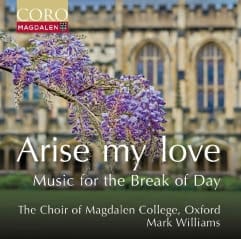
People have been going up for a very long time. So the music here fittingly spans some 500 years, from Tallis to Cheryl Frances-Hoad, music that celebrates a new day and the hope (and anticipation) it brings.
Released today (January 9), this is the Choir of Magdalen College, Oxford‘s second album on CORO (it is preceded by Peace I leave with you, which focused on day end). Magdalen College has a tradition, in addition to a weekly moving service, of singing on May Day dawn from the top of the College tower.
Mark Williams is Magdalen’s “Informator Choristarum,” the title used a Magdalen for the choral director. The music here goes back to John Sheppard’s magnificent Haec dies, himself Informator Choistarum of the College in the establishments first century of existence. Sheppard is represented by his Haec dies (This is the day which God hath made). Interestingly, Andrew Nethsingha offers a solo.version inserted between the Gloria and Credo of the Western Wynde Mass on Chandos with the Choir of St John’s Cambridge). There is a robust – to put it mildly – performance by the Choir of King’s College, Cambridge under Philip Ledger (so, a bit older) re-relesed on Warner on a disc untitled Music for Holy Week. Here at Oxford, a beautifully warm-toned choir offers the counterpoint. Warm the sound might be, but every line is clearly audible.
The disc begins in contemporary times, though, with Gabriel Jackson (born 1962) and his To Morning, which set William Blake (O holy virgin!), and an entreaty for Her to “Unlock heaven’s golden gate”. The poem is magnificent; Jackson’s setting equally so.
Tallis’ O nata lux does not greet just any morning; indeed, it was composed for the Feast of the Transfiguration. “Light born of light” is the text. Charlotte Bray’s “Winter is Past” (from Come Away), one of several settings on this disc from the Song of Solomon, does not pale in comparisou, instead holding an inner radiance of is own.
The Choir of Magdalen College, Oxford excel as much in this as in the jubilant choir and organ (Alexander Pott) Festival Te Deum by Britten, which includes a strong treble solo from Flavius Dimitru. This track alone is a fine and compelling reason for purchase:
The Britten s very much of its time and of its composer. John Tavener (1944-2013) offers a piece that is altogether more timeless in his slow-moving demeanour, As one who has slept.
Interesting to have music from another Informator Choristarum, now in the 19th century: John Stainer (1840-1901) and his How beautiful upon the mountains, beautifully underpinned by organ, a real discovery. Again, there is a sense of inner light here:
A more dissonant harmony informs Kenneth Leighton’s God’s Grandeur, a setting of Gerald Manley Hopkins’ magnificent poem. The choir delivers Leighton’s linear processes in fine fashion; Finzi takes us back to an early Metaphysical poet, Henry Vaughan (1625-95), Welcome sweet and sacred feast, which greets the day in Finzi’s characteristic mix of beauty and harmonic sophistication.
Arise My Love is the title of the disc, and also a piece by James Whitbourn, n Academical Clerk at Magdalen in the 1980s, who later produced some of their recordings until his death in 2024. The text is from the Song of Songs; Purcell’s O God, you art my God, Z 35 (Psalm 65) does eclipse it, though, a model of clean, heartfelt writing:
O come, let us sing unto the Lord is a fine piece by Cheryl Frances-Hoad – just one line of text (from Psalm 95), but with resounding harmonic arrivals:. Dyson’s Benedicite in F, along with the Britten and the Walton, presents a morning canticle, and acts as a reminder of Dyson’s stature; and asks why is he so under-rated the days? The harmonic mastery of Benedicite is beyond doubt. The text is based The Book of Daniel and Psalm 148, and delights in repetition, but Dyson offers a more varied surface, more directional. Incidentally, the Choir of S John’s Cambridge recorded the genre service und Nethsingha with George Herbert (not he metaphysical poet!) on organ. But he’s Magdalen:
John Amner is a name new to me. His Come, Let’s rejoice is indeed truly joyful in is busy choral scurryings, an.invitation to ” make joy to Him”. Like the Purcell O God, thou art my God,, it ends with an Alleluia – centuries apart, the function remains. And it loses out not one jot to Walton’s Jubilate Deo, which follows on:
Judith Wier’s Vertue is lovely, and cleanly a modern gem:
The disc closes with some Jonathan Dove. My jury seems to be perennially out with this composer. Everyone else seemed to love his opera Itch, but I preferred Simon Mayo’s book by some way. I was far more taken by his The Monster in the Maze (heard at Sheffield, and reported on at Classical Explorer here). Anyway, here, we have Ecce beatem lucem, to a text by (or attributed to) Alessandro Striggio (better known as a composer, perhaps), a perfectly pleasant close.
Arise my love presents a beautiful concept, beautifully realised.
This disc is available at Amazon here. Streaming below.