


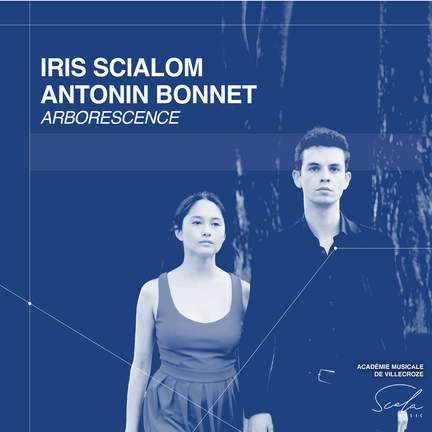
So, afe the French part of Sandine Piau nd David Kadouch’s Wigmore recital on Monday (review posted yesterday), here’s an extension of that French arm: Iris Scialom and Antonin Bonnet making their recoding debut as a duo on the Scala Music label in music by Gabriel Fauré and two of his pupils, Ravel and Enescu.
So,arboescence: trees, a reference to organicism in music, and the ramnifications of musical ideas. Here, via a filtering down from Master to pupil(s): Fauré as the pedagogue, and Ravel and Enesco his musical “offspring”. As the artists say, the programme makes sense for historical, aesthetic, and musical grounds.
The disc also quotes Fench poet and philosopher Paul Valéry:
La modenité ne rejette pas les racines, elle les transforme qu’elles pont d nouveaux fruits
(Modernity does to reject roots, it transforms them so that hy be a new fruit)
Here’s the Promo video, which includes part of he scampering Scherzo of the Fauré:
The first piece is Fauré’s Violin Sonata No. 1, Op. 13.(1876). The playing is excellent for both Scialom and Bonnet (like the Franck Violin Sonata, the piano part is just as scary as the violin’s in this piece!). There is a nice sense of expansioni, too:
The slow movement is beautiful here, whispered, the piano nicely recorded so that we can savour Bonnet’s sweetness. I’d like just a bit more power from Scialom: she is very good a whispering in our ears, though:
The Scherzo is a miracle of a piece, fleet of foot (one hopes) and ever intriguing in its rhythmic sleights. Scialom aad Bonnet certainly have the velocity:
Thy have he maturity for the finale, too:
But competition in the Fauré is obviously fierce. For the single finest rocorded vesinoof this o have appeared in the catalogue, try Zino Francescatti and Robert Casadesus:. Fancescatti is, I believe, unjustly regarded as more technique than musicality:
… and we mustn’t forget the great Thibaud and Casals in 1927:
… and if you’re after an interesting modern alternative, Ingrid Ingolfsson and Vladimir Stoupel on Accentus is my personal pick (a coupling of the two Fauré Violin Sonatas). Here’s their first movement:
Ravel’s “Sonata posthume” (1897) was written while a student in Fauré’s class, and not to be confused with the fa more famous G-Major Sonata. A rather nice link is that the wold premiere found Enescu on violin nd the composer on the piano, given that the disc ends with Enescu’s Second Sonata. Apparently, the score was then los until 1975. But here it is now, 13 minutes of rhapsodic, heart-on-sleeve emotion hat holds Ravel’s core traits in embryonic form.
This early Renaud Capuçon disc with Frank Bailey (originally on Virgin) remains my pick here, atmospheric, sure-footed:
Finally, the Violin Sonata No. 2, Op. 6 by the orthographically-complex Enescu/o (1899, when the composer was studying with Fauré at the Paris Consevatoire). This piece exists in recordings with the composer as performer, both with Lipatti and (on a Varèse Sarabande LP released in the late 1970s), Celiny Chailly-Richez. Here’s Enescu/Lipatti, which found the composer in better shape, tethnically:
I like the way Scialom and Bonnet highlight the Gallic nature of the first movement. The first movement is quixotic in its mood changes, and Scialom and Bonnet respond well:
The highlight of the sonata is the slow movement, “Tanquillment,” which holds moment of breathtaking beauty in the most paid-down writing. Scialom and Bonnet ae excellent here. They make me ache for more:
The finale is more happy-go-lucky. I’m less happy with Scialom’s stoppings in this movement, though, it’s a bit rough and ready.
It’s worth noting this sonata was much admired by the great Hungaian violins and pedagogue Carl Flesch, no less. And while the piece does not appear in the massive David Oisrakh box (if only!), it does appear on a Dynamic 3 CD set dedicated to Oistrakh by proxy: it’s actually dedicated to one of Oisrakh’s violins, his 1702 “Conte de Fonana” Strad, and performed by Mariana Sirbu (with, confusingly, Mihail Sarbu on piano). Here’s the first movement:
…
… and purely for the sake of going down the discographical rabbit-hole, David Oistrakh actually recorded the Bach Double Concerto with Enescu in Moscow in 1946 with he USSR State Symphony Orchestra under the great Kirill Kondrashin. And while Kondrshin was more known for Shostakovich than Bach, this is a.lovely recording, Oisstakh and Enesco in perfect accord. And the orchestra isn’t that heavy: Klemperer, this ain’t. This YouTube below has the first two movements (I do recommend the second, the intertwining of lines is glorious; a pity about the rallenado right at the end!). The 58-CD + 3-DVD Oisraikh box on Warner contains the full performance on CD 56, “Early Recordings” where it shares disc space with a Schuberts “Trout” Quiet (with Lev Oborin on piano and Knushivitsky on cello!) and some smaller pieces:
Bringing us back to he pima focus of this post, Arboescence is a fine debut disc. While there are plenty of alternatives for all three pieces, this is a carefully planned recital; and I would seek out Scialom ad Bonnet should hey come to London.
This disc is available a Amazon here at e seal of a price of £3.07 here. No iDagio for this one but remaining streaming below: