
We’ve met Philip Moore (born 1943) a couple of times on Classical Explorer previously: A Fugal Flourish on “Personent Hodie” on Christmas Bells, and one of his 21 settings of the Evening Service on Andrew Nethsingha’s and St John’s Cambridge’s Magnificat 3. I have also reviewed his Fantasia on Greensleeves for organ duet (!) (Christmas at Spivey Hall, on the Gothic, performed by Elizabeth and Raymond Chenault) for Fanfare magazine (Mar/Apr 2018 issue).
Here is a chance to zero in on Moore alone. He was organist and Master of the Music at York Minster for 25 years. Before moving to York, he held posts at Guildford Cathedral, Canterbury Cathedral and Eton College. He retired from the York Minster in 2008 and was appointed Organist Emeritus. The Archbishop of York awarded him the Order of St William.
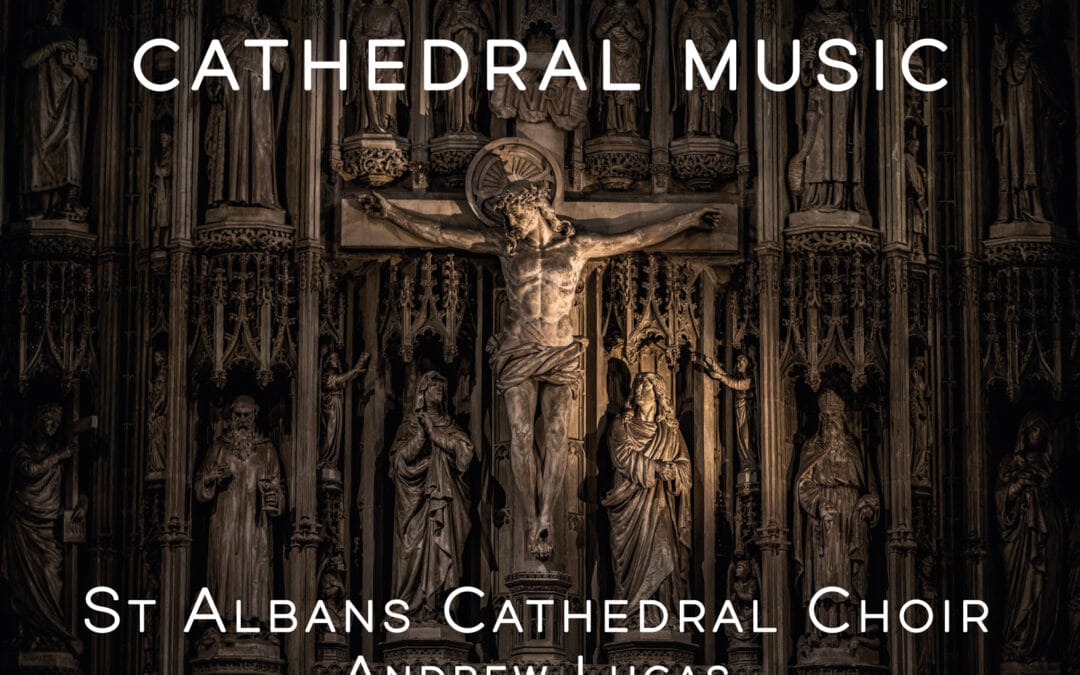
So now we land on First Hand Records and head over to St Albans Cathedral Choir (with Tom Wimpenny, organ) for a whole disc of his music. The choir is divided into 20 girl choristers and 16 boys, with four altos, five tenors, and five basses.
Here’s the promo video:
And how it begins – with Moore’s Jubilate Deo of 2001, a blaze of Christian choral light:
Of very different bent is Benedicite opera omnia, written in the wake of the destruction by fire of the South Transept of York Minster in July 1984 and for the service of Dedication in 1988. The scoring is grand (three each trumpets and trombones, timpani, cymbals, organ). For the Gloria, Moore used words by Eric Milner-White from the 1928 Prayer Book of the Scottish Episcopal Church. The music is more complex, as if grasping also the struggle of rebuilding. The following “Praise Him and magnify Him forever” is lovely, and beautifully sung by the upper voices:
After Benedicite, Benedictos with solo treble Finn Reid. It is based on a plainsong mode, Tonus Peregrinus, the so-called “wandering tone”. There is no missing the plainsong, heard in alternation with polyphony. It is a lovely take on the eternal nature of plainsong. How lovely the treble solo opening “Glory be to the Father …”, a passage added after the premiere of the work in 1984:
Composed for the installation of a new Dean at St Albans in 2004, Emmanuel again sets Milner-White (a former Dean of York). Scored for SATB choir plus three-part girls’ choir, this is full of glowing serenity. The performance is excellent, all choristers beautifully co-ordinated:
Good to have a solo organ piece (Wimpenny) – Dialogues of 2017, written for the St Albans International Organ Festival (as the test piece). There are dialogues between pedals and manuals, and Moore often plays with the total chromatic within individual phrases – but certainly not dodecaphonically. This is a fabulous piece, and Wimpenny is the ideal interpreter, the music’s rhythmic basis fully honoured.
All wisdom cometh from the Lord was written in 1980 for the 50th anniversary of Lanesborough School Guildford. It includes a wonderful baritone solo from William Houghton:
This is the most ambitious, complex setting on the disc (although not quite the longest), Plainchant-inspired Beauty rubs shoulders with glory in magnificent manner.
Dedicated to Rogers Covey-Crump, the Miserere Mei offers an alternative for the Allegri Miserere on Ash Wednesday’s Evensong. Organ pedals, hanging in the air, background There is a real sense of majesty at the climax; and how the music is brilliantly destabilised by solo voices thereafter.
Lo! God is here was written for St Paul’s Cathedral in 1997. Contrast between the timbral warmth of 18 men and the “bright intensity” of 30 boys (here a mix) became paramount to the creative process. For all oft he brilliance of his celebratory writing, it is in the quieter, more devotional sections that I find Moore speaks strongest. The organ writing is brilliant (and brilliantly played by Wimpenny), and there is the most seraphic singing from the solo trebles.
Finally, We praise and glorify thee, brass crowning the disc. Written for the enthronement of Dr John Habgood as Archbishop of York in 1983. Brass and organ interludes separate the carefully-chosen verses. A composed swell and recessional, this is a fine piece, performed with real fervour by the St Albans choir. The Sinfonia Verdi Brass Ensemble (three trumpets, two tenor trombones, one bass trombone) excels in its contributions:
Cathedral Music will be released on July 31, and is available for pre-order at Amazon here.


-DavidMonteith-Hodge-Photographisepleasecredit-Alcina2-(DMH_9148).jpg?w=670&resize=670,446&ssl=1 "A very modern sort of magic: Handel's Alcina at the Guildhall School of Music and Drama")


%20Graham%20Boulton.jpeg?w=160&resize=160,160&ssl=1 "Celebrating John Joubert at Royal Birmingham Conservatoire in advance of his 2027 centenary")