


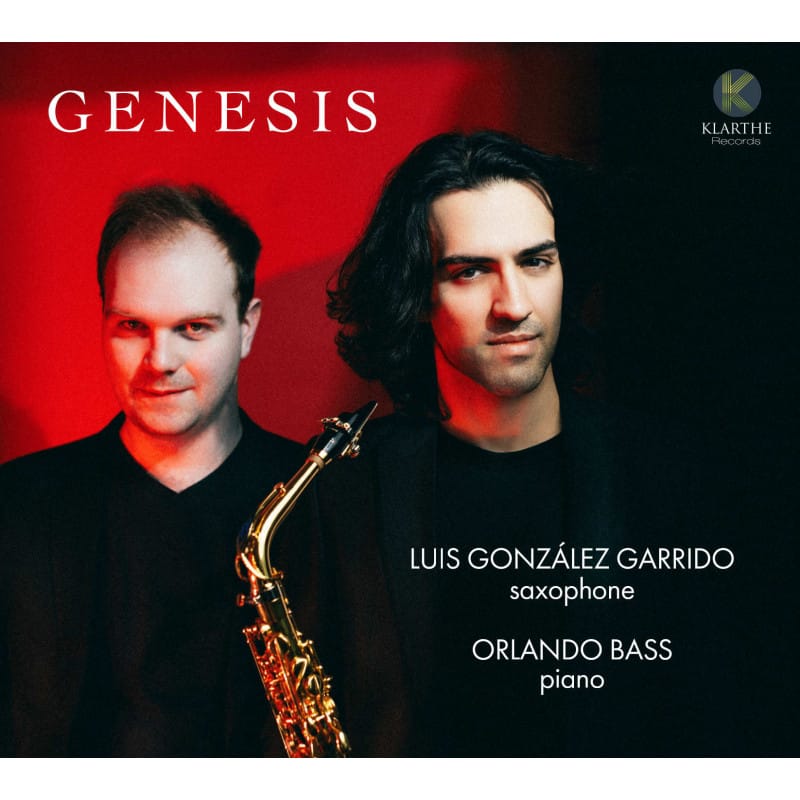
For his debut disc, saxophonist Luis González Garrido has chosen a succession of works that are fashioned from a single cell, or gesture. This process is even explicit in the title of the second piece, Fabian Waksman’s Crystal Seed
To begin with, though, Debussy’s Première Rhapsodie, best known of course in its clarinet original, but here beautifully expressive from González Garrido (who has a fantastic pianissimo); and Orlando Bass is a fine, virtuoso collbortor. The only fly in the ointment is the recorded piano sound, which is a bit shallow (and, as it is a Steinway D here, that’s a shame).
“Man versus machine” is at he heart of Waksman’;s Crystal Seed. The piano (with some Cage-like alteration, it sound like), offers an ostinato over which the sax sings. Left to its own devices, the sax becomes more “human,” but the mechanistic ostinato acts as a counterpoint (the composer ruminates on the influence of AI, its future influence, and our place in all of this). Crystal Seed “is a tribute to our human essence,” says the composer, which may account for the high-flying, exultant climax. I”m still tying to work out if the end is humorous or quizzical,though. Perhaps that’s the point?
First Debussy’s clarinet, now Pouleic’s oboe: the Oboe Sonata, FP 185. On sax, it takes on more of a sense of longing, but Poulenc’s lines lose none of their individuality. Most of all, Poulenc’s sense of enigma is fully honoured; listen to the closing bars of the opening “Élégie,” for example.
All credit to Orlando Bass (and his bass staccato) in the Scherzo; no concessions made to technique at all, this is full of scampering wonderments. But it is that pianissimo from González Garrido that is so spellbinding.
Here’s the second movement:
Vincent David offers a “kind of old French waltz,” L’éveil de la toupie, that was composed during a tour of China, a piece heady with trills. There is an influence of Debussy and Ravel here, but it is by no means the sole determining factor.
Eugène Bozza (2905-91) offers more straightforward fare in his Air; more Modernist music comes in Benjamin Attahir’s Coincidences, its opening, in Gonzâlez Garrido’s woads, a “generative core” of a trill. Commissioned by Duo Azur while Attahir was still a student in Paris, the piece is a hothouse of musical ideas, all of which strive for, but never quite achieve, completion. The version heard here is recent, the composer rcaching back into his past. The playing is stunning form both players, but particularly González Garrido, who creates multi-linear miracles.
André Caplet is probably best known for his Debussy connection; interestingly, though, his Impessions d’automne do not sound incongruous after the Attahir; perhaps an acknowledgement of the more contemporary composer’s lyrical side. Interesingly, Attahir’s El Asir was placed in the company of Debussy and Ravel string quartets on an Erato disc a few years ago (Quatuor Arod did the honours).
Finally, a sonata by Fernande Decruck (1846-1904): Cory Banfield deviously recorded it on sax for Centaur. Decruck studied with Dupré at the Paris Conservatoire. The title is simple “Sonate” as opposed to “Sonate pour …” as it is intended for either sax or viola. BUT – we can’t ignore the fact it was actually dedicated to a saxophonist (Marcel Mule) …
The music points more towards Ravel than Debussy, as one can hear in the first movement (Très modère, espresso); some headier slow arpggiations later on perhaps widen the envelope. The structure is inteesting, a slowish first movement, an Andante, a “Fileuse,” and then a “Nocturne et Final”.
A fascinating concept; a fascinating disc
Genesis is currently available fo purchase here.


,%20Flores%20(Issicratea)%20©%20Clemens%20Manser%20Photography.jpg?w=670&resize=670,446&ssl=1 "Photo essay: Cavalli's Pompeo Magno at the 2025 Bayreuth Baroque Opera Festival")


.jpg?w=160&resize=160,160&ssl=1 "Warm hearted & with a twinkle in his eye: The Brook Street Band bring out the sense of enjoyment in the violin sonatas of Ipswich-based Joseph Gibbs")