
Byrd Bow thine eare. Jeffreys How wretched is the state. Felice pastorella. A music strange. Lawes Royal Consort Sett No. 4 – Pavan. Jeffreys O quam jucundum. Whisper it easily. The Lord is thy adversity. Purcell Sonata in Three Parts No. 1 in G minor, Z 790. Jeffreys Look up, all eyes.
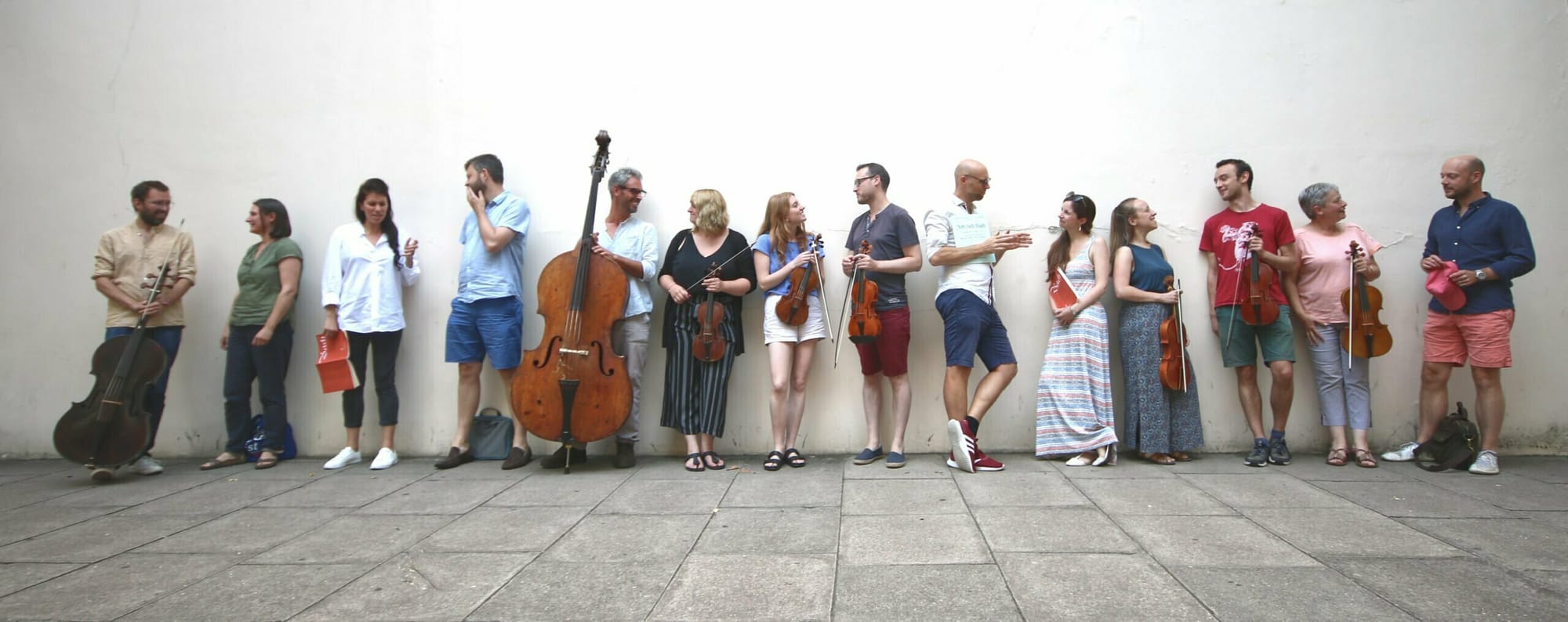
Solomon’s Knot; James Garnon, Helen Schlesinger (actors); Federay Holmes (writer/director)
Wigmore Hall, London, 24 February 2026
It was completely apt that the first music heard in Solomon’s Knot’s evening dedicated to composer George Jeffreys was some Byrd: the five-part Bow thine eare, O Lord (a contrafactum (nicely detailed definition here) of Civitas sancti tui), the one-to-a-part performance enabling each line to speak, vibrantly.
Here’s John Rutter and the Cambridge Singers Bow thine eare:
… and here’s Voces8 in Civitas sancti tui:
Jeffreys is a bridging link in English music between Byrd and Purcell (and, indeed, a Sonata in Three Parts by this latter composer was heard later); Solomon’s Knot’s devotion to Jeffreys is not only laudable, but results in revelation after revelation: do seek out their release, Lost Majesty, of Jeffreys’ sacred songs and anthems.
We know some things about George Jeffreys (c. 1610-1695), but not nearly enough; to tell his story, writer and director Federay Holmes constructed acted dialogues between the composer Jeffreys (played by James Garnon) and Helen Schlesinger as Lady Hatton (wife of Jeffey’s patron, Lord Christopher Hatton III, first Baron of Kirby), and as Jeffrey’s own wife. The proportion of spoken text to music was well-judged.
And here’s the rub: Jeffreys’ How wretched is the state you are all in suffered not one jot in comparison to Byrd.
Jeffreys’ setting of an anonymous text, underpinned by Francesco Zoccali’s theorbo, set the stall in several ways, not least the harmonic twists that Jeffreys introduces that are completely individual. Refreshing to have a brief “Amen” at the end that is all the more lovely in its brevity.
Jeffreys was very influenced by the Italian madrigal tradition, and clarity should thus be paramount, as it was here and everywhere: Felice pastorella (Happy the shepherdess) featured tenor David de Winter, joined later by soprano Clare Lloyd-Griffiths and and bass Jonathan Sells. Amazing that de Winter, standing in for an indisposed Thomas Herford, was absolutely stunning: professionalism at its finest. This is effectively an Italian cantata, the story-telling bending beautifully with the text. The last piece pre-interval was A Music Strange, balm after the spoken dramatics preceding it. And even here, there are extraordinary moments, deliberately dwelt-upon dissonances (the “music strange”) both in voices and, particularly grinding, via the organ (William Whitehead); and singers in pure imitation of the trumpets of the text (prior to “Say, men of Sion, say”). Of course, nightingales require florid writing, and Jeffreys delivers accordingly. Music that sits on the razor’s edge between haunting and ravishing, this is at once identifiably English and yet strikingly individual.
William Lawes’ opening movement from his Consort Sett No. 4 in D was a sort of pre-Bach counterpoint, the lines unveiling with the utmost ease, garlanded by continuo. Pure loveliness and a performance of the very highest level. And how Lawes’ clashes resounded with especial force after Jeffrey’s own harmonic twists and clashes in the first half.
Her’s a link to Fretwork’s complete Lawes consort music on Virgin; he Wigmore programme listed the Pavan as the opening movement, but the Fretwork performance gives its the second prefaced by a Fantasy:
‘O how delightful’ one might say. George Jeffreys certainly did, in his O quam jucundum, O quam suave (O how delightful, O how sweet), a liturgical set performed by alto, two tenors and bass. Jeffreys’ use of imitation is that of a master. There was not only dissonance here, but carefully calibrated chromaticism, too. More intimate still was Whisper it easily, the words “be not bold” teardrops in imitation. This five-voice devotional anthem is surely one of Jeffreys’ most interior, darkest statements (the subtitle is “On the Passion of our Blessed Saviour,” hence the “Passionide” in parentheses in the evening’s programme booklet).
The text here is liturgical; for The Lord in thy adversity, words are supplied by Goerge Sandys, the piece beautifully launched by soprano Zoe Brookshaw. As voices accrue, the music becomes ever more expensive: “Fried from the skies” is a high point. Jeffreys is not above some nice word-painting in the depiction of the horse in the fourth stanza (“They trust in horse, in chariots those”) with some nicely thrumming theorbo.
Purcell’s Sonatas in Three Parts are Rückblicks to a viol-heavy past of Byrd, Jenkins, and Locke. How light and agile the trapping figure was in imitation here, the perfect interlude. Here’s The King’s Consort in the G-Minor, the one heard in the concert, Z 790:
Movements: I. [Grave] (00:00) II. Vivace (01:33) III. Adagio (02:37) Presto (03:38) IV. Largo (05:01)
Organ launches the Ascensiontide anthem, Look up all eyes. Written for five voices, Garnon joined them as a sixth ‘presence,’ the melding of the man and his music. How pure was the tutti attack at ‘How shall we then sing his praise,’ which launches the final section. A perfect ending.
An unforgettable concert. Solomon’s Knot is a group at the top of its game, each singer possessed of great presence and yet they function as such a fine unit. Good to hear alto Kate Symonds-Joy in such fine, commanding form, too; her contribution to the Wild Arts Messiah last December at Smith Square Hall will not easily be forgotten. Most of all, though, it was the conjunction of educational revelations (Jeffreys as English ‘missing link’) and pure enjoyment that impressed so much. More, please.
Here’s the promo video for the CD:
The Solomon’s Knot disc of Jeffreys is available at Amazon here.