


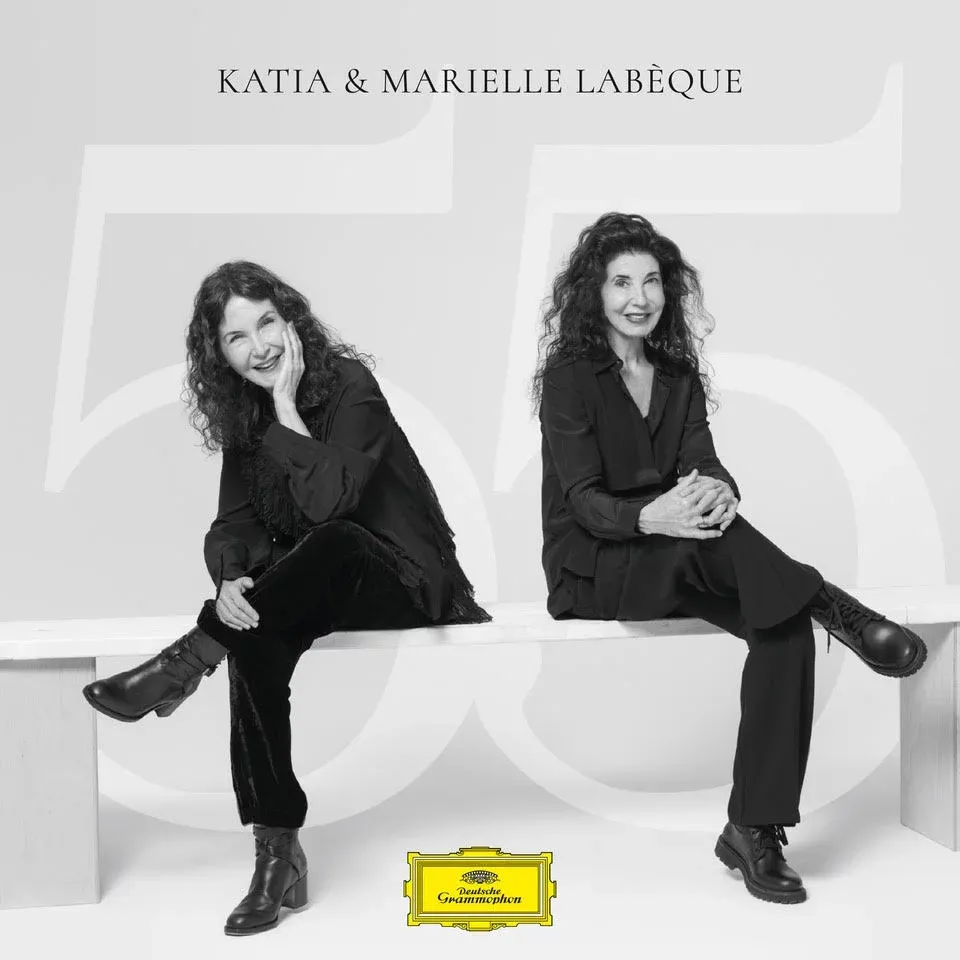
What a life the Labèques have led: a life saturated in music, and making music together for over half a century. A life celebrated here in this wonderful three-CD set, a recorded journey that began under the auspices of one Olivier Messiaen in a 1969 recording of the Visions de l’Amen.
55 years; 55 pieces, of which 25 are new, neatly split into three headings: Wild is the Wind, Bright Garden, and Points of Light, together a testament to the sisters’ commitment to contemporary music, to music for piano (whether duet or duo), and to togetherness itself.
Wild is the Wind
The first disc takes its title from the first track, Wild is the Wind (Tionkin/Washington, in a transcription by Michael Blasky, after Nina Simone’s version of this song). Here’s Nina Simone, in 1964, released on the 1966 album of that name. Simone appears with Lisle Atkinson (double-bass), Bobby Hamilton (droms) and Rudy Stevenson (guitar):
Here’s a link to the full album.
The Labèques’ version is spacious, almost dreamy. But within that is total adherence to line, to texture, and to controlled freedom, but rising to an almost symphonic climax before a fantasy-fuelled final few bars:
Margaret Bonds (1913-72) has been a regular visitor to Classical Explorer’s pages, appearing on Samantha Ege’s Lorelt disc, Black Renaissance Woman, plus Ege in concert at Milton Court (Spiritual Suite – of which Troubled Water is the third movement), via Troubled Water on Janeba Kanneh-Mason’s Sony Classical disc, Fantasie, to Yuki Negishi’s recital that included another Troubled Water. The performance by the Labèques (streamable at the foot of this post) is remarkable, alternating power and tenderness. Here’s an alternative take, from France Musique:
This disc includes (equally divided between Katia and Marielle, of course) solo numbers. The first comes from Katia, a new 2026 recording of a piece by Ethopian pianist, composer and nun Emahoy Tsegue-Maryam Guèbrou (Wikipedia; she is usually known just as “Emahoy,” a religious honorific, which helps counter the different spellings one encounters of her name!):
There is an almost gnomic, Satie-like aspect to Emahoy’s account; Katia is just that bit more outward-facing:
… and do watch this stunning video of Katia playing David Chalmin‘s Valse noire for M.:
Marielle gets her turn with a piece by Grażyna Bacewicz (1909-69): the fourth of the ten Concert Etudes, a harmonically spicy toccata – and what a bejewelled touch Marielle has. Again, there’s a superb video from DG:
.. and a nice idea to prolong our Bacewicz journey with the first of that composer’s Trois Pièces characteristiques, an Allegretto of mystery. Difficult to believe this is only 1″37 – so much is packed in here:
Continuing the theme of women composers, Dora Pejačević‘s Nocturne, Op. 50/2 from Katia, where the improvisational element of some of the jazz earlier on the disc seems to influence Katia’s brilliant freedom:
The music of Philip Glass is an important part of the Labèques’ work, and here we have a solo performance (Katia) of “Helen’s Theme” from Candyman, so perfectly Glass (his musical signature is unmistakable) and yet also intimately related to the pervading sense of dark melancholy of this first disc:
Glass is one of many musicians who have paid tribute to the Labèques:
Like many people involved in today’s music, I have long been an admirer of Katia and Marielle Labèque’s performance of traditional and new concert music for duo pianos. I was very happy to hear their brilliant playing and interpretative skills with my own music. The Labèque sisters are tremendous performers and extraordinary supporters of music—not only modern music, but music itself. It was great to work with them.
An alternative Minimalist is posited via David Chalmin, and his “Romeo’s Poison” from Star-Cross’d Lovers short but poignant, and finding Marielle on top form:
A different, more dynamic Minimalism appears for the 12th of William Duckworth’s The Time-Curve Preludes, Katia on sparkling form. This piece’s energy is perfect for her (the recording comes from the Labèques’ release, Minimalist Dream House):
This has signifcantly more propulsion than Emanuele Arciuli’s acocunt:
In a departure from the usual duo, Katia is joined by Chick Corea for Bill Evans’ We Will Meet Again (from Evans’ album of that name). Here’s the original:
And here’s Katia and Corea, in magical accord, on the album Blue:
Everyone knows “Somewhere” from Bernstein’s West Side Story: here it is in the tenderest of arrangements by Irwin Kostal – listen to how the theme seems to blossom like a flower at dawn:
Nice to have a transcription of a guitar piece – the original is enhanced by strings and more in Paco de Lucia’s original of Canción de Amor:
Joan Albert Amargós’s arrangement highlights the melancholy inherent in the music (which acts as a fine contrast to the de Falla “Spanish Dance No. 1” from La vida breve that follows). The articulation from both Katia and Marielle in the latter is out of this world:
But most of all, and this is total personal preference, I love the controlled zaniness of François Janneau’s arrangement of Stride pianist James P. Johnson‘s Carolina Shout. Here’s Johnson in 1944 (the piece itself dates from the 1920’s):
.. and here’s the ladies, tidier, for sure, and jauntier perhaps:
Finally for the first disc, the finale of the Gershwin Piano Concerto in F, performed sans orchestra, but plus a massive dollop of virtuosity. The music just flies, repeated notes abuzz with energy (as are glissandos). Here’s a YouTube that shows the original, memorable, cover:
Of a Bright Garden
And so, a step back in time for disc two, Of a Bright Garden. Mendelssohn first – Felix, it is important to state, as we must not forget Fanny. Arrangements of Felix’s Lieder ohne Worte (Songs without Words), the first such arrangement by Isabelle et Florence Lafitte, bejwelled, mysterious: the Song without Words, Op. 8/1:
How beautifully Fanny’s Mélodie, Op. 4/2 complements this, the melody so free, so inspired:
It was Henriu Dutiileux who arranges Debussy’s Suite bergamesque, “Clair de lune” for two pianos and who signals a shift from the Mendelssohns’ one pian,o four hands to two pianos. Such a delicate piece needs the touch of a Durtilleux to make the arrangement telling, and how he does, taking it one step more to liminality:
A nice idea to have two of Nadia Boulanger’s Morceaux played firstly by Katia, then Marielle. They a e certainly post-Debissian, the first suddenly harmonically shifting to the darker corners of Debussy’s Faun.
The Homage that follows is filled with beautifully melancholy. By Muriêl Biel Bosedorp, it pays homage to Marie Jaëll, one of whose Valses is the very next track:
The music shifts to Iberia for some Albeniz, unmistakably heavier-scented. But it is the revelation of Montgerault ( that lingers, a beautiful Nocturne in the guise of an Etude (No. 110!) unmistakably Romantic but couched in an individual voice try Clare Hammond’s BIS disc of that composer’s Etudes for more Montgerault).
It si good to have the familiar, too: a movement from Dolly Suite (Fauré), the darkness nicely spotlit, and great to have two sides of Ravel: the outward-facing “Le jardin féerique” (Fairy Garden) and the Pavane; a nice link to have Ravel’s transcriptions of Debussy’s “Fêtes” (from Nocturnes), too. Rarely can this last piece have sounded so exciting, the recording capturing the strength Marielle’s bass with utter clarity. And what finger strength from both!:
Interesting to insert a Dvorak Slavonic Dance in between so much French music (Bizet follows on), but it’s a terrific performance of the A-Major (Op. 46/5); the arrival at Jeux d’enfants‘s “La Poupée” is a bit of a crash, frankly:
.. here is all of that Bizet (Jeux d’enfants), with score:
The disc is rounded off by a similar sort of juxtaposition: Dolly Suite‘s famous Berceuse (langorous, lovely) against a Brahms Hungarian Dance (not the motst famous: No. 12 in D-Minor).
Points of Light
The final disc of the Labèques’ 55 set concentrates on modern and contemporary music, beginning with some wonderful music by Luciano Berio, Memory (1969, for two pianos or “piano and electronic piano”), one of the “softest” of the 20th-Century Modernists and at his softest here. Some of the harmonies point towards Stravinsky.
Here’s the composer on this piece:
“Memory” for two pianos, written in 1972 and dedicated to Peter Serkin, has existed in different versions: an older one for piano and electronic keyboard, a second for two pianos and a third, written in 1973, which is now the opening section of my Concerto for two pianos and orchestra.
The texture and the harmonic material of “Memory” are in fact mouldable: they can move to different directions, they can assume different forms. They can also take on fleeting traces of distant gestures…
:
.. here’s the 1973 version, performed on electronic piano and electronic harpsichord by Aldo Orvieto, electric piano, and Fausto Bongellli, electric harpsichord, an altogether different, sort of “hazy Cageian” soundscape:
… and here’s the Concerto for Two Pianos, conducted by the composer:
Composer/Conductor: Luciano Berio Piano: Antonio Ballista Piano: Bruno Canino London Symphony Orchestra
It’s interesting how the Labèques, performing on two acoustic pianos, actively invoke electronic gestures around the five minute mark. Photos of Berio working with the ladies are in the booklet, as is this tribute from composer to pianists:
… as for Karia and Mariellem I have always been moved by their way of playing.
Two pieces by Estonian composer Arvo Pärt follow, the first arguably his most famous, (Für Alina, which exists in multiple instrumentations, here solo piano, Katia) and Pari intervallo (both Katia and Marielle). Für Alina is deceptively simple, as there’s a lot under the bonnet, not least the composer’s “tintinnabuli” style, explained in this section from the Arvo Pärt Centre’s website:
The piano piece Für Alina is one of the most petit, yet one of the most significant works in all of Arvo Pärt’s oeuvre. It was born in February 1976, the first work in a number of years, with which Pärt emerged from a prolonged creative crisis; it is also his first piece to be written in the tintinnabuli style.
As is characteristic to the tintinnabuli style, the music of “Für Alina” follows a few strict mathematical rules. For instance, the voice of the melody grows by one note in each bar and, reaching its maximum (eight notes) begins to diminish again. The free-flowing melody is united throughout the piece with the so-called tintinnabuli voice, always following its nearest triad. These two voices are united into an inseparable whole. Interestingly, the composer allows himself to break both of the rules. The first time is when the voice moving through the b minor triads steps aside, stopping on the “false” c sharp note. This tiny but very striking acoustic event is further accentuated by the breaking of the pedal point that has been held down throughout the piece. The second rule is broken in the final bar, when the melody, which by now should be reduced to just a single note, is suddenly followed by three further notes, as if a new song, a new journey might still begin from here. It is remarkable that this natural union of strict rules and internal freedom, so inherent to the entire tintinnabuli music, should manifest itself already in the first work written in this new style.
Another major keyword to characterise all the tintinnabuli music and its aesthetic is silence. In Für Alina, it is present not just as the silence framing the piece, but, paradoxically, silence has been written into the music as an acoustic space of sorts. As a hint for the pianist, the composer has noted that the piece be played “in calm, uplifted manner, listening to one’s inner self”.
Für Alina can be considered the key composition of Arvo Pärt’s tintinnabuli style and, symbolically, the starting point for all of his later work. Many listeners also seem to associate it with the beginning of new life because since the release of the album Alina by ECM Records (1999), the composer has received numerous messages telling him that his Für Alina has been played at the birth of a child. Moreover, many of the girls that were born listening to the music have been named Alina. The “real” Alina of the piece was the daughter of Lithuanian theatre scholar and a close friend of Arvo and Nora Pärt, Irena Veisaitė, they were separated by the Iron Curtain — the daughter being left in England and the mother in the Soviet Union.
For a long time, official documents listed the ensemble Hortus Musicus as the first performers of Für Alina, as it was first heard—among other works—at the first evenings devoted to tintinnabuli compositions, the now-legendary concerts on 25 and 27 October 1976 at the University of Tartu and in the Estonia Concert Hall in Tallinn. All of the Pärt works performed that night formed, in concept, a single cyclical whole and were given a shared title, Tintinnabuli, in the programme. In the Hortus Musicus performance, Für Alina was played on two string instruments, with Andres Mustonen (viola da braccio) and Taivo Niitvägi (viola da gamba). In fact, however, Für Alina had already been heard months earlier—as a spontaneous, i.e., unannounced encore—at the solo recital of the young pianist Rein Rannap on 23 March 1976 in the Estonia Concert Hall.
Pari intervallo grows out of Für Alina here. Written in 1978, the two piano version only came about in 2008. Cast in E flat-Minor, one “voice” only plays notes from an E flat-Minor triad, the other moves in thirds to it:
Bryce Dressner’s Goiza Larrunen is stunningly played by Marielle Labèque, seen here in a filmed version.. Dressner takes Beethoven’s Op. 27/2 (i) (the first movement of the so-called “Moonlight” Sonata) or a walk, and its juxtaposition with Glass emphasises rather nicely a proto-Minimalist aspect to the Beethoven:
Perhaps Beethoven is seen as a “peak” here as the Basque title refers to the mountain Larrun (also La Rhune) in the Western Pyrenees on the Basque coast between France and Spain: Goiza Larrunen means “Morning on Larrun”. Certainly, the repetitive element maps to Michael Riesman’s arrangement of some Glass: the beautiful “La chambre d’Orphée” from Orphée. Let’s supplement the box with a live performance at Paris’ Cité de la Musique:
Captation produite par la Philharmonie de Paris Cyril Teste, direction artistique Nina Chalot, scénographie Mehdi Toutain-Lopez , création numérique, lumière Maison Francis Kurkdjian, création de parfums
This stands itself in contrast to the chattering “Les sœurs” from “La belle et la bête” (again in Riesman’s arrngement), surely a gem in Glass’ output: the linear workings against that ever-even chattering are remarkable:
The final Glass piece is from Les Enfants terribles, “The Somnambulist”: The repeated ascending scales remind me of Glass’ opera, Akhnaten, while encapsulating perfectly the “points of Light” title to this disc. There is quite the film to go with this:
“Points of Light” does indeed follow one of two excerpts from Dressner’s El Chan, the atmosphere now more subdued, the “points” themselves “pointillist”:
Interestingly, it is as if those points of sound coalesce in Dressner’s “Coyote” (also from El Chan):
.. and you can hear a complete performance of all nine movements live from the famous Teatro, Buenos Aires Colón from October 2019:
I. El Charco del Ingenio II. Points of Light III. Four Winds IV. Ballade d’Allende V. Coyote VI. Pool of El Chan VII. Mountain
… and it’s not too fat to the end of Part I of Stravinsky’s Le sacre du printemps, “Danse de la terre,” given in a rip-roaring performance which nevertheless keeps all the details (including the layering Stravinsky uses towards the end):
That seems to segment the final disc, ending a first part; it is Pärt that follows, at his most Messiaen-like: the Hymn to a Great City (1984). Here’s some background to the piece:
Hymn to a Great City sounds a little exceptional among Arvo Pärt’s oeuvre. The composer has almost never composed for two pianos, and this piece is also written in an unusual key: C-sharp major. There are only hints and hidden elements of the tintinnabuli style here. It has been designed according to the compounding principle, where sequences of triads are used in the cycle of fifths instead of tone rows. Receding from the main key is achieved by the constant tonic-dominant succession, but only to return ‘home’ soon afterwards.
… and here’s the performance, which originally comes from the memorably-namesd album, Minimalist Dream House:
I love the careful planning of repertoire here: from Pärt to Howard Skempton’s own expertise with pithy statement as a bridge to John Cage! So, two pieces by Skempton, from his Images (1989): Prelude 7 and Postlude, played with hypnotic subtlety by Marielle. Hr careful placement of chords in the last is nothing less than a representation of a pianistic ideal. Here’s the Postlude:
… and here’s a link to the full album, Minimalist Dream House.
John Cage feels just a heartbeat away, and so it is. And quite right to honour him here: his Experiences No. 1. I love the description of this piece from the LA Phil website, especially the bit about Swiss cheese:
This slow, careful, unaccented work for two pianos is as light and holey as a Swiss cheese. It was written at a time when Cage was coming under the influence of the Indian composer Gita Sarabhai. She had convinced Cage that the purpose of music was “to sober and quiet the mind, thus making it susceptible to divine influences.” Cage’s response was to seek a kind of musical Tai Chi: slow-moving musical exercises that incorporated silence were the result. Following the lead of Satie, he dispensed with forward momentum and harmonic narrative and instead brought in a calm consonance – parallel fifths and octaves – modal harmonies and Indonesian scales, structuring through balancing sound with silence. The work was written for a new dance piece by his boyfriend Merce Cunningham.
This is an early piece (1945). The Labèques bring a sort of swing to its Orientalist tendencies – and rather nicely make the silences speak. It is astonishing how the Satie (“En plus”from Trois pièces en forme de poire) emerges so naturally from the Cage:
The mists settle in them for Satie’s take on Debussy from Avant-dernières pensées, the “Idylle, à Debussy”), itself sequeing into the gentle sway of the Larghetto from Stravinsky’s Les cinq doigts (the five fingers in question belong to Katia). Inspired.
The final couplet is Stravinsky and Messiaen – the Petrushka “Danse russe” in Victor Babi’s arrangement and the “Amen de la consummation” from the Vingt Régards. The evenness of some of the Stravinsky is jaw-dropping, while the Messiaen is positively ecstatic. There is a change of recording quality as we move back from 1983 (Stravinsky, bright, almost a Pollini-like piano recording) to 1970 (Messiaen), but the power of the composer’s harmonies speak through:
An astonishing set, a testament to the Labèques’ achievements so far, but also a way-station, surely setting the scene for their next chapter?
At the time of writing, the set is unavailable at Amazon except on LP. Here’s the link to the CDs for when it comes back into stock.