


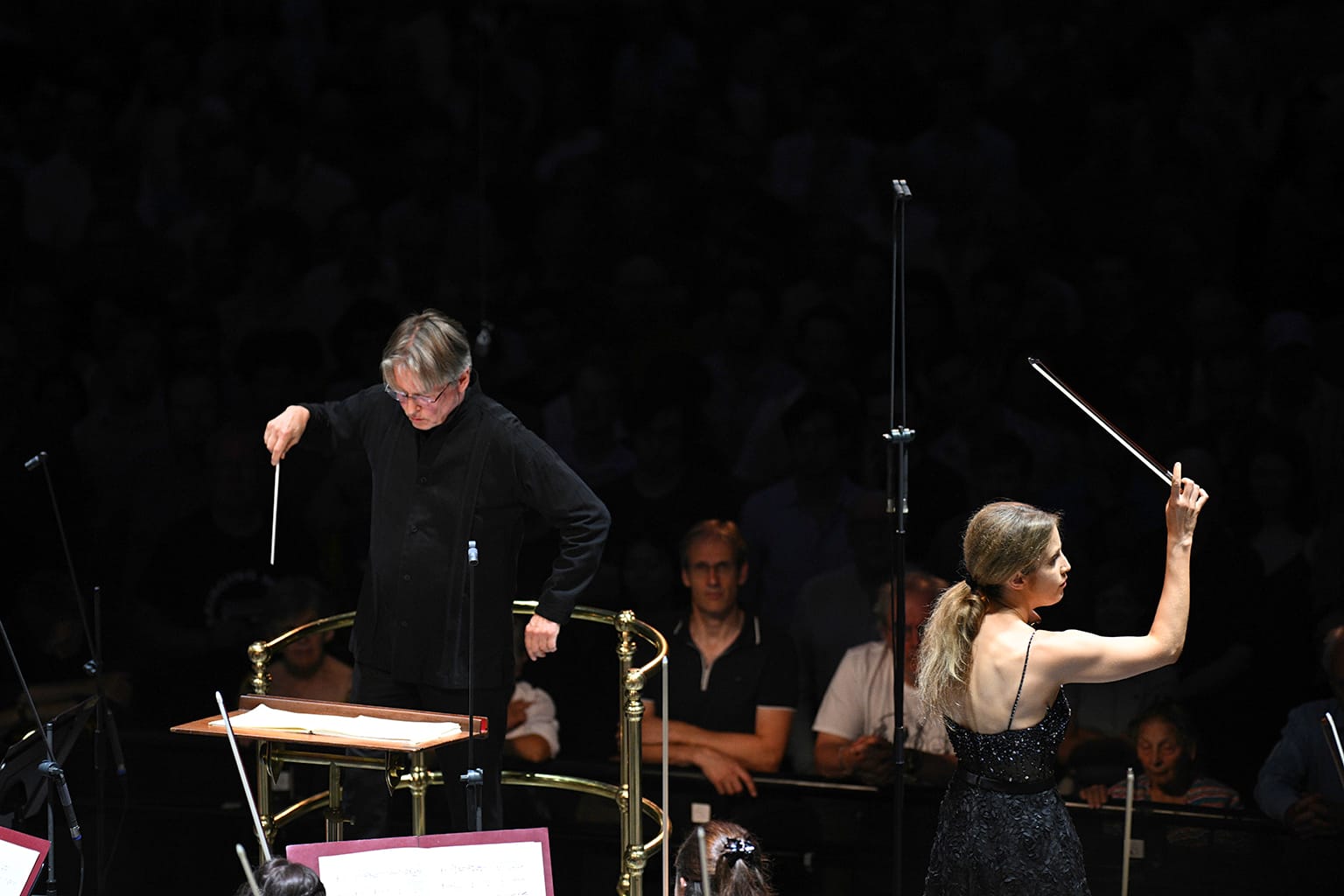
Stravinsky Symphony in Three Movements (1942-5)
Berg Violin Concerto, “Zum andenken eines Engels” (1935)
Bartók Concerto for Orchestra, Sz 116 (1943, rev. 1945)
Back at the Proms, players from Juilliard Orchestra and the Royal Academy of Music Symphony Orchestra combined to create a College super-orchestra. This London performance follows on from their concert of the same prorgamme at the Alice Tully Hall of Lincoln Center, New York on Friday, August 7.
The traditional youth orchestra Prom is that of the National Youth Orchestra of Great Britain. Here, it was a “supergroup” of students from two sides of the Atlantic led by the Juiliiatd’s Katya Moeller (who studies with Masao Kawasaki there).
Entitled “Salonen conducts 20th-Century Classics” (populist, but there’s no arguing with it), the evening began with a performance of Stravinsky’s wartime Symphony in Three Movements. Salonen launched straight in (I’m told that in New York he started before his second foot was on the rostrum. There are many effects in Stravinsky, so this approach is totally congruent). There was plenty of energy, for sure – not everything was spot-on, and inevitably in the Albert Hall bath-house acoustic, some detail got lost (some of the low strings quavers towards the end of the first movement). But there was character aplenty.
Salonen moved quickly into the second movement – far too quickly for the Albert Hall ushers, who let in a swathe of latecomers, some of whom got lost and ended up taking seats half-way through the movement. This second movement uses material Stravinsky had intended for the score for the 1954 Franz Werfel film The Song of Bernadette. Salonen plumped for a swift Andante – he is generally not known for lingering – and offered a lovely flow, a pair of oboes particularly entrancing, as were the passages for solo strings. Salonen is hugely experienced in this music, and it showed in the beautiful juxtaposition of sections.
The finale was abuzz, with some terrific contributions from pianist Dohyun Lee and the trombones (once, together in pointillist joy). Not everything was perfect, notably several messy horn passages (great upward glissandos in the finale, though). The arc of the concert was incremental, though …
Vilde Frang is a superb violinist, ever-musical, as her performances of Mozart with Amitai Grosz in China with teh Greater Bay Youth Orchestra under Daniel Harding proved (covered for the now sadly defunct Classical Music magazine. She plays with real intimacy, and so it feels right to include in the title of Berg’s Violin Concerto, “Zum Andeenken eines Engels”: To the memory of an angel. The tenderness implicit in this seemed particularly relevant to Frang’s interpretation – the “angel” in question is Manon Gropius, the 18-year old daughter of Alma Mahler and Walter Gropius, who died of polio in April 1935.
In interview, Frang talks about “needing the heart” for this piece. But of course, the piece is a masterpiece of construction, and Salonen and Frang conspired to weave the complex textures ,and elements (dodecaphony based on a triadic ascending row that closes with whole-tones), folk songs and a chorale) into a convincing whole. If Frang asserts she is the heart, Salonen is the brain, offering laser-like clarity. Together, the two made a whole greater than the sum of their parts. The move to the gentle syncopated motion after the establishment of the pitch set was as smooth as can be, the solo double-bass perfectly audible. So much polyphony was audible, and individual solos were uniformly superb (horns more confident now). If Berg’s techniques of combining twelve-note composition with tonal allusions reconciles supposed opposites, so the combination of Frang and Salonen enabled a parallel revelatory approach.
And how the players communicated with Frang: a recurrent phrase ends with a crescendo and a dismissive close; soloist and orchestra have to mirror each other , and how they did here.
Frang has the ability to imbue playfulness with saturated regret. And how she appreciated the function of her part – towards the end, she turned away from Salonen, communicating instead with the gossamer strings, a vital part of the overall texture, (just) first among equals. It was Salonen who not only shone light on details, but who allowed for that sense of harmonic motion that makes the arrival of the Bach chorale “Es ist genug” (one of that composer’s most chromatic examples, from the cantata BWV 60, O ewigkeit, du Donnerwort). Folksongs appeared as if through a window to a different reality, garlanded on occasion by Frang’s oh-so-controlled harmonics.
You can hear the chorale in its original setting in this performance of the complete cantata: the chorale starts at 14″30):
On a technical level, never have I heard that last, stratospheric violin note sustained so securely, so beautifully. Throughout, Frang’s sense of line was impeccable, intuitive. Her cadenza, with its remarkable combination of pizzicato and arco, was both commanding and heart-rending. Here, I did expect an encore, but (perhaps rightly given the work’s basis, perhaps because of BBC timings), there was none.
All credit to the orchestra, too: this is challenging music, still, nearly a century post-composition, and they excelled, just the occasional passage losing a touch of direction. The combination of youthful vitality and Salonen’s all-encompassing technique made for a memorable performance. Salonen’s clear in-depth knowledge of the score was everywhere apparent,
Here’s an alternative performance by Frang, with Currentzis and the SWR (South West German Radio) Symphony Orchestra. See also Classical Explorer’s posts on Currentzis’s Beethoven Fifth and Seventh.:
00:04 Andante – Allegretto 11:45 Allegro, ma sempre rubato, frei wie eine Kadenz – Adagio
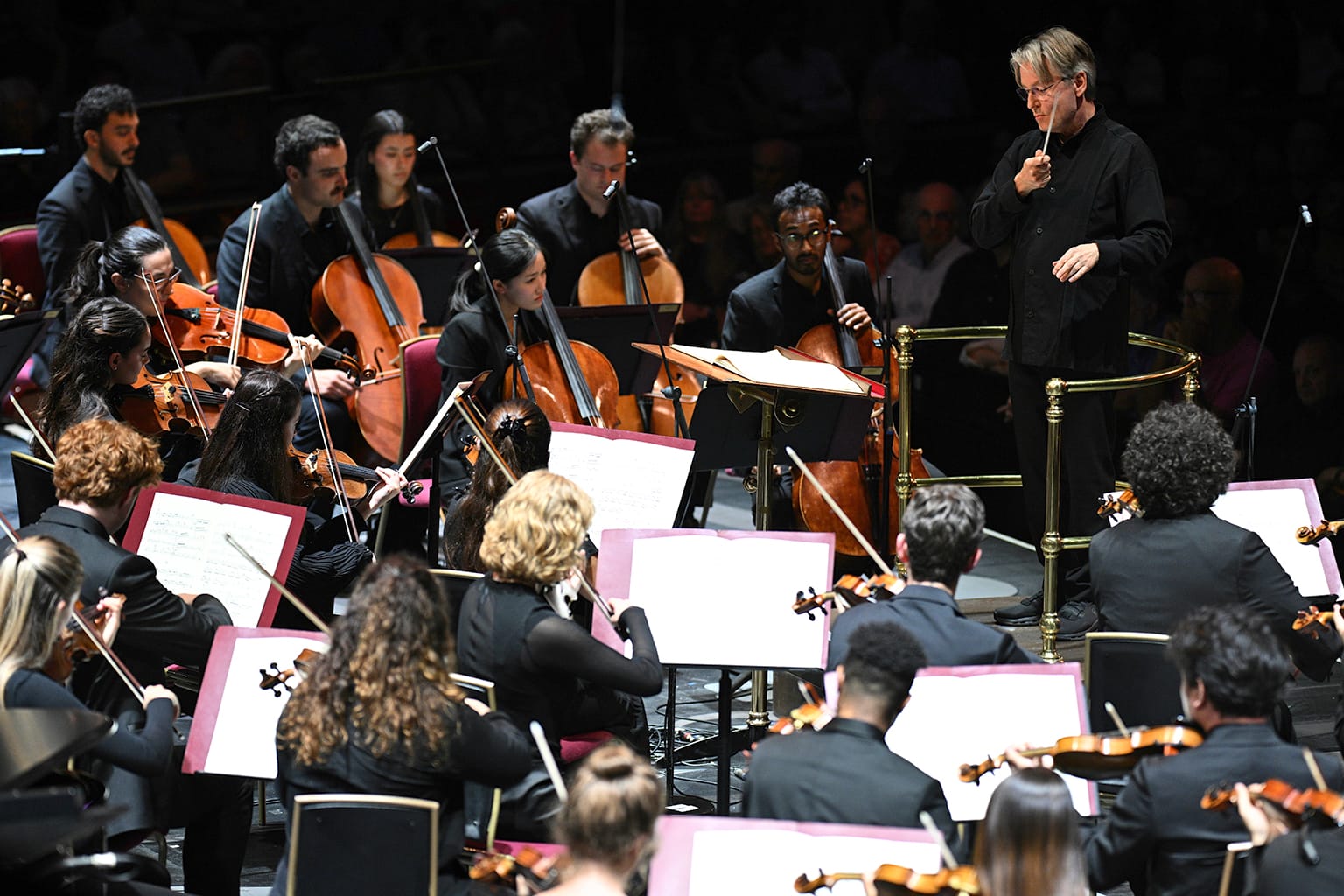
Salonen is right to find darkness in the score of Bartók’s Concerto for Orchestra amidst the light. There was huge tension in the opening movement, and a momentum that felt unstoppable. No surprise that the first movement accelerando was perfectly calibrated, nor that, from the score’s shadow, that phrases drooped as if lowering their heads. Counterpoint was a vital component, more highlighted than usual.
Looking back in the concert, interestingly enough, pairings – two bassoons in the Stravinsky, two clarinets in the Berg – stood out, which could be heard to presage the “Dance of the Couples” in the Concerto for Orchestra. What character there was from the players, two trumpets a joy. And all credit to Juilliard percussionist Chu Wen (April) Ong who both launched the movement impeccably and whose every entrance was perfectly judged. Salonen’s tempo was brisk, to say the least, arguably just a touch too much so; but what a performance.
It was the balancing emotional power of the “Elegia” that really hit home, though, Bartók’s “Night Music” . The moment Bartók gives the lower strings a big tune brought a strange moment of a parallel with Holst’s “Jupiter” (it could have been marked “nobilmente,” interrupted by the light, characterful oboe that launched the movement. The Shostakovich “Leningrad” quote was one of the best renditions I have heard, cartoony, comic-strip mayhem leading to an Ivesian mélange. But here, there was tenderness, too, set against the fervid string scamperings of the finale, a close cousin, surely, to Stravinsky’s “Shrovetide Fair”. The brightness of the score suited the brightness of the orchestra’s core sound, the bassoon-led woodwind fugato a moment of contrapuntal extravagance shape-shifted into a bassoon song. Salonen’s reading is as chameleon-like as Bartók’s music, one minute taking us to a folksy party, the next to music of brass-drenched heroism. Remarkable.
A ‘Galop’ by Stravinsky from his Suite No. 2 for Small Orchestra as an encore – hectic, manic, virtuoso, spicy – acted both as encore and as Rückblick to the equally manic Shostakovich quote in the Bartók. Genius programming. It’s an arrangement of a piece for piano duet – here’s the Labèques on DG: