
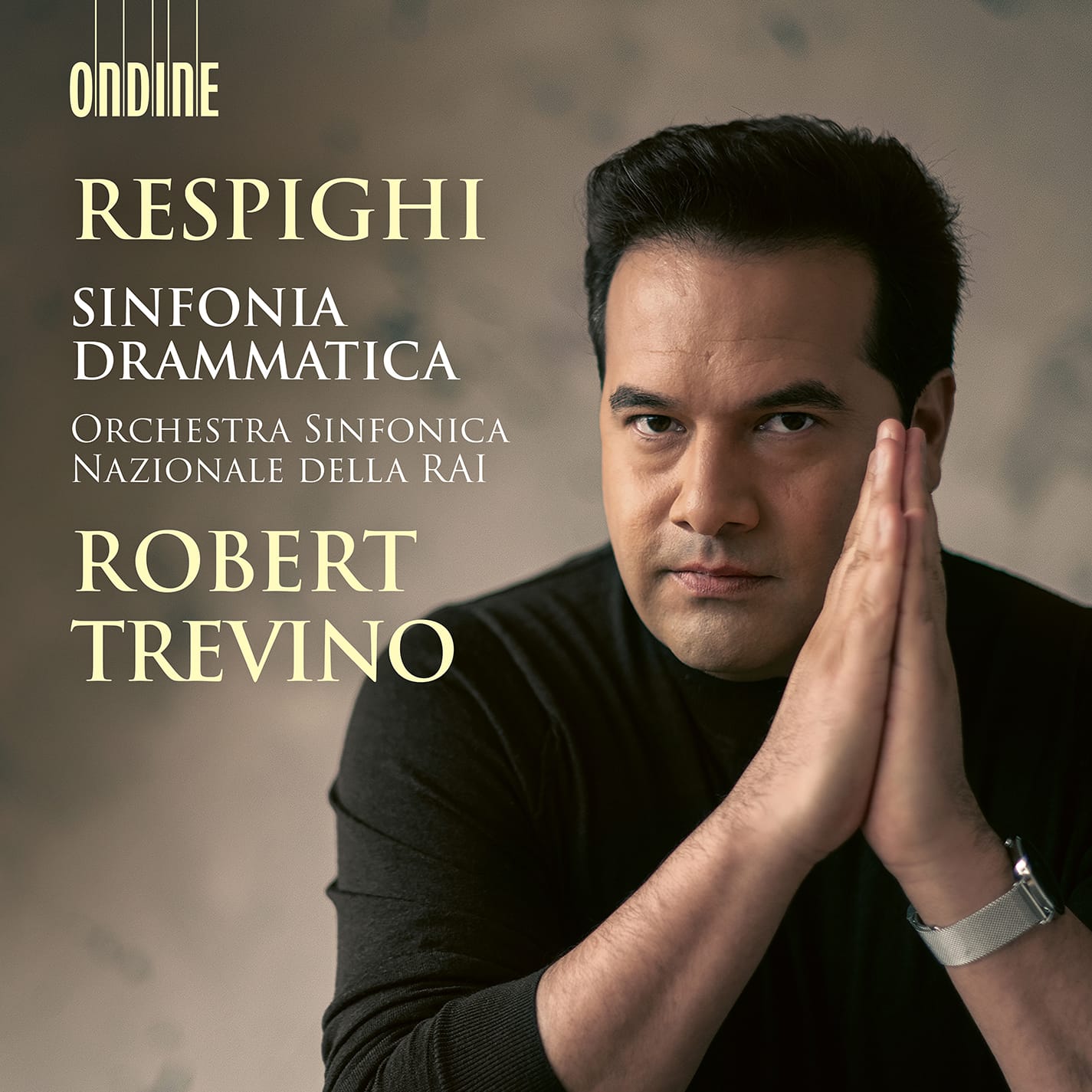
Here’s a symphony that lives up to its name: the outburst that opens Respighi’s Sinfonia drammatico (1913-15, P. 102) is a late-Romantic explosion, and al the music seems to want to do thenceforth is get back to that extreme of emotion.
Think Richard Strauss/Zemlinsky or even Schoenberg’s Pelleas und Melisande, but with an Italianate twist. The achievement of this performance is to be entirely convincing of the work’s merit – via what sounds like an extreme adherence to the score. Strings are so tightly together (even under duress). Robert Treviso knows when to let the music stretch and when to keep it taut. Strings also have no sense of strain in their upper reaches.
Another point of comparison I’ve seen is Alfvén’s Fourth, which we considered in this post.
There is something of the symphonic poem about each movement. That said, the arrival of the development of the first is more than evident, and Respighi’s sense of exploration is palpable (and he is at his most Straussian here).
The score can be approached in a number of ways: with an Italiantate/Russian (Respighi studied with Rimsky) angle, with a focus on colour (as the Slovak RSO/Nazareth on Naxos – originally Marco Polo, or “Hong Kong Records International” in teh States does) or a more Germanic sense of symphonic excess (Downes/BBCPO on Chandos). Treviso, for me, straddles them, offering a massive colour palette supported by a simply wonderful recording while not for a moment shying away from the score’s darker recesses and allowing climaxes to emerge naturally as a result of his appreciation of Respighi’s processes, both thematic and harmonic. Both Treviso and Neschling (on BIS, with the Liège Philharmonic) appreciate the deep seriousness of the score:
Trevino’s recording is staggering – it captures the force of the climaxes but also every detail of the quieter moments (try the solo violin towards the end of the first movement).
A word for the RAI’s terrific clarinettist in the Andante sostenuto con grande espressione. Expansive melodies prevail, strings doubled by French horn adding a touch of Sreaussian swashbuckling. The trombones play a vital part in this movekent, played with sombre authority by the RAI musicians. Trevino guides the work with authority.
A lot of the critical reaction to this symphony uses words such as “sprawling,” implying it is diffuse. It is certainly expansive, but the meeting of stream-of consciousness and symphonic structure seems to my ears to give it a real individually. Climaxes arrive naturally, the result of complex thickets of ideas that go through an emotional wringer. Moments of rest do offer glimpses of serenity, even of transcendence :
The finale begins with a grim turbulence, rhythmically maximally disjointed, garlanded by woodwind shrieks. It’s passionate stuff, Wagner now fully in the mix, together with a good dollop of Strauss’ Alpensinfonie.
This is conductor Robert Trevino’s second album release of orchestral music by Ottorino Respighi (1879–1936), together with the Orchestra Sinfonica Nazionale della RAI (the first offered the Roman Trilogy). The Sinfonia Drammatico is available from Amazon here; the Roman Trilogy, for some reason priced at £23 for a single disc, here. iDagio here.




%20Graham%20Boulton.jpeg?w=160&resize=160,160&ssl=1 "Celebrating John Joubert at Royal Birmingham Conservatoire in advance of his 2027 centenary")