


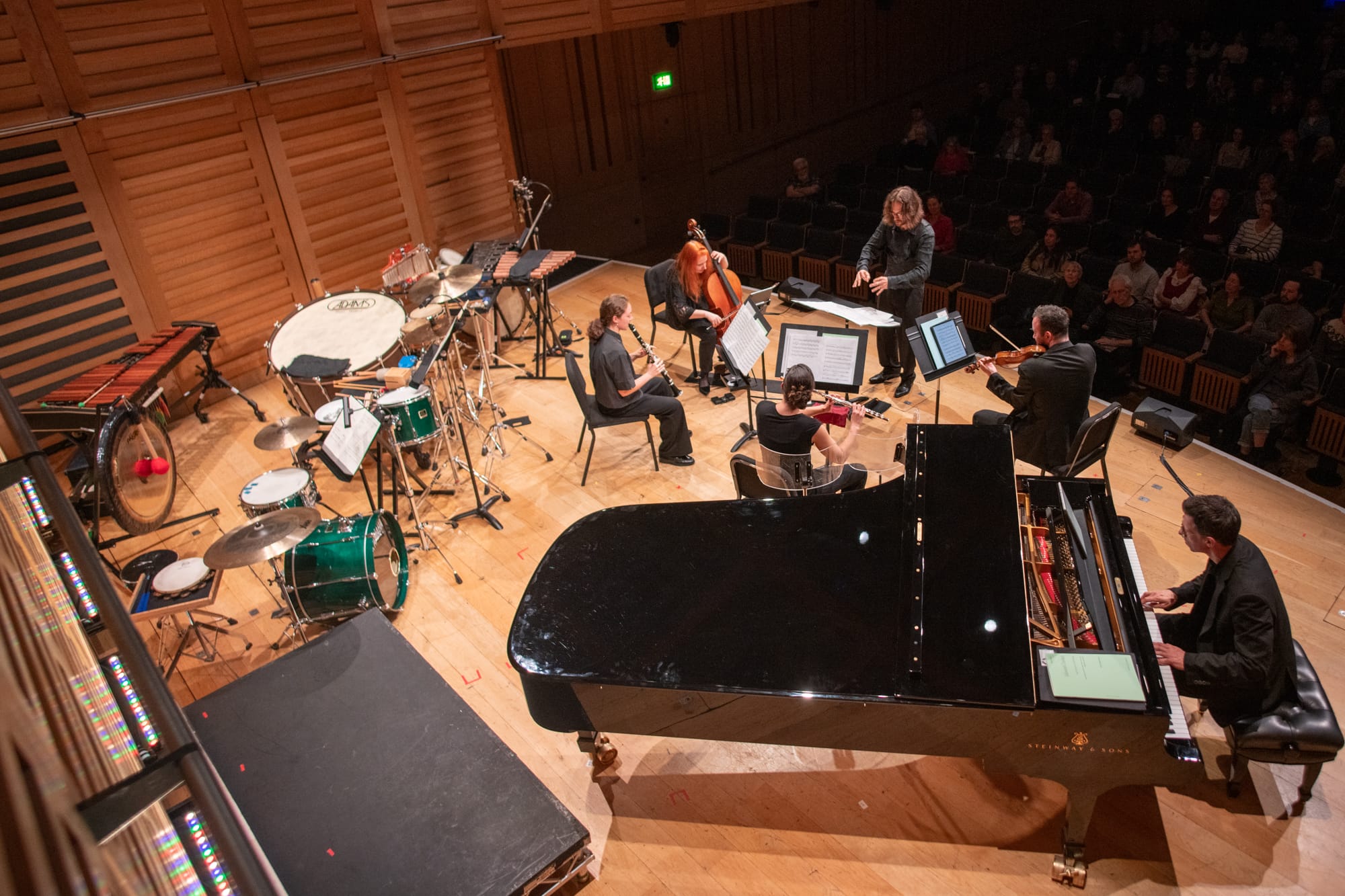
8 Songs for a Mad King Soloists; Manchester Camerata / John Andrews (conductor); Company Chameleon (stage direction). King’s Place, London, June 6, 2026
Judith Weir Blue Green Hill
Errolyn Wallen By Gis and By Saint Charity (with Rebecca Hardwick, soprano)
Schumann Kreisleriana, Op. 16 (arr. Simon Parkin)
Maxwell Davies 8 Songs for a Mad King (with Rosie Middleton, mezzo)
Various states of madness informed this concert. Perhaps Judith Weir’s distortions of Scottish folk song offered the first alterings of reality; Ophelia entered in Errolyn Wallen’s By Gis and by Saint Charity, while Schumann’s well-documented descent (which led to a tragic end) was represented by a multivalent Kreisleriana. Nothing though, could prepare one for the Maxwell Davies.
Written for Boston Musica Viva (and premiered by them in 2013), Judith Weir’s Blue Green Hill actually originated when Weitr was touring India with Birmingham musicians. An overture was required and swiftly despatched, offering arrangements of Scottish folk tunes; those tunes inform Blue Green Hill, but segments are extracted from the melodies to build bigger ones. The title refers to a Scottish tune (“The Hill,” and the “Blue/Green” bit comes from the second word of the Gaelic title, which, depending upon context, can mean “blue,” or “green”).
Weir’s piece opens with a cello solo, beautifully rendered by Hannah Roberts; The Manchester Collective found great expression in Weirs’s score, while honouring the linear aspects. Good to see pianist Ben Powell, ex-Psappha, on piano, launching the second movement with a bluesy piano bass-line (great clarity). It is fascinating that Weir can weave the odd pastoral interlude into her score. The third part opens with a lovely flute solo (Jimena de Vicente Alvarez) before what is surely a reel emerges. The performance was the epitome of contemporary chamber music.
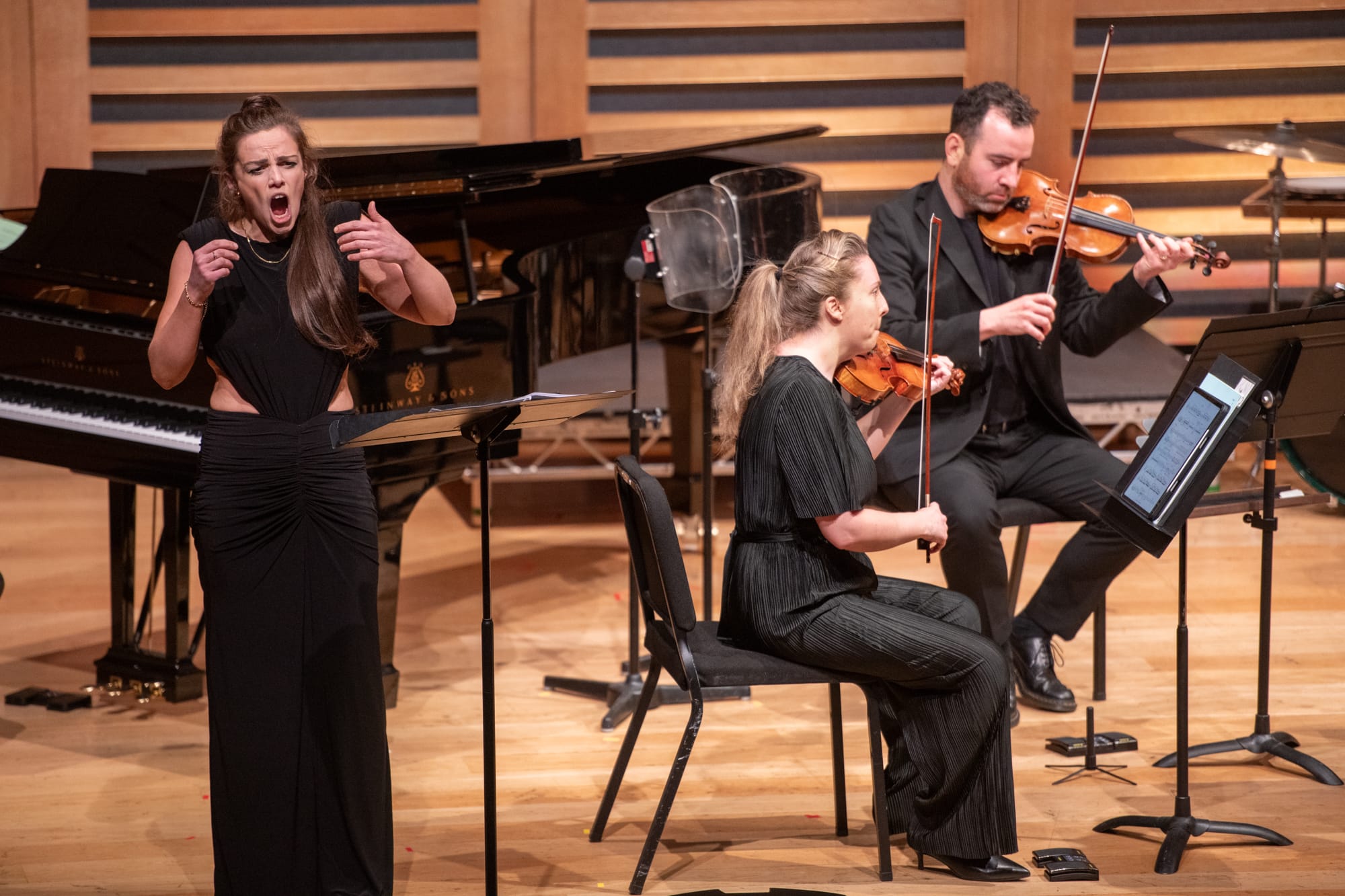
There was a real shift, with its cries of “shame” both from the flawless soloist (Rebecca Hardwick) and from members of the ensemble, to Errolyn Wallen’s 2022 piece By Gis and by Saint Charity: a shift, too, from a previous Master of the King’s Music to the present one. The text, of course, is Shakespeare (Act 4 Scene 5 of Hamlet, part of Ophelia’s mad scene in the wake of her father’s death). Hardwick was superb, Wallen’s setting is disturbing, for sure, with its obsessive repetitions and sinister melodic curlings. The writing is concise, the point made succinctly and powerfully. John Andrews conducted with clarity and expertise – he is a musicians’ conductor, and how it shows in the players’ responses throughout the concert.
… and here’s John Andrews’s recording with the BBC Concerto Orchestra on Resonus:
Schumann’s Kreisleriana is not short, but it is quite sectionalised. Using what might be called a “Mad King ensemble” (in the line of a “Pierrot ensemble”), Simon Parkin’s arrangement was highly imaginative. The very opening, something of a pianists’ graveyard, was instead beautifully articulated, but also immediately gave a feeling of deconstruction. Deconstruction, though, segued to displacement, with lengthy gaps between sections in a piece that feeds of juxtaposed contrast. The tension, and mood, sagged all too often, a shame as Parkin’s arrangement is chock-full of felicitous touches. It even made some passages sound quite spooky, while duo pairings (violin/cello against flute.clarinet) worked beautifully. Roberts again excelled in an extended solo (how often in Schumann, and especially Chopin, have pianists imagined “playing the cello”?): together with Powell, a Schumann Lied ohne Worte was created.
How good it was to see music by Peter Maxwell Davies on the programme. This music was grist to the mill of the 1980s; now really challenging music is hard to find on these shores. His Eight Songs for a Mad King dates from 1968, a time when all bets were off in Modernism. It was a nice touch to have a “female” King George III: after all, if Dichterliebe and Winterreise have been re-sexed over the years, there is no reason why not.
Andrews ensured the opening was properly cacophonous, his players all dressed in clinical white. Company Chameleon’s staging made maximal effect with minimal means, but it was mezzo Rosie Middleton’s assumption of the role of the King that was staggering in its resonance. Completely convincing in every scream, every shout, every whisper. “The Country Walk” (the second song) was elusive, harpsichord offering a glimpse of another, earlier world, but through a distorting fairground mirror. “Dear land of sheep and cabbages” begins the song, its demeanour in contrast to the lighter “The Lady-in-Waiting” and the wide-open pitch spaces (chasms, really) of “to be sung on the water). How sweetly Powell brought in nostalgia (again to be twisted) in “The Phantom Queen”; how febrile the incessant rhythms of “The Counterfeit”. And of course who could miss the bastardisation of Handel’s “Comfort ye”.
There was more than a hint of modern cabaret about this staging. Nothing offensive, so I expect Max might not have approved (I dare not put in print how one director chose to stage this piece in a performance I saw previously, while a performance of Vesalii icones heard at University – so, early 1980s – severely affected at least one of my classmates). But this Songs or a Mad King was a performance of great virtuosity from all, all expertly handled by Andrews.
Given the mention of Psappha above, here’s a performance by them (although with a different pianist: Kelvin Thomas, soloist; Conrad Marshall – flute; Dov Goldberg – clarinet; Richard Casey – piano; Tim Williams – percussion / cimbalom; Benedict Holland – violin; Jennifer Langridge – cello):
The emphasis on mental health is (rightly) very much of today. Visceral, grizzly depictions of madness, less so. Maxwell Davies reminds us mental illness is real, and uncomfortable. And, yes, we need more hard-hitting music of this ilk in London, beyond doubt.

.jpg?w=670&resize=670,446&ssl=1 "Virtuosity & discipline: John Wilson & the Sinfonia of London in Respighi's Roman trilogy & Walton's Cello Concerto")


%20Graham%20Boulton.jpeg?w=160&resize=160,160&ssl=1 "Celebrating John Joubert at Royal Birmingham Conservatoire in advance of his 2027 centenary")