
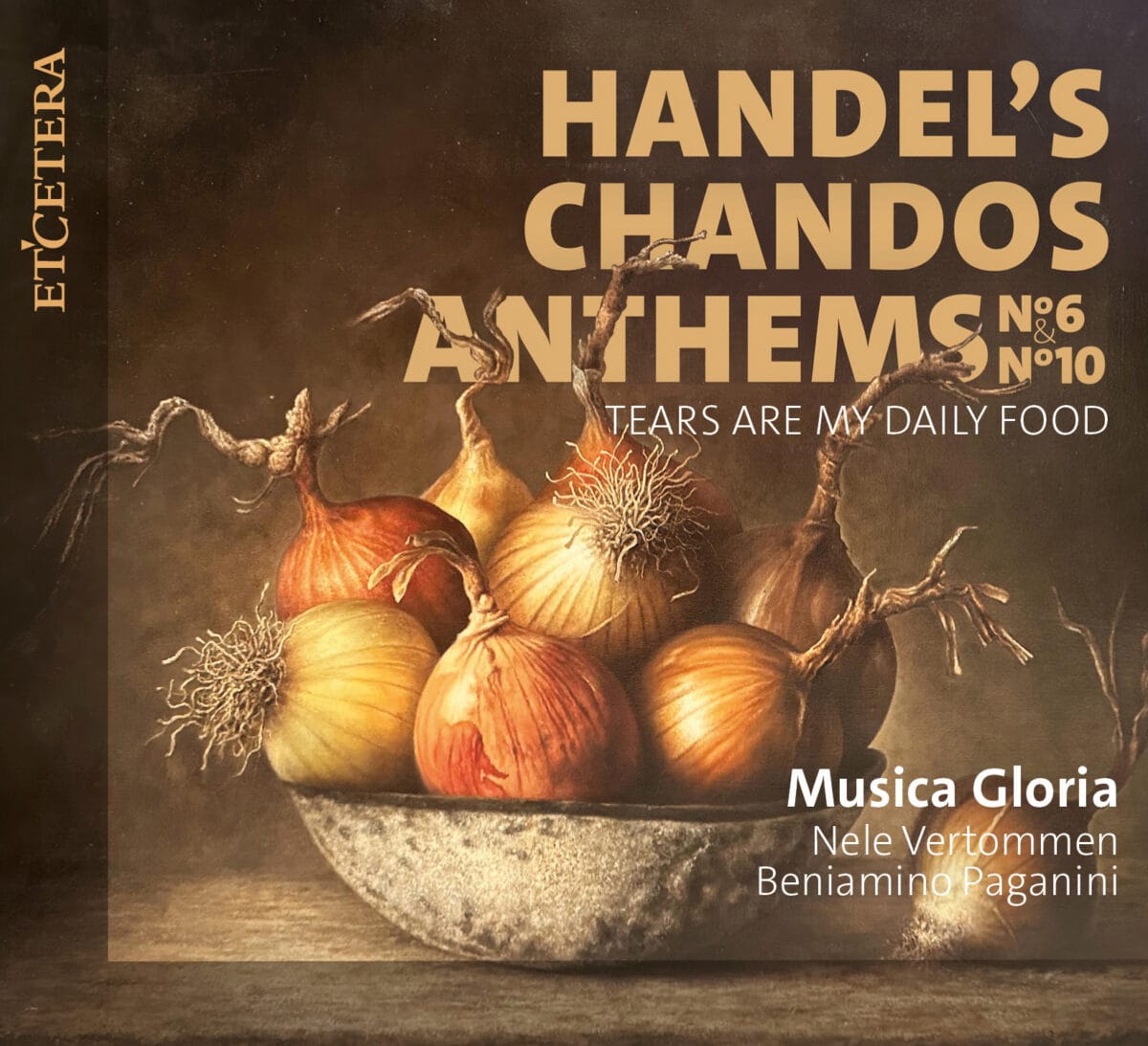
Recorded in Antwerp, this new disc of two of Handel’s Chandos Anthems and an Oboe Concerto from Musica Gloria, Tears are my daily food, acts as a reminder of this ensemble’s importance. Here are intimate performances of Handel’s anthems – forget the grand choral steams of yore, here we have eight singers, and seven instrumentalists. Chandos Anthems Nos. 6 and 10 sandwich an oboe concerto (HWV 302a).
Handel’s Chandos Anthems wee composed for Lord Henry James Brydges and St Lawrence’s Church (mear the Duke’s use in Cannons). Dating from early in Handel’s English sojourn, the music feels appropriately fresh, and offers an exploration of new (musical) territories.
As well as performing on original instruments, Musica Gloria worked with linguistic historian Professor David Crystal on the original English pronunciation of the texts. In Professor Crystal’s own words:
Original pronunciation adds a fresh resonance to familiar words, whether spoken or sung. Some features are especially noticeable, such as the sounded “r” in woads like “Lord,” prominent in the Chandos text – so “lord” is pronounced “lawd” and “heart” is “haht”. Using an accent that a composer would have recognised gives singers and listeners a greater sense of identity with the easier period – a new intimacy. Handel would feel at home here.
Continuing this sense of detail. the performances use a claviorganum, one of Handel’s favourite keyboard insolents (although it was probably not used at those works’ premieres).
You can hear a live performance of the anthems Nos. 6 and 10 by Musica Gloria from Osrava, broadcast on Czech television here:
The first anthem, The Lord is my light, HWV 255, begins with a “Symphony” (Overture) – and how the small group illuminates the counterpoint of the allegro:
Th first number, “The Lord is my Light” is performed by soprano Maia Ladurner as opposed to the specified tenor; switching voice range like this was commonpactice in Handel’s time, , and was effected here for “a balanced programme” (as Musica Gloria explain). The air is light and optimistic, answered by a remarkable chorus “There is a host of men”, where long cantus fermus lines sound against far more agile soundings:
Tenor André Pérez Muiño is offers.light-voiced “One thing have I desired,” joined by a charming pair of recorders (Musica Gloria co-director Nele Veommen and José Rodrigues Gomes, who doubles elsewhere on bassoon!). This more reflective air, with its lovely shift for the central section to more veiled territory. Surely this is one of Handel’s most beautiful utterances, anywhere in his output:
All credit the chorus fo they agility in “I will offer his dwelling,” the first of four choral movements in a row. Perhaps the most impressive is “They are brought down,” its writing unfailingly imaginative:
Adriaan De Koster is sweet-voiced un “he Lord is my strength,” while Ella Marshall shows remarkable agility in “It is the Lord,” leading to he remarkable unfolding dissonances of “Sing praises”. Here Handel subverts expectations, given the text, that unfolding lading to a rapid-fire fugue “I will rememberers thy name”:
Separating the two anthems is the Oboe Concerto, HWV 352a, with soloist Nel Vertommen. There is a chain of inheritance in this concerto: it borrows from other Chandos Anhems (which makes perfect sense in context here), which music itself borrowed from previous works by Handel. The opening Vivace is curiously resrained for the indication.
There is the feeling of a Concerto grossso, almost: the oboe often doubles oher parts, only coming fully into the spotlight in the Andante. But it is the busy Fuga second movement that impresses so much, Musical Gloria bringing Handel’s genius fully into focus through attention to detail:
Vertommen’s oboe sings beautifully in the Andante, very much an equal to the airs in the Anthems, exchanges subtle and civilised:
Finally, the anthem, As pants the hart, HWV 251b (a rescoring of HWV 251a). This is a lament and an entry to us in the Christian God. The chorus “As pants the hart,” with its descending suspensions, is most affecting:
Fitting that “Tears are my daily food” features an oboe obbligato, beautifully delivered by Vertommen; Sophia Fallas is the alto soloist. It ends with the remarkable question, “Where is now thy God?”:
Slow-moving chorus sounds against fast-moving instumentalists in “Now who I think,” and again clarity shines. This is a poignant text, and Handel treats it as such. Alto Pieter de Praetere and bass Adiaan De Koster provide one of the highlights of he album in dialogue with Verommen’s oboe in “Why so full of grief?”
A lovely release. The disc is available at Amazon here.


-5.jpg?w=160&resize=160,160&ssl=1 "Cross-cultural cross currents: Jasdeep Singh Degun with Fantasia Orchestra in Terry Riley's iconic In C performed by string orchestra, piano, sitar and tabla at Smith Square Hall")