


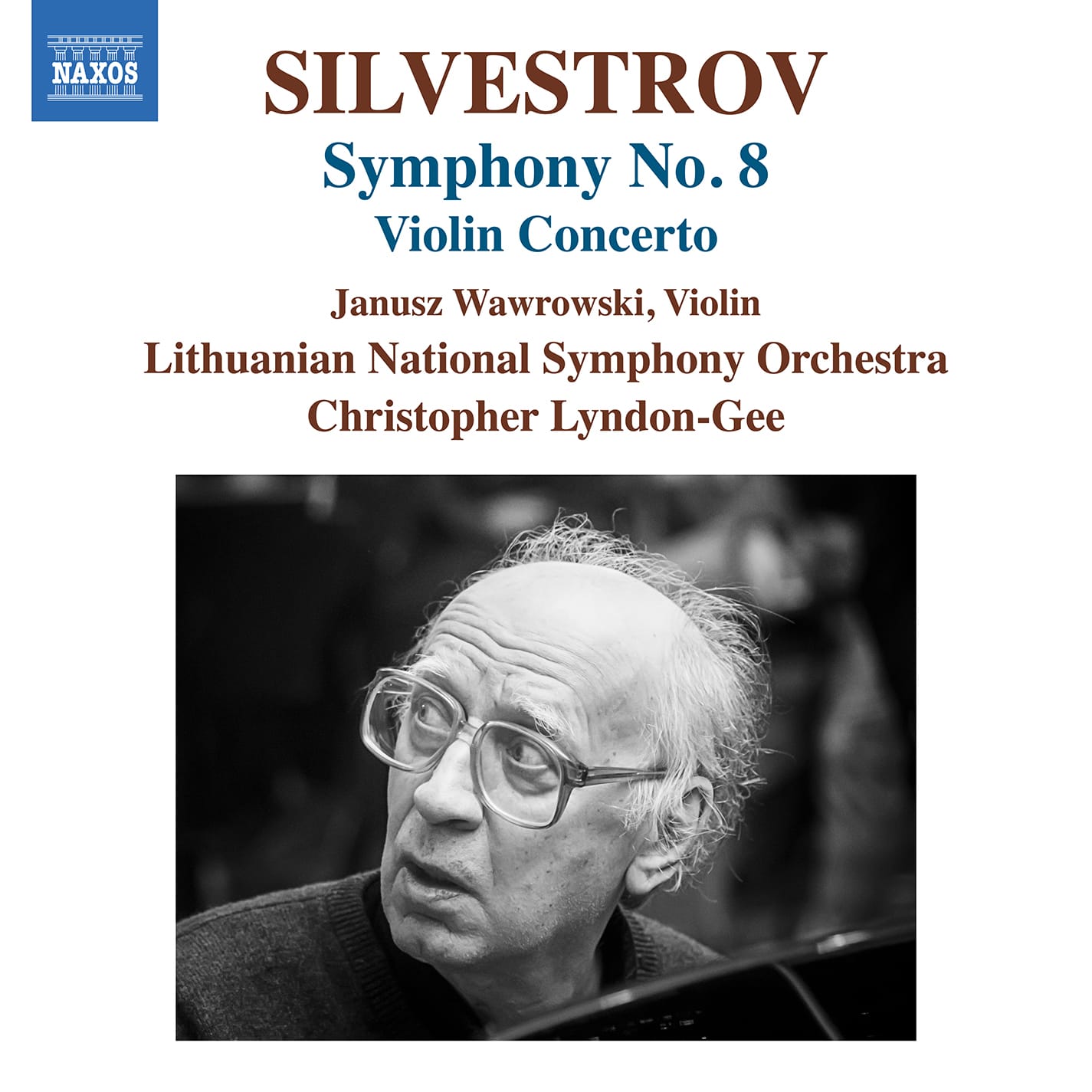
Valentin Silvestrov was forced to leave his native Ukraine after the Russian invasion of 2022, seeking refuge in Berlin. There is hope in this music but its eems rooted in a full realisation of teh horrors of the present: perhaps this is why the two can co-exists in Silvestrov’s music so easily.
Previously on Classical Explorer, we looked at Grimaud’s DG disc Silent Song, and also her The Messenger on the same label. Now, we hop over to Naxos and a fascinating, beautiful, harrowing coupling of the Violin Concerto and the Eighth Symphony.
The Violin Concerto was written in 2015. It works with “moment” against “remembrance,” ideas formed in what the composer calls his “bagatelle period” of 2000-17.
What impresses here is the sheer intimacy of the work, despite some moments of higher volume, The third movement sums it up best, elliptical, quizzical gestures from violin in a “pastorale” marked Andante:
The whispers towards the end of this movement are remarkable – this is a wholesale rethink of what the word “concerto” means. The traditional soloist versus orchestra here becomes soloist calms orchestra, as we can hear from the more dynamic first movement, an “Elegie”:
Janusz Wawrowski is a fine soloist; Christopher Lyndon-Gee has such an understanding of this music (something underscored by his detailed and knowledgeable booklet notes).
The Eighth Symphony (2012/13) is cast in one long span subdivided into six movements. It sits frequently on the edge of silence in the most beautiful way. Lyndon-Gee writes most beautifully and stimulatingly on what “post-modern” may mean, but his most eloquent statement is via sound and Silvestrov’s score. Perhaps the Intermezzo holds the essence, leading to the dark, quiet momumentalism of the fourth section (with its repeated, gong-underlined sonorities that seem reminiscent ofMahler’s “Der Abschied”). And how that fourth section impresses when it moves to lullaby-mode, purely melodic, infinitely touching – remember that Silvestrov is quoted as saying that he feels any type of music is a form of song:
In both works, I hear the influence of Alban Berg; specifically and ironically, in some of the ascending, accruing harmonies of the fourth movement of Silvestrov’s Eighth Symphony, of the climaxes of the Berg Violin Concerto. But there are magical moments too that might not appear in Berg. The Lithuanian National Symphony Orchestra is superb here in particular (and everywhere, really – this is an orchestra I did not know, and how magnificently they play).
Although there are 24 tempo markings within the symphony’s 34-minute span, the music is not markedly diverse: instead, it is like the gentle ebb and flow of a tide. When ritualism settles in in the penultimate movement, for all of its disquiet, it does rather feel like we have arrived at core Silvestrov:
The final section seems to offer hope (“dolce, leggiero”) but the sheer beauty of teh flute’s curlicues are contradicted by dark, low grumblings. Peace is hard to find, it seems.
Frankly, this disc is worth it for the conductor’s booklet notes alone, Then there are the performances, shot through with a sort of dark light that seems immersed in Silvestrov. Both pieces are presented as World Premiere Recordings – a vital disc. The recording quality itself is excellent.
This Naxos disc is available at Amazon here. Streaming below.