


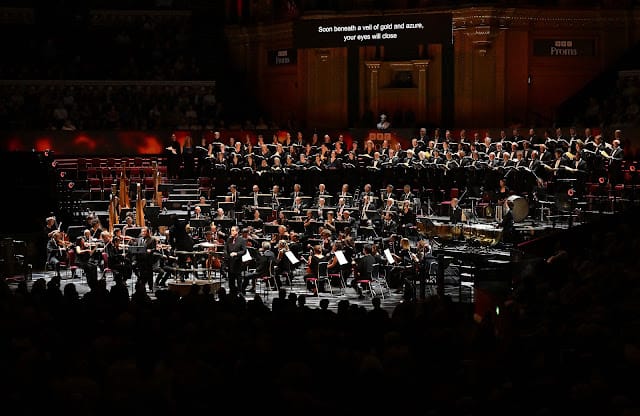
As his Grande Messe des Morts (Requiem) in Pappano’s LSO performance proved conclusively (August 15), there are fewer if any better spaces to hold Berlioz’ monumental imagination.
From the religious to Goethe’s great work of mysticism, Faust, which inspired Berlioz’s 1845/6 ‘concert opera’. This was not Berlioz’s first encounter, as he previously penned Eight Scenes from ‘Faust’ (1828/9) but it is one of his greatest masterpieces, perhaps only eclipsed by Benvenuto Cellini.
The Radio 3 miking allows the tenor of John Osborn to register rather more presently than it did in the hall. I was not too far, in the stalls on the left side fairly close to the orchestra – and yet Osborn repeatedly sounded too quiet on the night, and within this limited dynamic range, there was too little timbral variety of voice. There was (even) more detail in the hall as opposed to the broadcast,, too, from the orchestra. The use of original instruments, including natural horns with all the colour that entails, of stopping and half-stoppings (as when the first horn takes up the tenor’s theme – which ends with semitonal drop achieved via half-stop), gave us a painterly canvas consisting of myriad colours, and brightnesses. Against the tenor voice was an orchestral tapestry surely never heard in this piece in thai hall before: all the previous performances had been on modern instruments. Woodwind doublings were revelatory, a new multi-instrument; and how effective Berlioz’s scoring came across as in Méphistophélès’ evocation of dark spirits. The conductor, Jakob Lehmann, not only excelled on the minute-by-minute level, but also appreciated the narrative trajectory, with tempo changes impeccable (as from Faust’s opening monologue to the entry of the peasant chorus, which was then underpinned by deliciously rustic drones, The various distanced effects worked brilliantly, too, and whether delivering flickering half-lights or Infernal revelings, the orchestra never missed a beat. Some agogics in the famous ‘Hungarian March’ raised an eyebrow, but certainly added to the character. Yes, there was the odd acknowledgement of the perilous nature of period instruments (cor anglais and oboe), but there is no escaping thai was an aural treat.
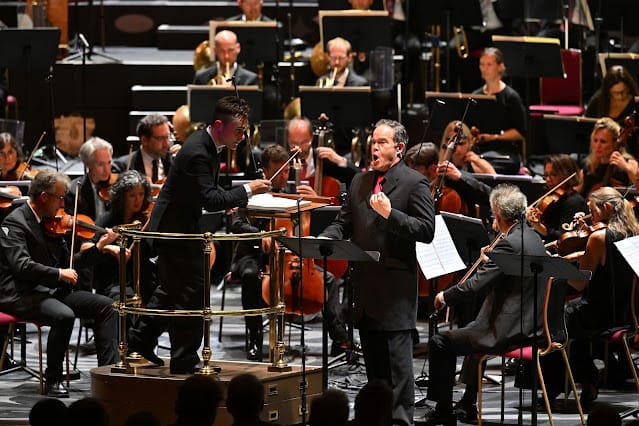
Neither was there any doubt of the nocturnal aspect to Part 2. Osborn was better here (“Voici des roses …”); but the Méphistophélès of Gerald Finley was by far the greatest role assumption of the night. Clad in a black suit with a red tie (the Devil’s colours!), Finley’s voice was as large and commanding as his stage presence, his part 4 “vaincoeur!” a highlight. Shorn of staging, the singers and orchestra had to paint the work’s trajectory, and how effective the move to the cellar in Leipzig for Part 2’s second part (which part also featured a brilliantly delivered Song of the Rat by Thomas Dolié as Brander; Finley’s Song of the Flea was just as impressive).
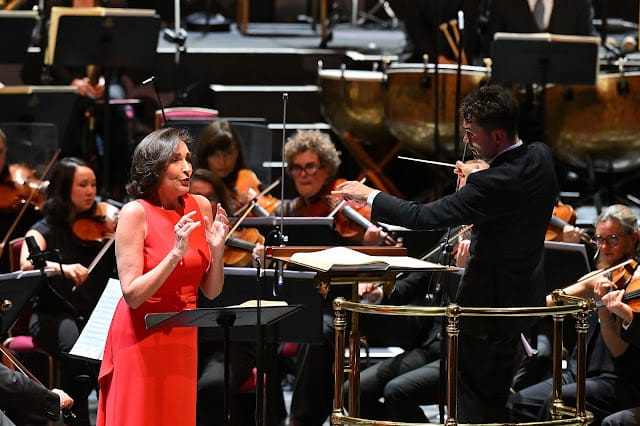
We have to wait for Part 3 to meet Marguérite: luxury casting with Véronique Gens (clad in red), her dream of her future lover incredibly touching. She was superb in her song about the King of Thule, too; but almost outshone by some of the most brilliant viola playing I have heard (Hélène Desaint). How beautiful and convincing Gens’ drooping “Folie” sounded (at the end of “Que l’air est étouffant!”),
Part 4 offers transcendence at its close; it offered transcendent violin playing at its opening, too, violins just so together, both in pitch, movement and phrasing. In between are falls into the abyss in a war between Good and Evil as Méphistophélès pursues his prey, the orchestra gloriously rhythmic against the choir’s “Sancta Maria, ora pro nobis”.
The chorus, the Choeur de Radio France, was a little rough-and-ready throughout. While they do depict soldiers and students (neither known for their restraint when not occupied by their day jobs), ensemble remains important, as does depth of sound. The choral sound was a little shallow, rhythms not always pin-point. Nice to see the children’s choir at the close, too, beautifully disciplined. It was Claudine Margely of the choir’s second sopranos who sang the name of “Marguérite” at the close, from the side, beautifully (and as far as I can see, uncredited in the programme: it is an important moment).
A somewhat mixed Berlioz Damnation, therefore; I do wonder if the immediate applause was part of the Proms experience or a response to the close itself. In most performances, surely, there would be silence after Marguérite’s ascent t o Heaven. Certainly, not as satisfying as a performance as that Pappano Requiem (which took that behemoth and reminded us of its subtleties, too), but one which offered myriad revelations. Berlioz’s scoring emerged as even more modern, especially as wind instruments take on huge individuality of sound. A fascinating, if not ultimately satisfying, evening. Amazing to think that this piece has not been heard at the Proms since 2017; good to hear it again.
PROMS 2026: Berlioz’s “The Damnation of Faust”
Berlioz: La damnation de Faust, Op. 24
John Osborn – Faust; Véronique Gens – Marguérite; Gerald Finley – Méphistophélès; Thomas Dolié – Brander; Maîtrise de Radio France; Choeur de Radio France; Les Siȅcles; Jakob Lehmann (conductor)
Royal Albert Hall, London, 30 August 2026
All photos © BBC Proms © BBC/Mark Allan