


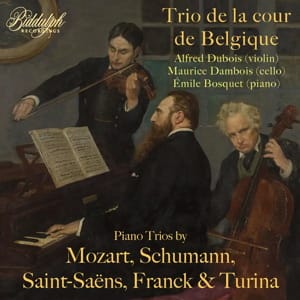
This is the “Belgian Court Trio” (Trio from the Court of Belgium, literally)” Emile Bouquet, piano (1878-1959); Alfred Dubois, violin, and Maurice Dambois, cello (1889-1969). All encodings are taken from Columbia originals (a watchword for quality), and the surfaces are pristine – well done Biddulph label and Ward Marston for his engineering and mastering. The ‘royal’ title of the ensemble was bestowed on the ensemble by Queen Elisabeth of Belgium in 1925. The line-up we hear here is the final one fo this ensemble: originally, the violinist was Emile Chaumont (1878-1942).
Over its lifetime, the Trio de la you de Belgiqu numbered five members, all proteges of Ysaye. Originally called “Trio Belge,’ it launched in the 1922/3 season and initially composed Bosque, Dambois and, the, violinist Émile Chaumont (1878-1942).
This is what it’s all about: discoveries like this one. Mozart fom the archives that still sounds fresh as a daisy. But first, Rameau, a Pantomime and L’Indiscrète, the first eloquent, and moving in both senses (emotional, and as in it doesn’t stop).. Hee’s the Pantomime:
The recording of Mozart Piano Trio in E-Major, K 542 dates from 1930 (the Rameau is the preceding yaar). The Allegro sparkles, Bosquet’s fingerwork a miracle; the Andante grazioso is beautiful; the finale, Allegro, contests that sparkle against, yes, heaviness. It makes beautiful sense. Here’s the first movement:
It’s.long way to Schumann; here’s the G-Minor Piano Trio, Op. 11 recorded just before Christmas, 1928. Texturul transparency is the watchword here: lines speak so clearly, and the Trio takes to heart Schumann’s making, “Bewegt, doch night zu Rasch” (With movement, but not oo quickly). Dambois’ cello seems to speak particularly eloquently. Occasionally, the piano is a little backward in the sound picture, but that is to be expected perhaps, from the date of the recording. But the power of this is remarkable, caluminating in the Ziemlich langsam of deep profundity. It sounds at once perfectly Schumannesque, but also quite modern (remember this is Op. 110!):
The Scherzo is full of life, but it is the swagger of the finale (Kraftig, mit Humor) that appeals so much. There is so much power here …
… so much power we need a wind-down, in the shape of eight short pieces for violin and piano recorded again for Columbia by Dubois and Fernando Goeyens in 1928/9. There is some very pedal-heavy Debussy for Goeyens in La plus que lent; Dubois is notably cleaner. I do like Dubois’ line in the flaxen-haired girl. but the big harmonic arrival is underplayed by Goeywns, But how lovely that Dubois gets to project Debussy’s counterpoint all by himself a bit later:
Three pieces by Naples-born but France-based composer-violinist Alfredo d’Ambosio (1871-1914) follow, the Canzonetta in particular very Gallic. This is perfect salon music, almost but not quite elevated by then performances; the Sérénade is rather more Italian. Despite his short life, D’Ambosio was quite prolific: his works include an opera (Pia de Tolomei), a ballet, two violin concertos and a string quartet. He himself recorded the Canzonetta, which is his most famous work. His was a 1907 recoding. The Sérénade was recorded by Heifetz and Enescu. As a violinist, d;Ambrosio studied with both Sarasate and Wilhelmj; he was teacher of Salvatore Accardo.
And, if you’e super-keen on D’Ambrosio, there’s.a 3-CD set on Brilliant Classics of his complete woks for violin and piano performed by the “Gran Duo Italiano” (Mauro Tortorelli and Angela Meluso)
Inevitably there is some Ysaÿe, here the charming Rêve d’enfant, Op. 14, Dubois superb in his upper register, perfectly in tune, clarion-clear:
The music by Goeyens is interessting (dare I say, more so than the Ysaye?!). What poignant harmonies, and what melodic fecundity in Passage triste!. The Humoesque is no less fascinating.
In some ways I wish the disc had ended with he Goeyens; the Voss Serenade, while perfectly pleasant, is not of the same standard musically. No first name for Voss in the listing (i’s Eugène). It’s perfectly pleasant, anyway!
Phew. And that’s only disc one! The programme of disc two is even more gripping. I’m a great fan of the music of César Franck, who seems to get a bad rap: his music is sometimes considered too chromatic (“I makes me feel queasy” said my piano teacher, back in the mists of time), or dense. It is neither: listen to the D-Minor Symphony (Beecham or Giulini, or Barenboim; aad don’t forget the Naxos conducted by Jean-Luc Tingaud). His Piano Quintet is a a masterpiece. Here’s the Piano Trio No. 1 in F sharp minor, Op. 1/1, the opening Andante con moto beautifully given here, again with that textural veracity, particularly stunning especially given the recording date (January 2, 1929, another Columbia).
The music bathes in half-light at times, and how wonderful is this performance of a piece I’d love to hear live;: not sure I’ve ever had the chance! With that in mind, it might surprise you to learn that thee’s a recording bu Sviatoslav Richter, Oleg Kagan, and Natalia Gutman! But just listen to the music:the Trio de la Cour de Belgique embraces every twist and turn of this music. the whole is perfectly emotionally satisfying.
The Allegro molto is remarkable, testing the boundary of Allegro molto/Presto and staying just on the right side. Technically, this is a tour de force from all three players; musically, it is even finer. The finale is a dream, moving to pronounced muscularity at is climax. It is impossible not to be convinced of his piece’s worth while listening to this remarkable perfomance:
I have to say this perfomance bought back memories of a Franck Piano Quintet in Sheffield in 2024 by members of the Ensemble 360 (with Tim Horton, piano).
Saint-Saëns remains one of the most underrated composes out there. Given the composer’s own virtuosity within the French School of pianism, his piano writing demands much légérdemain, something Bosquet seems to have in spades. Recorded in September 1920 (LFX 10/13), this performance of the Piano Trio No. 1 in E-Major (Op. 18) is a delight. The first movement is certainly “vivace”: almost dance-like at times. heard in a miraculously buoyant performance:
Th Aadante is fascinating: if it is a dream, it is a disturbed one;. followed by a pizzicato-laden Scherzo, perfectly complemented by the Allego finale, itself full of contrasts, including moments of sun-filled frolickery. Here’s the Andante:
… and here’s a YouTube of an alternative restoration, one track, but included here only for the YouTube “cover”: that of the original Columbia release (which, as you can see, also included the Rameau that kicks off the present twofer):
The completé music for piano trio by Joaquin Turina (1882-1949) fits nicely on one disc, as a Brilliant Classics disc by the Orphelion Ensemble nicely proved, while the Lincoln Trio on Çedille offers a more than able alternative. The Piano Trio No. 1 is not actually Turina’s first (there’s an earlier Trio. 1904 against 1926); while the earlier Trio is dominated by the shadow of Tchaikovsky, this breathes an altogether more individual air. Perhaps the Beaux Arts Trio get the wit of the first movement’s final gesture keenest, though.
The second movement is a “Thème et Variations” (five of ’em), the theme given by cello against chordal piano: Dambois is maximally eloquent here, Bosquet’s response the epitome of dolce, the ensuing conversation demure. Wondeful to hear such detail, too. The variations are beautifully delineated; dance is (unsurprisingly) an element of the discourse:
The finale is marked “Sonate”; it has more of a Gallic tinge to it. The Trio de la Cour de Belgique finds real depth, Dambois’ cello again featuring promiently.
Earlier, we hd a Fernando; here, Fernand: Fernand Quinet (1898-1971), a composer and cellist as well as conductor and conservatoire director. The piece Charade has a subtitle, “Quatre Pièces enfanines” and dates from around 1927. It was recorded at the same sessions as the Schumann above: the music has an acidic tang (and a extraordinary, revolving moment in strings that needs to be heard to be believed). As the piece is only 3″38, I assume this is only one of the fourth pieces. There is a hint of Debussy’s “Images” about this. It’s a great piece – what an encore it would make!
A truly important historical release, full of beauty and discoveries.
This twofer is available from Amazon here.
no 3