


Cast:
Wozzeck – Stéphane Degout
Marie – Annette Dasch
Captain – Peter Hoare
Doctor – Brindley Sherratt
Drum-Major – Christopher Ventris
Andres – Eirik Grøtvedt
Margret – Kitty Whately
Fool – Adrian Thompson
First Apprentice – Callum Thorpe
Second Apprentice – Dominic Sedgwick
London Voices; Tiffin Boys’ Choir, London Philharmonic Orchestra / Edward Gardner.
Projections by Ilya Shagalov.
Royal Festival Hall, London, 25.4.2026.
The first of two posts on Berg’s seminal opera Wozzeck, and the first of three performances considered, this is the LPO’s Southbank performance from last weekend; the second post will consider two recorded performances, one from 1965 (Boult/BBC), the other a 2013 performance from Houston on Naxos conducted by Hans Graf.
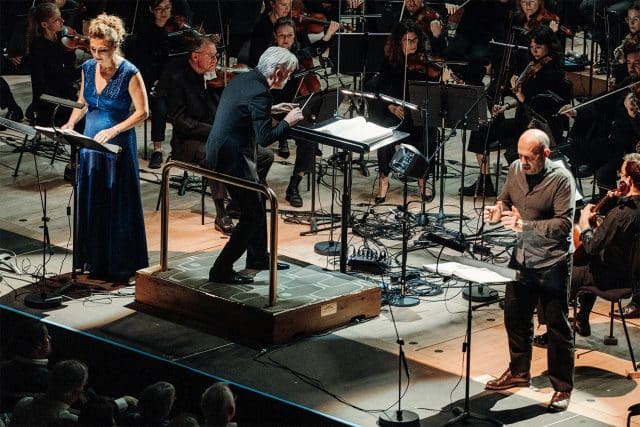
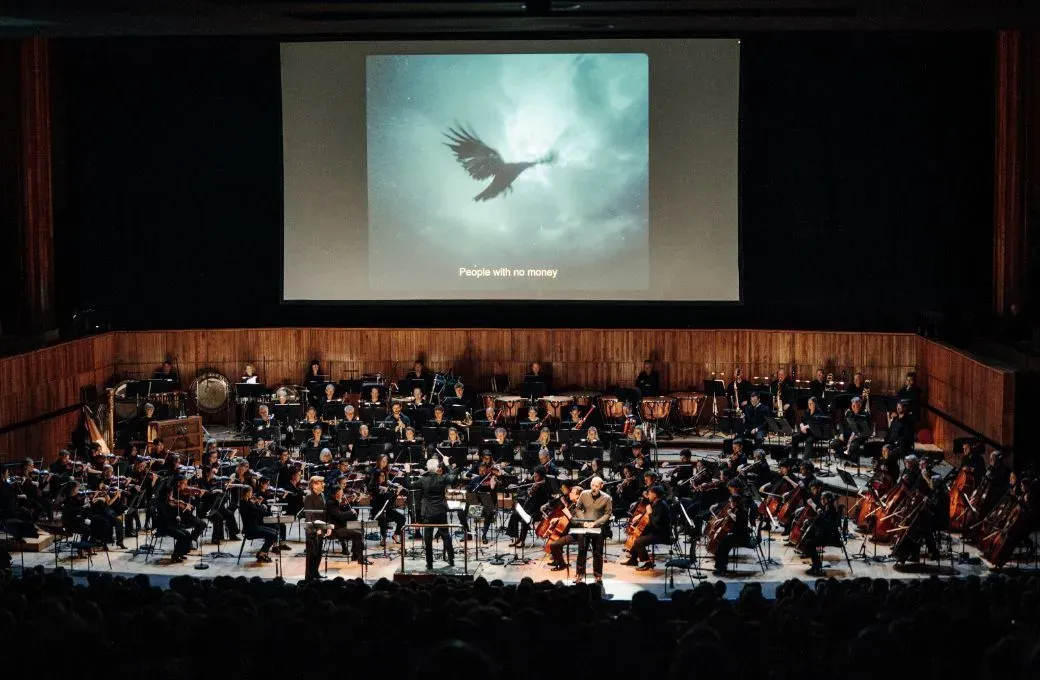
Wozzeck is harrowing enough, even in concert performance. Here, the physical concert performance was supported/illustrated by a sequence of projected images (almost but not all still – there was some movement around the murder) each lasting from about 4 to 10 seconds. Billed as an ‘atmospheric and expressive photo-film inspired by British social realist dramas,” Shagalov shifts Wozzeck to today, the title anti-hero’s plight seen as analogous to that of invisible migrant workers, shown often in hi-vis jackets in menial jobs..
This ‘concert staging’ (elsewhere in the e-documentation it is described as ‘semi-staged’) works better on paper than in the actual concert hall: the constant changes of image, effectively a 90-minute slide show, drag one away from the music. The parallel of Wozzeck the man to the plight of many today in a very fractured globe is undeniable, and the ‘snippets’ of underdog life captured in the photos maps well onto the idea of Georg Büchner’s scattered collection of scenes for his play Woyzeck. A crow, or raven, and groups thereof regularly feature in the images: both are associated with death (Brünnhilde’s ‘Fliegt heim, ihr Raben’ from Götterdämmung; Lady Macbeth’s ‘the raven himself is hoarse / That croaks the fatal entrance of Duncan’). Photos of gluttony accompany the Doctor (who as an experiment is feeding Wozzeck on a limited diet, high in beans). And the ‘blood moon’ (‘Der Mond ist blutig,’ sings Wozzeck) is shown as the moon with a red corona. Photo negative is used, too, for a forest image. Perhaps there was even an influence of the film Goodfellas at one point, along with a glance at Trump. The question is, whether the idea has legs, whether it works in real time. I wish in many ways it had; for all of the painful relevance of the updating, it failed to move. Worse, subtitles shared screen space, but sometimes were lost when projected against the same or similar colours. I also remain unsure whether ‘Bloody hell’ works as a translation of ‘Donnerwetter’, either.
But part of the dimming of Wozzeck‘s blood-red light has to go to the performance. While Edward Gardner’s white hot Richard Strauss Salome and Elektra with Bergen forces (released on Chandos) carry real power, the more Expressionist Berg felt rather muted. A tendency to rush through sections was mostly responsible: the faux-chorale in the very first scene a case in point, at ‘Lasset die Kinder zu mir kommen’ (when Wozzeck quotes the Bible, ‘Der Herr sprach …”). From the off, the LPO felt somewhat mild, and perhaps in this respect one should mention the first scene of the second act in particular. an uninvolving counterpoint to the gripping Annette Dansch; and later, too, at the fateful mention of the knife. And yet Berg’s writing is bold, bloody, and uncompromising, the work of genius. For all of Shagalov’s images (co-created with Nina Guseva), sometimes aiming to shock, the viscerality lies within Berg’s score. Even the great unison crescendos just fell short of the physicality required.
The third act more than the other two asks huge interpretative questions. While the first act is effectively a series of character portraits and the second has symphonic tendencies (including a Scherzo-Waltz in the Tavern Scene), the third points forward, musically, way into the future, each an invention on a different parameter: scene 1, a theme; scene 2, a single note; scene 3, on a rhythm (a Hauptrhythmus); scene 4 on a chord (a hexachord); there is an ‘Interlude on a tonality’ (D-Minor); and finally, scene 5, an invention on a moto perpetuo. How much of this do we need to hear? The arrival on D-Minor is the one that no-one can miss: the final Interlude is a mini-symphonic poem that references Mahler. Again, none too shattering here. The processes over the five scenes surface at times more than others, but whatever our level or awareness, there needs to be the feeling of an exploration of the unknown that reflects Berg and Büchner’s fearless prodding of the lower echelons of the human psyche. Sadly that was not really the case here.
Stage space was mainly effectively used though, including the choir stalls (the Doctor and Captain, post-murder), separating Marie and Margret, and placing the onstage band front stage; but the children (from Tiffin Boys’ Choir) shuffled on an off at the end, and the chilling line ‘Du, dein Mutter ist Tod’ went for nothing. Good ‘Hipp, hopp’s though. Perhaps its neutral delivery was the point, in stark contrast to the anything-but-neutral images. At the end, the wheel turns, but nothing changes (the intervallic structure of the closing chords link to the work’s opening: Wozzeck and Marie’s son’s future is bleak indeed). Marie, very obviously, in Wozzeck has had the child, whereas here the images showed her as heavily pregnant.
Annette Dasch was a fine Marie, possessed of all the range Berg asks of here. she has the low end of ‘Lauter kühle Wein muss es sein!’; but the descent from the top end of the soprano range was (presumably intentionally) disjointed. A shame, as the lullaby itself was beautiful. Dasch’s achievement was that we lived her torment, her pain, her attempt to escape everyday drudgery via sex with the Drum-Major, a living embodiment of the bestial animus; her “Lieber ein Messer in den Leib, als eine Hand auf mich!’ was beautifully convincing (Wozzeck’s repetition, as the idea takes hold, less so). Perhaps her exclamations of ‘Herr Gott! Sieh’ mich nicht an!’ could have carried more import: they are sung, notated, against the Sprechstimme of the Bible readings, and we need to hear the contrast. But balancing that was her heartfelt reference to Mary Magdalene (‘Wie steht es geschrieben von der Magdalena?”). Nevertheless, hers was one of two spectacular role assumptions, the other the Doctor of Brindley Sherratt, whose voice delivered all the gruesome obsession with human experimentation the role demands (and, at one point, at maximum speed). Here, Shagalov’s images were certainly chilling.
Wozzeck himself was Stéphane Degout, strong-voiced, almost lyrical in the Fischer-Dieskau mould, but less authoritative than his noble predecessor, ‘Wir arme Leut” perhaps not the given the emphasis it deserves (it is a core motif in Berg’s tapestry, after all). The excellent Kitty Whately was Margret, Marie’s outspoken friend, the separation between them (culminating in Marie’s insult of ‘Luder!’) reflected in their stage distance. Peter Hoare gave all he has to the Captain, a touch more human perhaps than the caricature-archetype role demands (neither Captain, Doctor, nor Drum-Major have names, after all). Christopher Ventris was a strong Drum-Major.
And just as Marie has her foil in Margret, so Wozzeck has Andres, sanity versus Wozzeck’s increasing mental implosion via hallucinations. While Gardner’s fast tempos posed some issues with giving passages requisite weight, they also added to Eirik Grøtvedt’s burden as Andres: he has to negotiate tricky roulades in his rustic hunting song, a post-Weber Jagdlied. The fact he did so is testament to Grøtvedt’s abilities. Clearly a versatile singer (his performances encompass Poppea to Lady Macbeth of the Mtsensk District and Der Kaiser von Atlantis), I very much want to encounter him again, sooner rather than later.
Good to see Adrian Thompson, recently so strong as General Sir Philip in the Guildhall production of Britten’s Owen Wingrave in February (post), exuding just as much stage presence and character as the Fool (Narr). Callum Thorpe and Dominic Sedgwick threw themselves into the roles of the two Apprentices. Choruses, be they bold or of the snoring variety, were well done by London Voices.
A spoken introduction to the evening, part of Southbank’s Multitudes Festival, by Mark Ball, was dispensable. I wish I could be more enthusiastic: but Shagalov’s slide-show and Gardner’s rushing robbed Wozzeck of its core power.
More Wozzeck(s) tomorrow!


%20Graham%20Boulton.jpeg?w=160&resize=160,160&ssl=1 "Celebrating John Joubert at Royal Birmingham Conservatoire in advance of his 2027 centenary")