

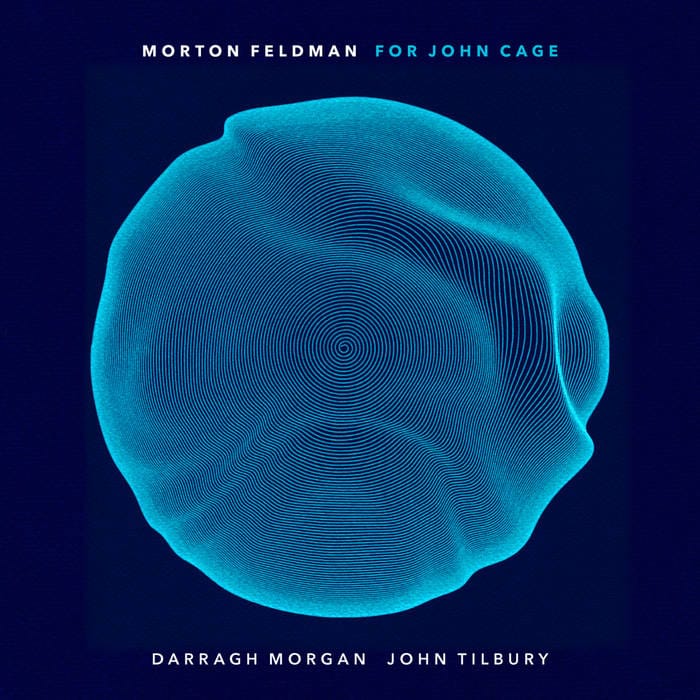
The late music of Moton Feldman (1926-87) is like no other. It kind of speaks for itself (perhaps that’s why thee are no booklet notes here!): or does it kind of “unspeak”?. Although there ae sounds moving in time, they seem to go nowhere, a sort of on-directionally tat is itself in contradiction.to the very fact of time’s arrow (or is that an illusion, too?). This “composed silence” is surely the link between Feldman and his tribute, John Cage, and Feldman. The piece was written as a 70th birthday present for Cage
This is rarefied music in extremis. There is no “tempo” here: events just happen, often just fragments, often in the mid- to high registers (so that who the piano’s bass does enter it makes quite the effective – but still quietly). So many contradictions: perhaps they create oppositions at he centre of which sits Feldman’s anti-music. Music which is though suffused with an ethereal beauty.
For John Cage was written in about 1982. While there was a somewhat complex relationship between Feldman and Cage, it was a musically fruitful one. They met at a New York Philharmonic concert concert of Webern (Symphony, Op. 21) in which the audience reaction was less than enthusiastic. Possibly vocally so, as both Cage and Feldman walked out, setting in the process.Cage was to introduce Feldman to the leading lights of the incredibly fertile New York music scene; my of h concerts had no programme notes (as here).
You can hear.a conversation between Cage and Feldman broadcast on the radio station WBA from 1966 here (follow that link for access to the complete set; it is split into several videos), or sample via the first video here:
Intonation is used expressively in For John Cage; or is it transcended? The purity and expressivity of Morgan’s playing is extraordinary, and Tilbury is like his alter ego, reacting whit ravishing sensiitivity. It is as if they “examine” the very core of music, of sound in space.
I believe that at the Purcell Room performance by these two artists in 2012, and that o the occasion Morgan used a Baroque bow; this recording is from City University, London, September 3, 2018 (presumably in one take?).
The performance by.Paul Zukovsky ad Marianne Schroeder, issued I believe sound 1993 on the CP2 label, is another the rarefied piece of Feldman magic, and on YouTube you get the score:
It sounds strange (everything is strange here, really) to talk about “historical performance” aspects to Feldman, but there is a recording by pianist Aki Takahashi (with Yasushi Tokoshima, violin) on the ALM label – and Takahashi not only knew Feldman, but also premiered the piece. And there is snippet of.live performance available by Morgan and Tilbury from King’s Place:
I wonder (alhough the volume knob plays a big part in this) whether the performance by Morgan and Tilbuy could be even ore whispered: on the verge of inaudibility? That said, when the violin eventually indulges in stopping, the effect is huge, as if another “voice” has ended the conversation. Incidentally, another version to be heard is that on Hat Hut by Josje Ter Haar and John Snijders. Here’s the first YouTube video (its split, for some reason, on there):
Do try to hear the new Morgan/Tilbury, though: maybe though headphones late at night! It’s available here on Amazon. Sreaming below.
:


%20Graham%20Boulton.jpeg?w=160&resize=160,160&ssl=1 "Celebrating John Joubert at Royal Birmingham Conservatoire in advance of his 2027 centenary")