


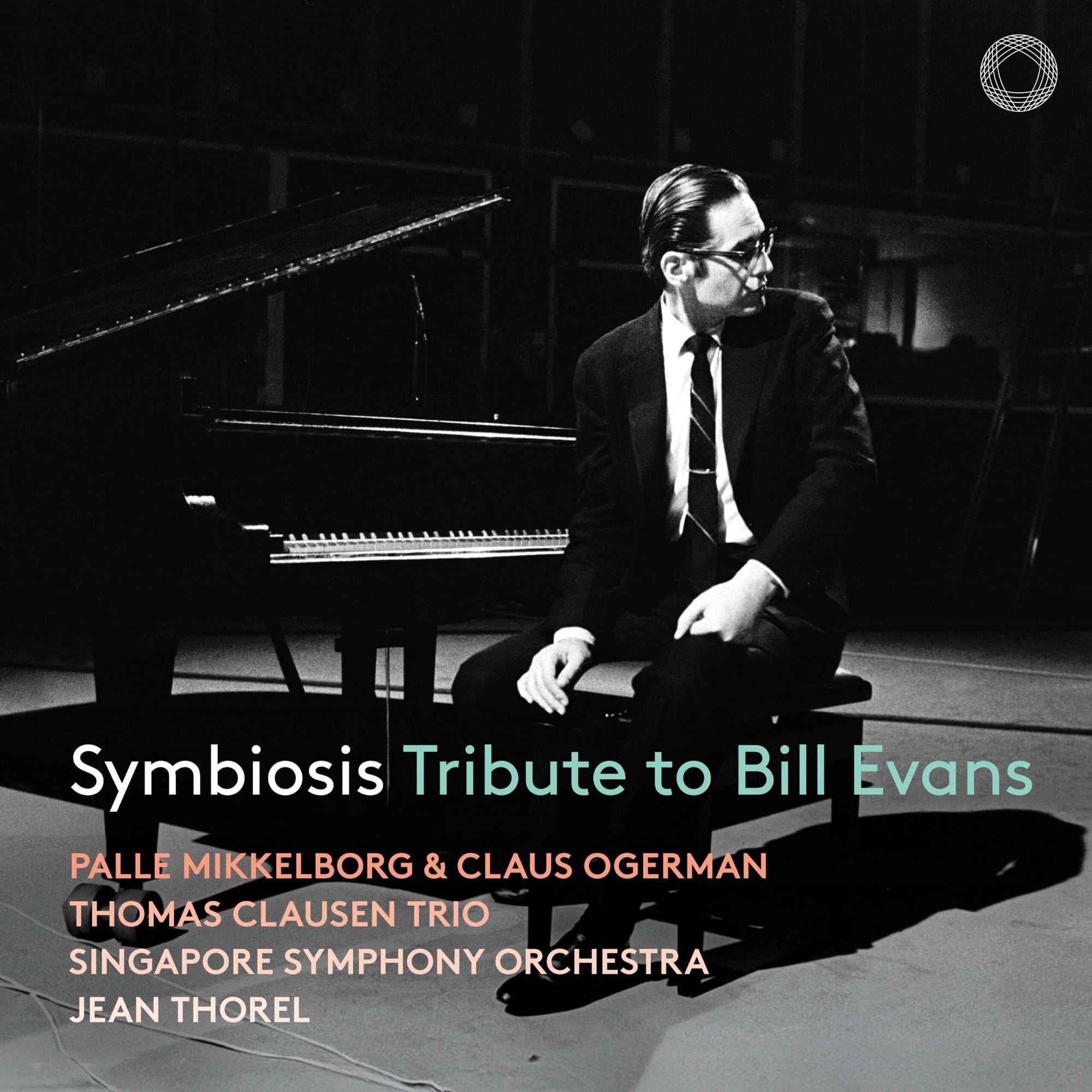
What a wonderful idea.! This Pentatone release takes Pale Mikkelborg’s Bill Evans Suite as a starting point – a suite recoded initially in 1969, and which takes Evans’ classics and juxtaposes big band and jazz group, specacularly well. The Suite was recorded originally by Claus Ogermann: here, for instance, is “Time Remembered”:
The Danish cumposer and jazzer Palle Mikkelborg was commissioned by the Danish Radio to compose the Suite in 1969; the original TV broadcast featured members of the Royal Danish Orchestra and the Danish Radio Big Band.
I love the way the opening chords of “Interlude” into Walz for Debby” sound like thy could com from the pen of any of the composers of the Second Viennese School (perhaps especially Berg), but then the Waltz appears, lilting, carefree:
Here’s Evans himself:
We heard “Time Remembered” in the original above; here’s the Singapoeans under Jean Thorel with he superb Clausen io (Thomas Clausen, piano, Thomas Fonnesbœck, bass, Kasten Bagge, drums)
Swooning stings introduce the Trio is “My Bells,” while more sweet chords infuse “Interlude (Treasues): with a stellar trumpet solo from Anders Malta; and listen to the bass responses, so slick and, well, slidey. Great drum breaks from Bogge, too:
A lovely idea to reprise the Waltz for Debby. Clausen’s voicing is simply superb; as we hear it is as a mini-fiesta: here those counerpointing lines appear on trumpets, full of excitement, ceding to the Trio (and what sharpness to the big band interjections!). Finally, “Walkin’ Up”. It’s th perfect close, and thie Pentaone perfomance is mpccably slick. Nothing will match Evans himself live at the Montreux Jaxx Festival, Switzerland, in 1968 though:
… and now it’s Thomas Clausen’s turn in For Pi (2023), a jazz ballad written in the style of Bill Evans: the documentation cites Evans’ Flamenco Sketches s a reference point, but also widens the net to Miles Davis’ 1959 Kind of Blue and Evans’ Peace Piece (from the 1958 album Everybody Digs Bill Evans):
The “Pi” of the tile is th composer’s ex-wife, who killed herself in 2006 (her nickname was “Pi”). The piece is heard in a new orchestration, effected in a mere two house in a hotel room in Singapore by Clausen during a week of performances in Jaanuay 2023. The focus lies on stings, the two, and “Anders’ smooth trumpet on top”.
Finally for his 80-minute disc, Claus Ogermann’s Symbiosis, a reconstruction fom 2019-22 by Hing Jian Han and Hans Sørensen.
Symbiosis was the third collaboration been Ogermann and Evans (theee are two previous albums, 1963 and 1965). Thee are two movements (subdivided as thee sections for movement one, and two for movement two). The harmonic material is set out at the beginning via four sets of chords on four alto saxes, an arresting sound in itself; the chords also function as structural articulators,
Listen out for Fonnsbœck’s bass solo too, around 6-7 minutes in! It’s stunning. the “symbiosis” of the art of improvisation (the trio) and through-composition (the written-out parts for the orchestra). Sections are clearly delineated (try around the 13-minute mark of movement one). Here’s one Glenn Gould extolling the piece’s merets, especially the first movement:
… the through-composed sections ae really quite marvllous. Ogerman has a naggingly inventive harmonic imagination and the first of Symbiosis’ wo movements, in particular, is possessed of enormous sweep and dive.
Here’s a link to the original MPS please (this link takes you to.playlist in which you can play the full album sequentlaly; below is just Part I):
NB when it says “Part I” above that’s that LP’s segmentation, as in tracks: here’s the (more extended) Part I on Pentatone:
he second movement begins slowly reflexively; sounds are lusher until a sense of organic growth takes the music to a magisterial close. The original (1974) score was lost, so had to be reconstructed. The Singaporean composer Ding Jian Han was the major force, overseen by the Singapore SO’s Director for Artistic Planning, Hans Sørensen. The first performance was in January 2023, and the first time the music had been head in front of n audience Ogerman’s Two Concertos quotes Symbiosis, which helped further with instumentation, for example. It is an astonishing achievement, as you can hear. Here’s the second movement:
A disc that I would love to see become a classic here from Pentatone. Available from Amazon here; streaming bdlow (iDagio here)