
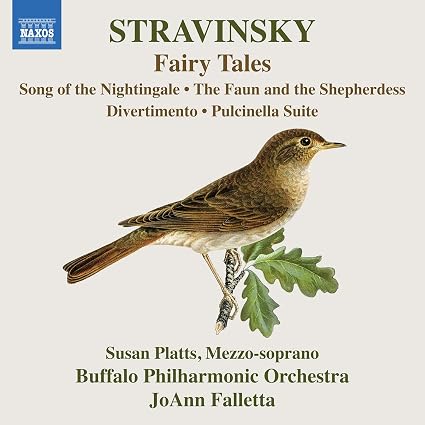
Fortunately, it was worth the wait and certainly betters the 4 discs noted above. The program begins with “Song of the Nightingale” (Chant du Rossignol), and later we get Divertimento from “The Fairy’s Kiss” (Le Baiser de la fee) and the Pulcinella Suite. It’s terribly disappointing we don’t get the entirety of the latter two instead of what they give us instead – The Faun and the Shepherdess – a curiously titled song cycle consisting of three songs: faun, shepherdess and the River. But they are so gloriously sung here (in Russian) by mezzo Susan Platts, that after a quick sampling, I ended up actually listening to them. I’m not usually interested in vocal items on an orchestral program, but the recorded sound and orchestral playing were so wonderful, I just let the CD keep playing. And continued to enjoy what I heard.
I complain a lot about the inconsistency of sound that Chandos achieves for Wilson’s Sinfonia of London, and this latest Naxos CD rather proves my point, providing yet another glorious-sounding recording from Buffalo. Naxos gets it right every time. And, realistically, it shouldn’t be that hard to do (yet Chandos struggles time and again). It certainly helps that the Kleinhans Music Hall in Buffalo sounds to be one of the most luxurious orchestral halls in the world, so maybe Naxos has an advantage there. Still, the recording engineer has to know what he’s doing, and actually pay attention and listen to the results before proclaiming it good enough and calling it a day.
And indeed, it’s the sound here on this Stravinsky disc which first grabs your attention, draws you in and keeps you in your seat for all of it. The next thing which captivates you is the absolutely glorious playing of this orchestra, especially soloistic passages from the principal players, immersing you into the musicmaking at every turn. If I can’t really point out anything particularly extraordinary about these readings as a whole, it’s the character of the orchestral involvement which is extremely satisfying. (Along with the recorded sound.) This orchestra never sounds like they’re just merely playing on autopilot. JoAnn Falletta doesn’t for an instant accept generic, anonymous, routine playing from these musicians. She makes them work at it. And you can hear that in their playing. They are fully engaged and actually sound interested in making music. This orchestra obviously adores their conductor; and as I’ve said before, which bears repeating, if ever there was a match made in musical heaven, it is this orchestra and this conductor.
As to the current album, this is as enjoyable a Stravinsky program as you can imagine – for all the reasons I’ve just described. Musically, this is appropriately incisive, expansive, rich, thoroughly involving and dynamic enough to be completely satisfactory. However, this is an album of fairy tales, and Falletta never loses sight of that. She concentrates on atmospheric allure, color and descriptive story-telling above all else. And the orchestra takes it from there, delivering all the character and charisma you could ever want. The result is some of the most beguiling Stravinsky you can imagine.
Right away in Nightingale, the solo playing is notable. And so too are the strings. To get this many string players to play with such precision of articulation is impressive. (Again you can hear she makes them actually work at it.) And the brass principals are just as characterful as their woodwind counterparts – from trumpet, to trombone to tuba. And complimenting it all, the excellence of the recording – the sheer presence and immediacy of the orchestra within a spacious acoustic – is exemplary. The brass don’t fade away timidly back in the distance (and reverb) as they often tend to do in London (on Chandos). They play with a bright, brassy vibrancy wholly appropriate for this music – a quality disastrously restrained in the earlier Gothenburg recording. And the dynamics expand effortlessly into the hall. Naxos gives us the very best seat in the house.
The 3rd movement then is positively sensuous – a flirtatious flute in conversation with a truly woeful-sounding solo violin (played here with an awesome George Crumb-esque eeriness), followed by energetic, crisply articulated passages reminiscent of Firebird. A wonderful solo oboe announces the long final section, where Falletta is masterful in characterizing the music with such captivating story-telling, you can’t possibly tear yourself away from it. And again, everywhere, one notices the playing of this orchestra as being exceptional. You just hardly ever hear this kind of musical involvement on record any more. And when you do, it is transfixing. For instance, listen to the bassoons, followed by the trombones, and then stopped horns – oh the color and characterization of their playing, bringing the music to life measure after measure – is absolutely marvelous! And when that mournful solo violin comes in again, this time with the harp plucking away in the background, creating an atmosphere of such anticipation, one continues to be drawn into it, wondering what is going to happen next. And oh that trumpet solo near the end, so expressive and songful, reminding us this music comes from an opera. In fact, it actually reminds me very much of Gershwin’s opera! (Remember, I had just listened to Bennett’s Porgy and Bess Symphonic Picture on the earlier CD.) And the piece ends with the strings fading into the night…er, the expanse of the hall.
So how can you follow this? Yes indeed. So, yes, I was reluctant to listen to the song cycle which comes next – for more than one reason. Though, as mentioned above, I did enjoy it, I’ll leave it for others to comment on and happily move on to The Fairy’s Kiss, where we encounter a completely different soundworld. This is more than just an homage to Tchaikovsky; it is actually based on some of his relatively unknown piano pieces. So even with Stravinsky’s own unique orchestration, it’s much more traditionally Romantic – though not as much so as Stravinsky’s own Symphony in Eb, composed when he was studying with Rimsky-Korsakov. This is still unmistakably Stravinsky.
After a songful introductory Andante, where Falletta invites one to come along for another fantastical story, hang on to your hat for a very fast introduction of the Allegro section at the 2-minute mark! (The incisiveness of the strings at this tempo – Wow!) And this entire section reminds me over and over of Tchaikovsky’s Orchestral Suites, and even 1812 in places! Falletta seems inclined to bring out as much Tchaikovsky as Stravinsky; she is simply masterful in this. The Dances which follow are superbly characterized and superbly colorful – again aided by the gorgeous recorded sound. What makes this really special is the articulate precision of orchestral execution within the glowing acoustic of the hall. It really is quite wonderful. And this orchestra really dances too, as Falletta relates it to Stravinsky’s ballet music, particularly Petrushka. You simply can’t help but smile ear to ear listening to this. Even the valse lilts delightfully, with that big tuba buoyantly thumping away below.
The Scherzo is pure Tchaikovsky in creation, adorned with pure Stravinsky in orchestration. And what a combination it is. While Falletta brings out its pastorale element beautifully in the central section. The Pas de deux Adagio again features glorious solo playing – from violin, to an especially wonderful clarinet, to cello, interspersed with a flamboyant little flute flourish, before returning to the unmistakable world of Tchaikovsky – even the exuberance of his Sleeping Beauty.
I know I’m gushing a bit. This is one of my favorite pieces and I can’t help but love it, especially when played with such elan. But hearing just the Divertimento makes me wish so much that the entire ballet had been played. The same can be said for Pulcinella, which comes last. It isn’t quite as magical as everything which has come before, though it is certainly well done here. But this is one instance where I welcome the vocal parts every time. They’re such an essential part of the piece, it really loses something shorn of this vital ingredient. Nonetheless, no one looking for just the suite will be left wanting for more. Falletta continues to be fabulous – energetic and jubilant; and the orchestral playing also continues to be fabulous – characterful, charming and full of life. It sounds like the full orchestra is employed, but Falletta brings a delectable lightness of touch and transparency to textures which bring out its Baroque origins perfectly, along with all the color and enthusiasm to bring it firmly into the 20th-Century. And again, it is the precision of the string playing and the brass which are most impressive. (Have you ever heard a more macho trombone in the Vivo?! Or a more beautifully played lyrical solo in the Minuetto? What a fantastic trombone player this is.)
In the end, while this may not be the most muscular or “spiky” Stravinsky you’ll ever hear, it is certainly some of the most charming. And it is thoroughly enjoyable from beginning to end. Falletta’s imaginative insight, musical sensitivity and commanding leadership of this orchestra are everywhere displayed. And I cannot emphasize enough how glorious the orchestral playing is. Add in the excellent recorded sound and an amazing total playing time of over 79 minutes, Naxos has another real winner. Yes, it was definitely worth waiting for.