


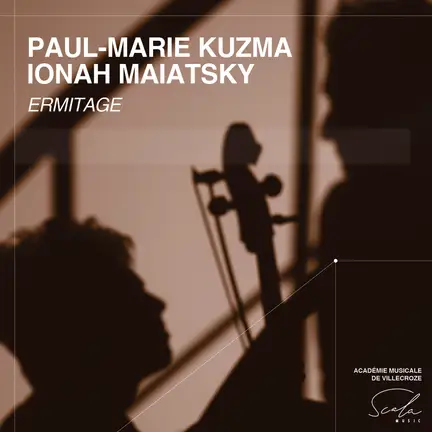
The booklet fo his Scala Music release is French only, but there’s an important opening paragraph by Michail Maiasky:
The name “Hermitage” may seem paradoxical for a duo: Doesn’t the hermit want to go away into a desert (eremos [the Greek ford for solitary]) to be alone? No, he only seeks solitude in order to better find the Other, that “without you, there is no me,” as the author Martin Buber (1879-1965) wrote, a contemporary of the three composers united in this programme. This Other can be not only the Divine, but also the meaning, harmony, or even that something which remains untranslatable in the message for which the author has chosen musical language as the least inadequate.
During the often solitary work of a musician, a dialogue (duo-logue!) creates a value that falls not only on each of the intersecting lines, but also their sum. Each voice acts, asserts, and resounds, yet immediately receives the other, listens to it, acknowledges it, and falls silent before the other’s beauty and enigma.
The Poulenc Cello Sonata, FL 143c, is a great way to start: Paul-Marie Kuzma and Ionah Maiatsky are a fine duo of equals. With Kuzma and Maiatsky, Poulenc is never frivolous or merely acidic: this is a pinpointing of Poulenc’s very individual voice at a highly sophisticated level.
This, the “Cavatine” appears as a multi-coloured tone-poem sometimes interior, sometimes more external, always touching. Maiatsky has the perfect understanding ho Poulenc’s harmonies, and Kuzma’s blanched single line contains multitudes.
In this light, the “Ballabile” emerges as a contrast that is not just “typical French,” but also provides a satisfying function. The performance is superb; the recording good if not exceptional.
The finale begins grandly, but seems to contain all of the various aspects of Poulenc he chooses to reveal in this sonata.
This is a major performance of this piece, never frivolous, each gesture part of a greater, sometimes almost Cubist, whole.
The Cello Sonata of Nikolaus Roslavets (1921, published Moscow, 1924) is rarely heard, but we need to hear more of his music. Angular , 10-minutes in duration, the piece is magnificently unpredictable. “con brio” the the marking, and Kuzma and Maiatsky are than and more besides: Roslavet’s stunningly individual voice, which encompasses both Modernism and High Romanticism, is superbly honoured;
The Rahcmaninov Sonata is heard in a laudably contained performance which sits it perfectly against the Roslavets and Poulenc. There is no overt Romantcisim, just lightness and song in the first movement:
The Allegro scherzando is given a fabulous performance dark, skittish, both musicians light of delivery, Bracing and crisp, this is fascinating, as is the light song of the Andante, delicate as silk at times:
The finale is an extension of that song; there is more turmoil, for sure, but it is the lyric impulse that remains to the fore. By refusing to unnaturally highlight Rachmaninov tropes, Kuzma and Maiatsky deliver a composer of individualism and integrity without a single hackneyed moment. It is a wonderful achievement, as is the Roslavets.
Ermitage is a fascinating disc, available for download from Amazon here.


%20Belinda%20Lawley.JPG?w=670&resize=670,446&ssl=1 "All change at the National Youth Choir as they bid farewell to three principal conductors")