
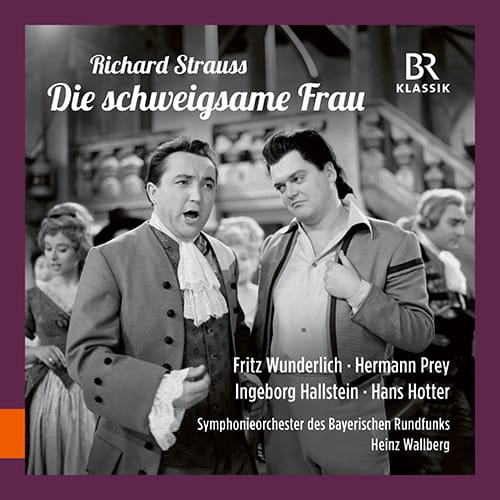
In a week which included Richard Strauss’ Ariadne from Glyndebourne, it feels only right to reach for this from the pile: excerpts from Richard Strauss’s comic opera Die schweigsame Frau (The Silent Woman), pre-produced as studio recordings for a television programme in November 1960.
The cast was fairly close to that of the opera production at the Salzburg Festival in 1959, under Karl Böhm (who conducted the premiere). The cast included the great Hans Hotter (Sir Morosus), Hermann Prey (Barber), Fritz Wunderlich (Henry), and Ingeborg Hallstein (Aminta), with Heinz Wallberg conducted the Bavarian Radio Symphony Orchestra. A more apt orchestra for Strauss would be difficult to find: the warmth (still there to this day), the virtuosity (ditto).
Strauss had enjoyed a miraculous spate of collaborations with librettist Hugo von Hoffmanstahl, including Ariadne auf Naxos. But with von Hofmannstahl’s death, the field was open. Step forwardS Stefan Zweig, who based the libretto for Die schweigsame Frau (The Silent Woman) on Ben Jonson’s 1609 Engish comedy Epicœne, or The Silent Woman.
Composed on the cusp of the Nazi era, Strauss had to explain himself to Goebbels (as Zweig was Jewish). An exchange between Zweig and Strauss was read by the Gestapo, which meant Strauss had to resign his post as President of teh Reich Chamber Music.
However, HItler allowed the performance in Dresden in June 1935, but neither he nor Goebbels attended; it was cancelled after three performances.The conductor was, as here, Karl Böhm.
This comic opera is set in London, around 1780 Here, we have excerpts from only the first two acts, a total of just shy of 49 minutes. But this is a performance of not only such character, but Straussian resonance. Wallberg paces beautifully, giving space as required,
It all begins with Morosus seated in the barber’s chair: Hans Hotter, no less, Hermann Prey the barber. Echoes of Wozzeck, perhaps, in a very different language; this is Strauss at his conversational best. Morosus claims he has never met a “silent’ woman”; the barber suggests he knows many; the two voices are nicely juxtaposed, and Strauss “clothes” them differently, and suavely. But it is the sheer understanding of Prey and Hotter of Strauss’ vernacular that enables this music’s success. There is never any rush, each syllable counts, and yet there is a feeling, occasionally, of appropriate speed. Wallberg gets such colour from the orchestra, too:
At nearly a quarter of an hour, this is the longest excerpt on the disc. It offers space for contemplation before the plot advances (away from this disc!) with the arrival of failed law student Henry, who has returned to London in the company of an Italian theatre company that includes three young singers (Aminta, Henry’s wife, Isotta, and Carlotta). Morosus is appealed and throws him out, while instructing the barber (factotum!) to find a “silent woman” to whom he can transfer his fortune. Meanwhile, the troupe is incensed and out for revenge on Morosus.
Cue the second excerpt: the barber sides with the troupe, and here we hear Prey. Unfortunately, we lose the love duet between Aminta and Henry. S staged wedding echoes of Mozart Cosi, perhaps) is intended to teach Morosus a lesson. Prey is incredible at “patter”. Strauss’ juxtaposition of spoken and sung is every inch as expert as in Ariadne:
Wallberg finds the dance in Strauss’ orchestral writing in this excerpt beautifully, too.
The third excerpt concerns the fabricated marriage contract. Strauss’ writing is so deft (listen to the ensemble “Silemzio”), but it is in the sheer Straussian layerings (portraying stage chaos) that are so impressive in the final excerpt from act 1:
The first excerpt from the second act shows Strauss’ predisposition for earlier musics and his transference of them into his own world, “Anhiero gestatte ich mir”. But it shows so much more, too: Hotter’s noble lyricism in Straussian housing, and such beautiful ensemble writing:
Like the first act’s shavings, the second act’s excerpts are front-weighted – this is the longest. There are parallels in beauty to the final Trio of Rosenkavalier, except you don’t have to wait so long for it. Strauss’ high soprano writing is radiant, and radiantly delivered.
Not that the booklet tells us, but the next excerpt is so successful because it features the Morosus of Hotter (that bit it does) and the stunningly agile soprano of Ingeborg Hallstein’s Amintsa. It’s light and frothy. And Wallberg’s way with tempo shifts is magnificent, including the sudden arrival of circus music:
That’s from the ninth scene, and initiates a sequence of one excerpt for each othe next three scenes. For all of the controlled chaos of “Wat geht hier vor?” but it is in “Siehst du, Ohm?” that we get glimpses of the archetypal Romantic Strauss in the horn-led melody:
Fritz Wunderlich is fine in these final excerpts, and it is he who initiates the final excerpt, “Du süßester Engel,” his voice opening out nicely. It is an ardent way to close, but where’s act 3? Anyway, Winderlich is a joy here:
What with the Ariadne at Glyndebourne, it is worth noting that Die schweigsame Frau was actually performed there in in 1977 and 1979. Time for another go?
Available from Amazon here.