


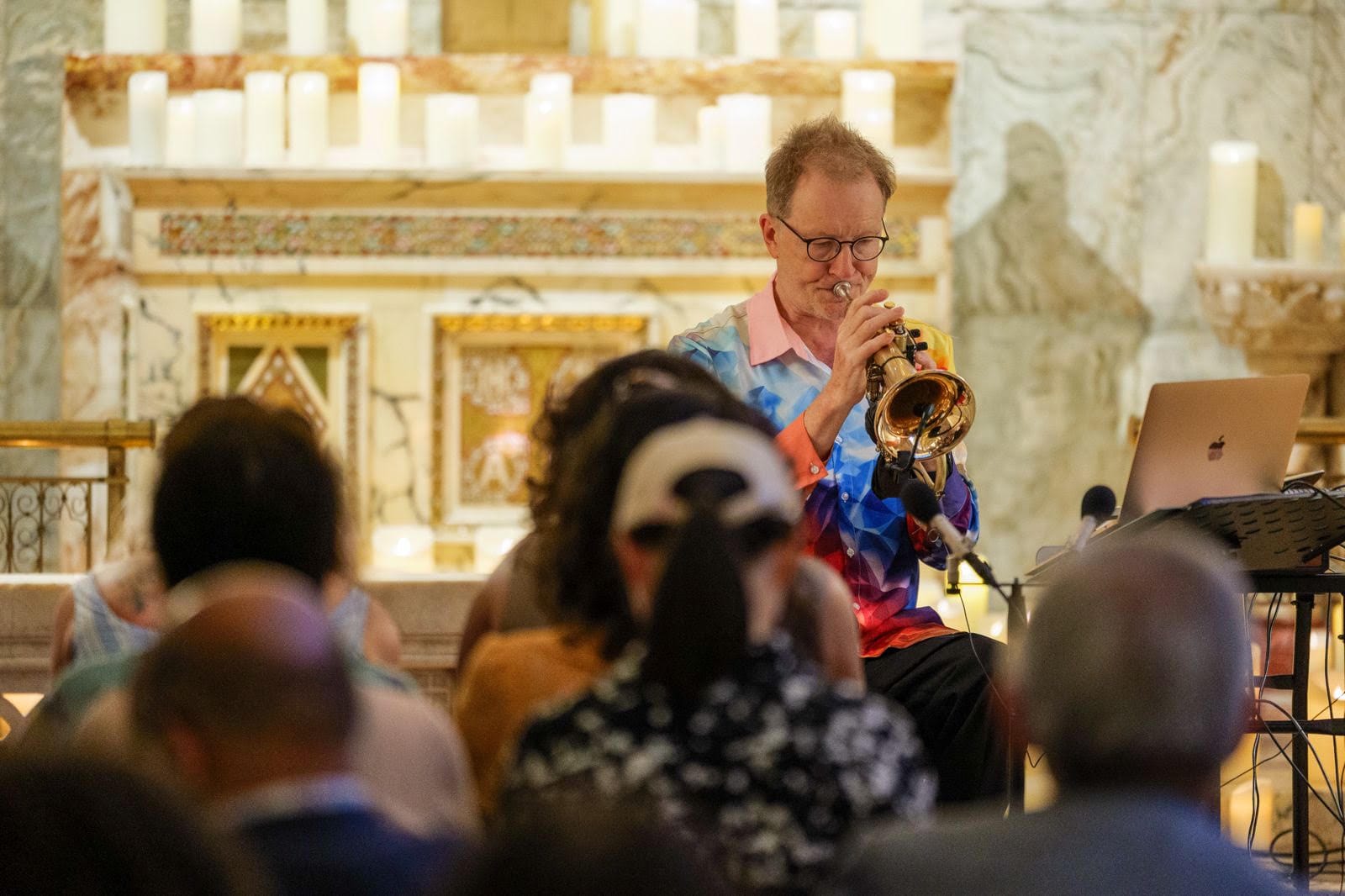
The World Premiere of Pip Eastop’s suite, Se ven colores en la luz blanca (Colours are seen in white light) took place as part of the Fitzrovia Arts Festival (at Fitzrovia Chapel) on Thursday, June 18, available via Bandcamp.
I was lucky enough to be at this event. Eastop becomes a veritable orchestra; what is even more astonishing is that he is known for his activities as a horn player, so to perform on trumpet and flugelhorn to this exalted level is not just remarkable, ut surely unique.
As Eastop himself says,
I used to play the French horn. I played for everyone. You’ve definitely heard me.
Now I live in my little studio, play the piano and the trumpet, compose, record, mix, rinse and repeat …
The suite begins with a semi-improvised piece based on John Coltrane’s Giant Steps, the first track of his album of that name:
Eastop’s version is just as sophisticated, parallel chord sequences taking it into a remarkable sound world of some sort of doctored Hammond organ.
The first of the Shakespeare settings is Sonnet 23 (“As an unperfect actor on the stage ….”), featuring the voice of Stephanie Ellyne against flugelhorn, piano, bass and drums. The music is a response to the detail of Ellyne’s recorded voice, reacting to the variations of spoken pitch and rhythm. The opening spread chord seems to take us to a smoky jazz nightclub; the tracing of voice by instruments, inspiring flugelhorn flights of fantasy, works supremely well. This is more than an experiment,
Sound-only experience strips us of the sight of the tiny keyboard stripped to Eastop’s trumpet for “Yellow,” allowing Eastop “the superpower to play chords on a Baroque organ with a single fingertip while still playing the flugelhorn” There is also an “expression pedal”, while a “ghost tuba” allows for subterranean lines two octaves below the melody that “shadow” the main line. A central section finds the flugelhorn in a “hall of mirrors” where its staccato gestures multiply around itself, transmogrified.
“Green” sets Sonnet 64 (with the voice of Robert Maskell), but the first verse is all flugelhorn One aspect of Eastop’s playing, on whatever instrument, is an ability to negotiate extremes of register, evident here in the upper reaches (he can go super-low, too). The link between voice and bass is fascinating; but most astonishing is how it works so well and so cohesively (given the base material is contours of spoken word).
“Blue” is ocean-inspired, a flugelhorn “diving” beneath the ice of Antarctica’s Ross Sea, performing “alongside” Weddell and leopard seals, while a bell perhaps invokes echoes of Debussy’s submerged cathedral. The underwater recording used is by Douglas Quin, who spent 10 weeks in Antarctica in 1996 recording soundscapes and wildlife: sound is captured by “hydrophones”. Slowly descending glissandi represent so-called “T-calls” of Weddell seals (the seals can “shout” at 200 decibels, around twice the volume of your average rock concert). Trills represent the leopard seals, while all around is ice and water. As atmospheric a soundcsape as one might hope for! The music is less melodic, more a representation of a space that sits on the verge of music. There are also sound of Adèle penguins diving past hydrophones.
Shakespeare returns for “Indigo”, Sonnet 71 (“No longer mourn for me when I am dead”) with its church organ – specifically, a sound model of Notre-Dame-de-la-Croix de Ménilmontant in Paris. Again, the music is all derived from the speaker’s (here Maskell’s) recitation. The brass instrument soars majestically at “Do not so much as my poor name rehearse”; Eastop knows the power of a simple ascending scale.
Finally, a meditation for trumpet and organ, “Violet” which brings in pitch-shifters and an “infinite sustain” (reverb-freeze) pedal. That low sound is Eastop playing. The piece seems to meditate on sonority against brass aspirational phrases. A message of hope, perhaps, from what is, in esoteric circles, the most spiritual colour.
The piece of course moves “up” the colour spectrum (remember ROY G BIV for the order of colours from school?) – which is also the colour order of the chakras on the human body in modern esoteric thought. So the otherworldly sounds of “Violet” should perhaps not be so surprising.
The performance was an unforgettable experience; it is good to have it available on Bandcamp.