


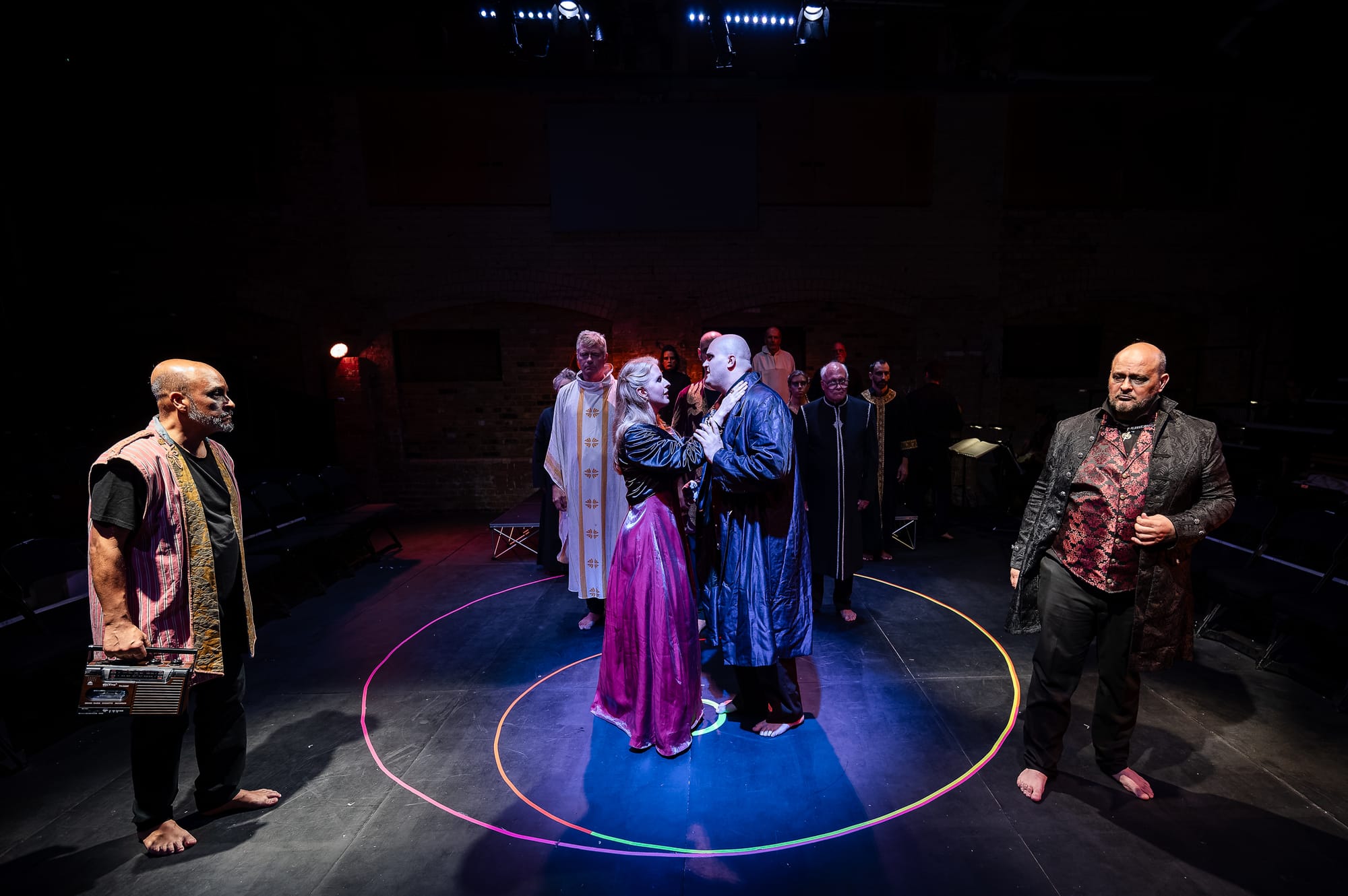
Last week’s five sold-out performances of The Magic Flute at Arcola Theatre (25 – 29 August, 2026, within the framework of the annual Grimeborn Festival, July to September) have shown how much impact such productions can make, even at small venues, and, no doubt, on a limited budget.
For readers not familiar with the name, “Grimeborn” is a playful wink at the audience, hinting at the differences between East London, where the festival takes place, and the formal, still rather exclusive Glyndebourne Festival. Anyone who knows the gritty area around Dalston Cross cannot miss the joke.
The festival, started in 2007 by Mehmet Ergen (the artistic director and joint founder of the Arcola Theatre), presents a mix of new, experimental works, some rare historical gems, and reinventions of classic operas. It’s hard to believe that Grimeborn Festival will celebrate the 20th anniversary of its foundation next year.
This year’s Zauberflöte was the first revival of the original 2019 production and, as the Brazilian director and conductor Marcio da Silva wrote in the programme note, some elements in this singspiel inevitably belong to the 18th century. However, the company has not attempted to disguise the differences between that century’s aesthetics and that of our time: its aim is “to enter the opera’s world and enjoy its magic”, and that is indeed what it did in this revival.
Marcio da Silva’s Ensemble OrQuesta was founded in 2013, and the company has been doing sterling work in popularising 18th century repertoire in the community, and performing in various Off West End venues, as well as in France. It also provides opportunities for performers from all over the world, and its overall ethos is to be admired.
Arcola Theatre Studio 1 seats up to 200, and the tiny, bare stage in the round, at the foot of four tiered rows of seats, resembles an amphitheatre. The floor had a Yin/Yang pattern but its symbolism doesn’t seem to have been otherwise exploited, spatially or otherwise. A few collapsible tables stage right, forming a kind of platform, were also used. However, the sparse space, minimalistic design and the economical, physical direction, with minimal movement and gestures, served the performance well.
Among very few props were an old transistor radio, a picnic basket and a few dinner plates and glasses, which suggested the appropriate atmosphere in the individual scenes. A candle-lit procession was particularly effective. Several costumes were lavish, though the overall aesthetic seemed a little disparate.
There are no cuts in this production which lasted over two hours and 50 minutes (over-running by about half an hour), and perhaps the show needs to be tightened a little. However, this might indeed have been done in subsequent performances. There are always occasions on the opening night when nervousness is discernible, but there was a definite sense of collaboration throughout.
Singing in German (with spoken dialogue loosely rewritten in English), the international cast of 17 consisted of singers from Brazil, Britain, Germany, Hungary, Serbia, Turkey and the U.S, some long settled in this country, others guesting. There were some very good voices, particularly among the women; among men, John Twitchen (Tamino) seemed to have the role in his blood and Sarastro (Vedat Dalgiran), whose role was written for basso profondo, also made an impression. The part requires plunging down to low F and even a low E in the famous arias such as “In diesen heil’gen Hallen” and “O Isis und Osiris”.
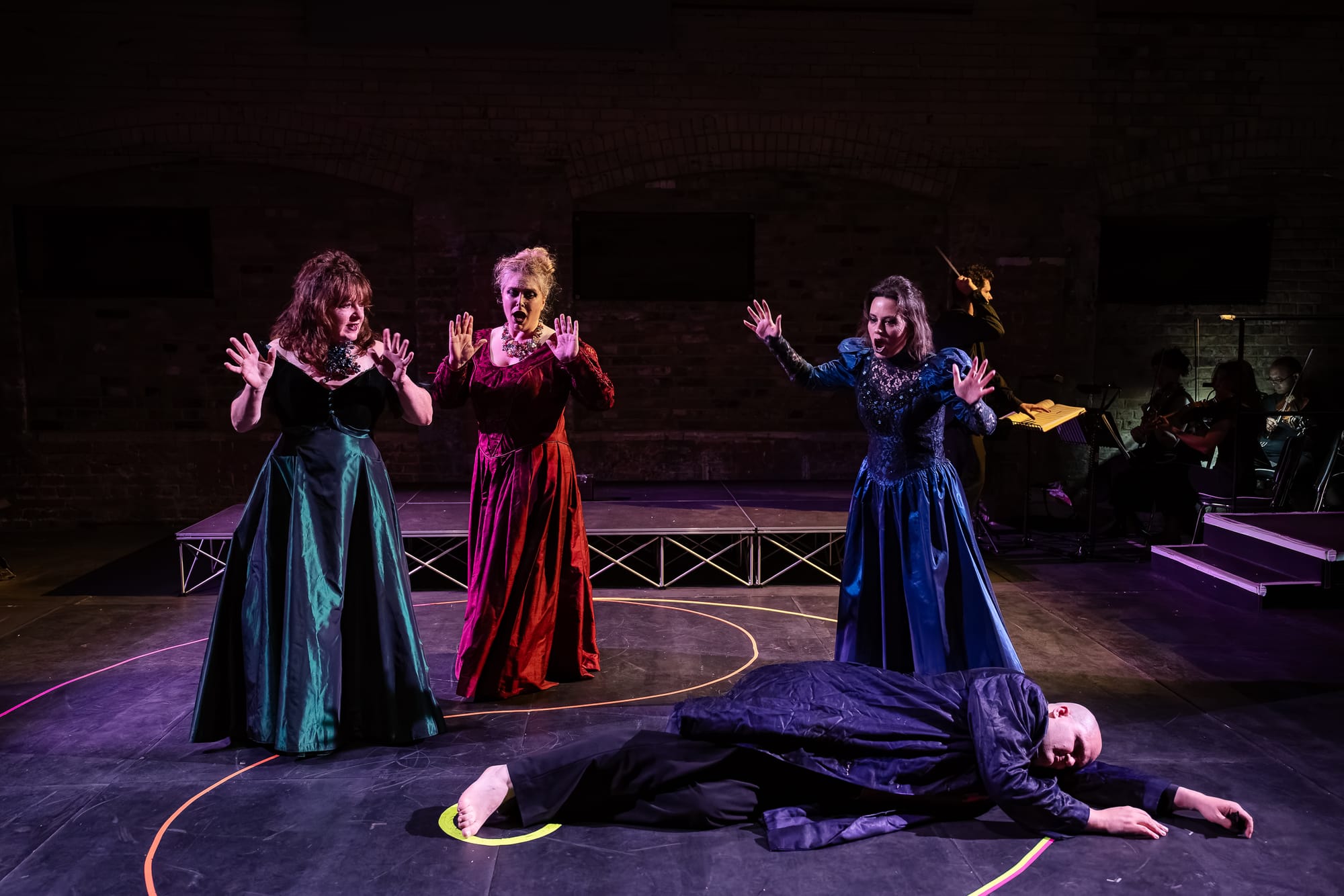
The Three Ladies (Rosemary Carlton-Willis, Jordan Gascoigne and Juliet Telford) were outstanding: well matched vocally, they would grace a much bigger and more renowned opera house.
Juliet Petrus shone as The Queen of the Night. She joined Ensemble OrQuesta again after her Aricie in Rameau’s Hippolyte et Aricie in 2019 (see Colin Clarke’s review here). She has been singing the Queen of the Night for some twenty years, with various American and European companies and, most recently, last year in China, as the first Westerner to perform it there in German and Mandarin.
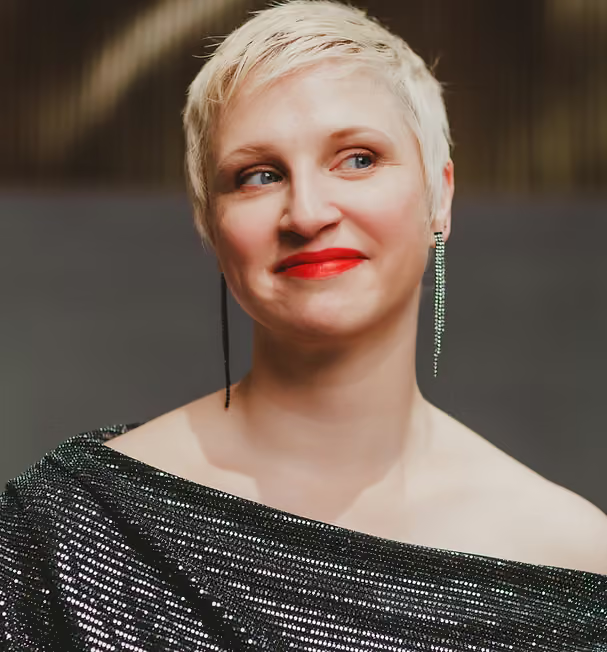
The aria demands extreme vocal agility, spanning as it does high Fs, as well as performing rapid arpeggios and crisp staccato jumps, and Juliet’s coloratura and pitch were faultless. She looked appropriately regal in her voluminous, sparkling dark costume, contrasting intriguingly with her slender figure and boyish cut blond hair, and earned a big ovation.
Pamina in this production (Helen May, alternating in subsequent performances with the German soprano Anna-Luise Wagner) has, to my mind, been conceived as a fighter, rather than a little wife-to-be. Helen May has a commanding presence but her fine, big voice is perhaps almost too resplendent for this small venue, and personally I would have welcomed a little more lyricism rather than tragic passion.
Papagena (the young Hungarian soprano Jázmin Kirsch-Veszeli) was appealing in her brief role, another in this opera that displays bright coloratura and dotted rhythms. I hope to hear her in London again.
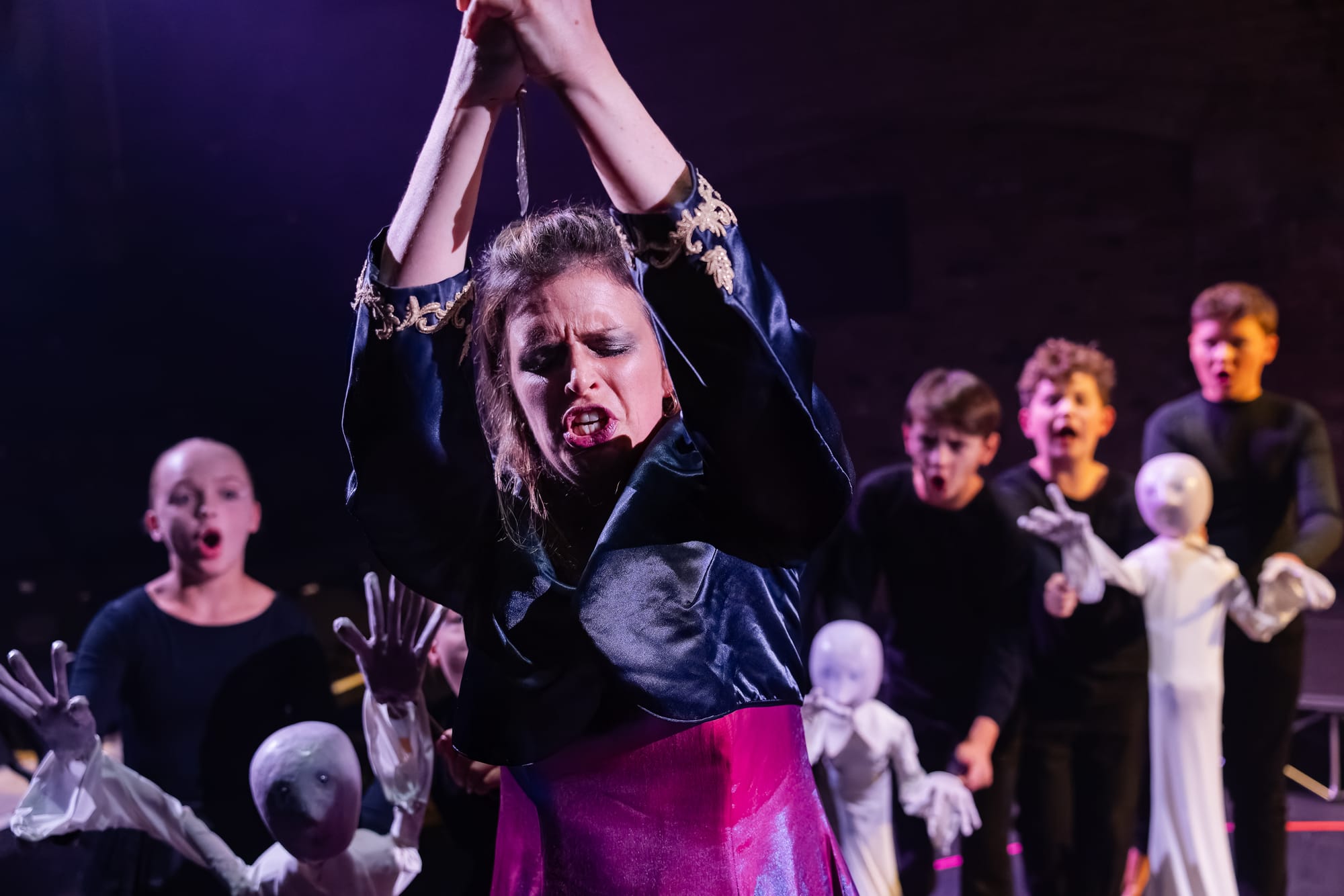
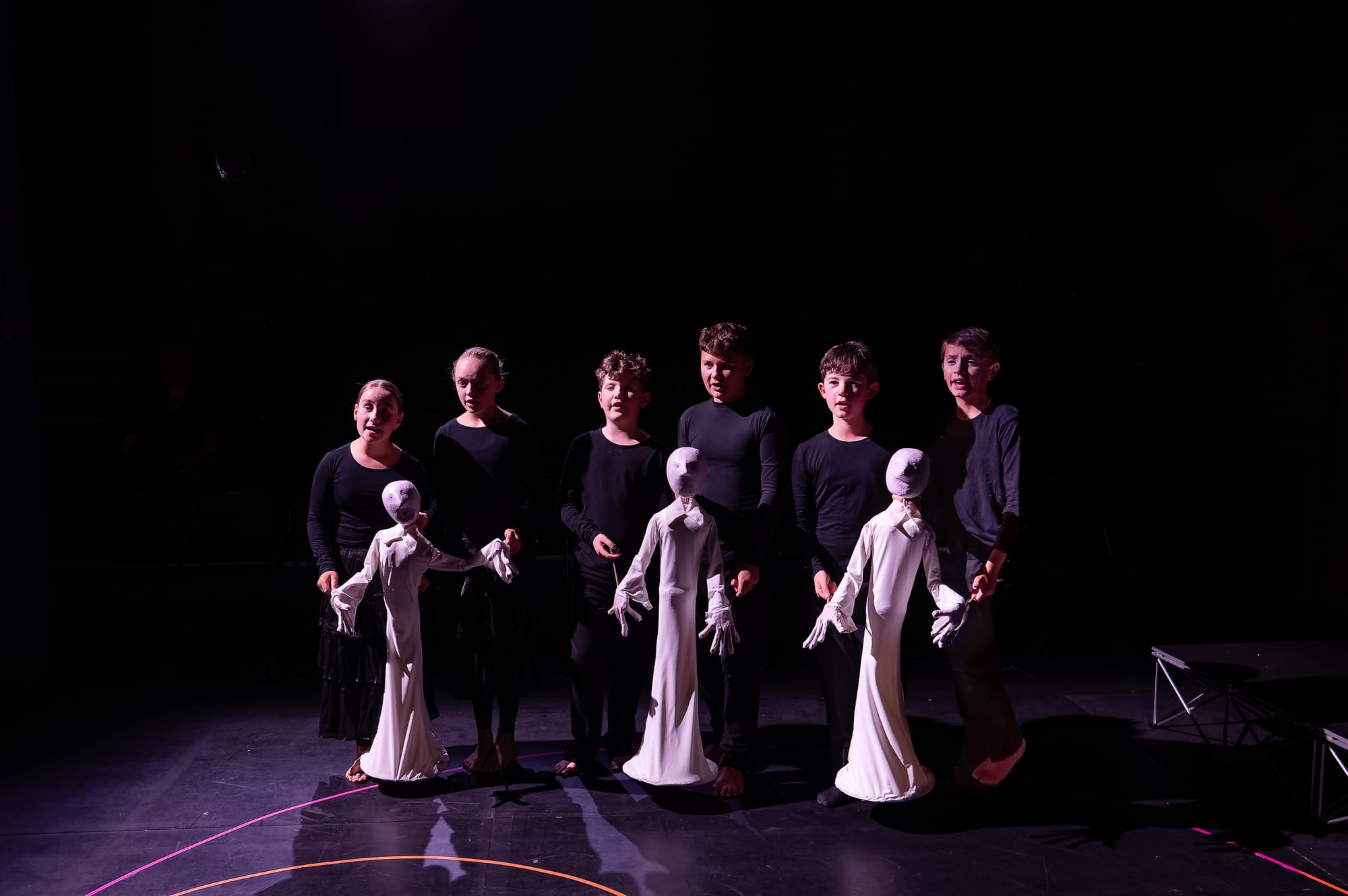
The Three Boys in this production were, in fact, four boys and two girls, all dressed in black and holding white wax-like marionettes half their size (Orlando Bishop was the puppet master). With their angelic faces, the children were lovely to look at and a joy to listen to. Judging by the surnames, two of the children were the offspring of the da Silva family.
Although there were some very good voices in the cast, I thought that musically the strength of this Zauberflöte was in the choruses. However, non-native English speakers occasionally stumbled just a little in the spoken dialogue, and in roles performed by native actors, while their sonorous voices added gravitas, delivery was nevertheless sometimes rather wooden.
Interestingly, the entire cast, including the children’s ensemble, performed barefoot. This is, apparently, an increasingly common trend and some critics find it unsettling. Personally, having seen operas (and indeed worked in some) where singers were asked by directors to wear hobnail boots and stomp through many piano passages, I have no objections to “barefoot opera”.
The Hastings Philharmonic Orchestra ensemble, performing alongside the cast, amounted merely to a couple of violins, a double bass, some woodwind and percussion. Marcio da Silva, as a director and conductor, had his hands full throughout the evening but showed great energy, with crisps attacks and brisk tempi employed, and the handful of musicians responded with flair.
His tempi were, in fact, the kind of tempi I was used to in Mozart as a child and teenager in Czechoslovakia (as it was then). I have always thought after arriving in the UK that many British musicians played Mozart a little too slow. That eventually changed quite a lot with the development of the early music movement.
The very mixed, diverse audience (from young people to pensioners) seemed knowledgeable and was very appreciative. As I was leaving the auditorium, I overheard a young spectator answering his girlfriend’s question: “Well yes, that was pretty much what opera was like in those days.”
Vox populi, vox Dei.
Mirka Zemanová


%20Graham%20Boulton.jpeg?w=160&resize=160,160&ssl=1 "Celebrating John Joubert at Royal Birmingham Conservatoire in advance of his 2027 centenary")